

Which pressure control systems are used in Gynaec Modular OT With Laminar Airflow?
Introduction
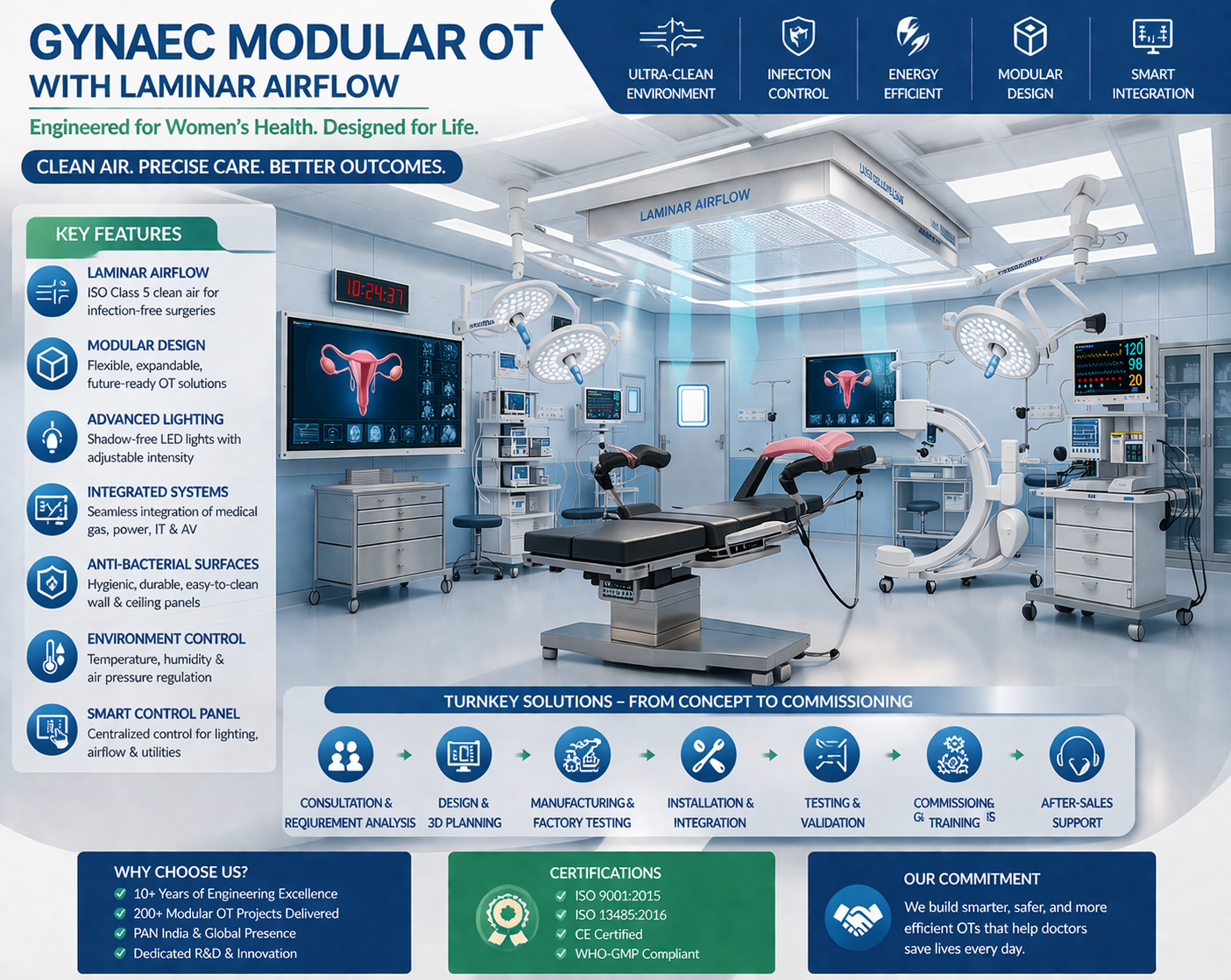
Maintaining the correct air pressure inside a gynaecology operating theatre is an important part of creating a controlled surgical environment. Pressure management helps regulate the movement of air between the operating theatre and adjoining spaces, reducing the possibility of unwanted air entering from less clean areas. Gynaec Modular OT With Laminar Airflow combines planned ventilation, filtration, and pressure control systems to support suitable environmental conditions for surgical procedures.
A reliable pressure control arrangement requires more than installing an air-handling unit. It involves coordinated HVAC design, supply and return air balancing, differential pressure monitoring, door sealing, and regular performance testing. These systems must work together to maintain the pressure relationship specified in the hospital's engineering design.
In a modular gynaecology OT, pressure control also needs to be coordinated with wall panels, ceiling systems, surgical lights, medical gas services, electrical installations, and other technical components. Proper planning helps maintain room performance while supporting the clinical workflow.
Why Is Pressure Control Important in a Gynaecology OT?
An operating theatre is a controlled clinical space where air movement must be managed carefully. Staff movement, door openings, equipment activity, and ventilation imbalance can influence the room's pressure conditions.
Positive pressure is commonly used in operating theatres to help prevent air from less clean adjoining areas from entering the surgical environment when doors are closed. The pressure difference encourages air to move outward through unavoidable leakage paths rather than allowing surrounding air to flow inward.
Pressure control is not a substitute for filtration or infection prevention practices. It works alongside appropriate ventilation, cleaning, sterilization, surgical preparation, and staff hygiene procedures.
The pressure requirement should be established according to the hospital's room classification, applicable healthcare ventilation guidance, and the approved engineering design. Not every room in a hospital requires the same pressure relationship.
1. Positive Pressure Ventilation System
Positive pressure ventilation is one of the main pressure control approaches used in operating theatres. The HVAC system supplies air to the OT at a rate that is appropriately balanced against the air being returned or exhausted.
When the supply airflow is greater than the return and exhaust airflow, the room can maintain positive pressure relative to designated adjacent spaces. This helps reduce the inward movement of air from corridors and other surrounding areas.
The system must be designed carefully because excessive or insufficient pressure can create operational problems. The airflow balance should account for room dimensions, door conditions, ventilation requirements, and the presence of connected spaces.
In a modular OT, positive pressure performance also depends on the quality of wall and ceiling joints, service penetrations, access panels, and door arrangements. Uncontrolled leakage can make it difficult to maintain the intended pressure relationship.
2. Differential Pressure Monitoring System
A differential pressure monitoring system measures the pressure difference between the operating theatre and an adjoining reference area. It helps engineering and clinical teams understand whether the intended pressure relationship is being maintained.
The system generally uses pressure sensors connected to a monitoring display. The display may be installed near the OT entrance so that authorized staff can check the room's pressure status without entering the operating area.
The monitoring arrangement should be selected according to the required measurement range, sensor accuracy, installation conditions, and hospital monitoring requirements. Sensor locations should be chosen carefully to avoid misleading readings caused by local air movement.
Differential pressure monitoring can also help identify problems such as HVAC imbalance, damaged door seals, or unexpected changes in room conditions. However, a monitoring display does not correct pressure automatically unless it is integrated with suitable control equipment.
3. HVAC Air Balancing System
HVAC air balancing is essential for maintaining the intended pressure difference. It involves adjusting and verifying the supply, return, and exhaust airflow quantities so that the ventilation system performs according to the approved design.
The air-handling unit supplies conditioned and filtered air through ductwork and ceiling diffusers. Return-air grilles collect air from the room, while exhaust arrangements remove air where required by the ventilation design.
If the supply airflow is too low, the room may fail to maintain its intended positive pressure. If the airflow balance is unsuitable, it may also affect temperature control, air distribution, and occupant comfort.
Balancing dampers, airflow measurement points, and suitable control arrangements help engineers adjust the system. Final balancing should be carried out by qualified personnel using appropriate measurement instruments, with the results recorded during commissioning.
4. Pressure Sensors and Digital Display Units
Pressure sensors provide continuous or periodic information about the pressure relationship between the operating theatre and adjacent areas. Depending on the system, readings may be displayed digitally near the entrance or at a central monitoring station.
Digital display units make it easier for hospital staff to identify whether the room is operating within its specified pressure range. The display should be easy to read and positioned where staff can check it without disrupting theatre activities.
Some systems include visual indicators that show normal or abnormal pressure conditions. The exact display arrangement and alarm thresholds should be determined by the hospital's engineering team.
Sensors require periodic calibration and functional checks. A faulty or incorrectly positioned sensor may provide misleading information, even when the HVAC system itself is operating correctly.
5. Automatic Pressure Control Systems
Some advanced OT ventilation systems use automatic control arrangements to help maintain the required pressure relationship. These systems may use pressure sensor readings to adjust airflow through compatible dampers, fans, or control devices.
For example, when the pressure difference changes, the control system can respond by adjusting selected HVAC components within the approved operating limits. This helps reduce the need for frequent manual adjustments.
Automatic pressure control must be designed with suitable safeguards. Changes in airflow should not compromise ventilation requirements, filtration performance, temperature control, or the intended airflow pattern.
The control sequence should be documented and tested during commissioning. Hospital engineering teams should also understand how the system behaves during power interruptions, equipment faults, and maintenance activities.
6. Door Sealing and Room Leakage Control
Pressure control depends not only on HVAC equipment but also on the physical condition of the operating theatre. Gaps around doors, wall joints, ceiling panels, and service openings can affect the room's ability to maintain the intended pressure relationship.
Modular wall and ceiling systems should be installed with properly finished and sealed joints. Electrical conduits, medical gas connections, duct openings, and other service penetrations should be coordinated and sealed using suitable materials.
Operating theatre doors should fit correctly and close reliably. Damaged seals, misaligned frames, and doors that remain open can affect pressure stability.
Where automatic doors are used, their operation should be coordinated with the hospital's workflow and safety requirements. Door interlocks may be considered in specific designs, but they should not obstruct emergency access or safe movement.
7. Integration with Building Management Systems
A Building Management System (BMS) can provide centralized visibility of selected HVAC and environmental parameters. When pressure sensors and compatible controllers are integrated with the BMS, engineering teams may be able to monitor pressure conditions from a central location.
Depending on the system design, the BMS may display pressure readings, operating status, alarm conditions, and selected ventilation parameters. This can support maintenance planning and help identify recurring performance issues.
Integration requires compatible sensors, controllers, communication protocols, and a clearly defined control strategy. The system should also specify which alarms require immediate attention and which conditions can be handled through routine maintenance.
BMS monitoring does not replace local verification. Pressure readings and HVAC performance should still be checked during commissioning and periodic inspections.
8. How Does Laminar Airflow Work with Pressure Control?
Laminar airflow and room pressure control perform related but different functions. Laminar airflow is designed to deliver filtered air in a planned, predominantly unidirectional pattern over a defined surgical zone. Pressure control manages the movement of air between the operating theatre and adjoining spaces.
In Gynaec Modular OT With Laminar Airflow, both systems should be planned together. The air supply arrangement must support the intended airflow pattern while maintaining the required room pressure relationship.
The ceiling diffuser array, HEPA filter housings where specified, return-air grilles, surgical lights, and equipment pendants should be coordinated. Poor positioning or unsuitable equipment installation can disturb airflow and affect the intended distribution.
A properly designed system should therefore be assessed as a complete ventilation arrangement rather than treating laminar airflow and positive pressure as independent installations.
9. Pressure Control Testing During Commissioning
Commissioning confirms whether the installed pressure control system performs according to the approved design. Testing should take place before the OT is handed over for clinical operation.
The commissioning process should include verification of differential pressure readings, supply and return airflow quantities, sensor operation, alarm functions, and HVAC control sequences. Door conditions and room sealing should also be inspected.
If automatic controls are installed, their response to pressure changes should be tested. The commissioning team should confirm that adjustments do not compromise the ventilation system's other specified performance requirements.
Test results should be documented in a handover report. Any identified imbalance, sensor fault, or leakage issue should be corrected and the relevant tests repeated.
10. Maintenance of Pressure Control Systems
Regular maintenance helps ensure that pressure control systems continue to perform reliably. Pressure sensors should be calibrated according to manufacturer recommendations and the hospital's maintenance schedule.
HVAC filters, dampers, fans, duct connections, and control devices should be inspected at appropriate intervals. Door seals and modular panel joints should also be checked for damage or deterioration.
Hospitals should maintain records of pressure readings, calibration activities, airflow measurements, service visits, and corrective actions. These records help identify recurring issues and support planned maintenance.
Any modification to the room layout, HVAC system, ceiling equipment, or door arrangement should be reviewed by qualified engineering personnel because even small changes can influence pressure conditions.
Conclusion
Pressure control in a gynaecology operating theatre requires coordinated ventilation design, positive pressure management, differential pressure monitoring, HVAC balancing, reliable sensors, and effective room sealing. Automatic controls and BMS integration can provide additional monitoring and adjustment capabilities when included in the approved design.
Laminar airflow supports filtered air distribution over the intended surgical zone, while pressure control helps manage air movement between the OT and surrounding spaces. Both should be designed, tested, and maintained as part of a complete environmental control strategy. Altus Airflow provides modular operating theatre solutions with attention to HVAC coordination, airflow planning, pressure management, and technical integration.
Frequently Asked Questions
1. Which pressure control systems are used in Gynaec Modular OT With Laminar Airflow?
Common systems include positive pressure ventilation, differential pressure sensors, digital monitoring displays, HVAC air balancing, automatic pressure controllers, and room sealing arrangements. Their selection depends on the OT design, clinical requirements, and applicable ventilation guidance.
2. Why is positive pressure maintained in a gynaecology operating theatre?
Positive pressure helps reduce the entry of air from less clean adjoining spaces when doors are closed. It is maintained through suitable HVAC supply, return, and exhaust air balancing.
3. What does a differential pressure monitor do in an OT?
It measures the pressure difference between the operating theatre and a reference area. The reading helps staff and engineering teams check whether the intended pressure relationship is being maintained.
4. Can automatic pressure control systems adjust OT airflow?
Yes. When properly integrated, automatic controllers can use sensor readings to adjust compatible fans or dampers. Their operation must be tested to ensure that ventilation and airflow requirements remain satisfied.
5. How often should OT pressure control systems be inspected?
Inspection frequency should follow the equipment manufacturer's recommendations, the hospital's preventive maintenance programme, and applicable healthcare engineering requirements. Sensors, HVAC components, room seals, and monitoring displays should be checked regularly.
Read Our Previous Blog-------->How can Major Orthopedic Modular OT With Laminar Airflow control airborne contamination?

 English
 Arabic
 French
 Spanish
 Portuguese
 Deutsch
 Turkish
 Dutch
 Italiano
 Russian
 Romaian
 Greek
