

Automated Cooking Systems Market Share: Why Commercial Kitchens Lead
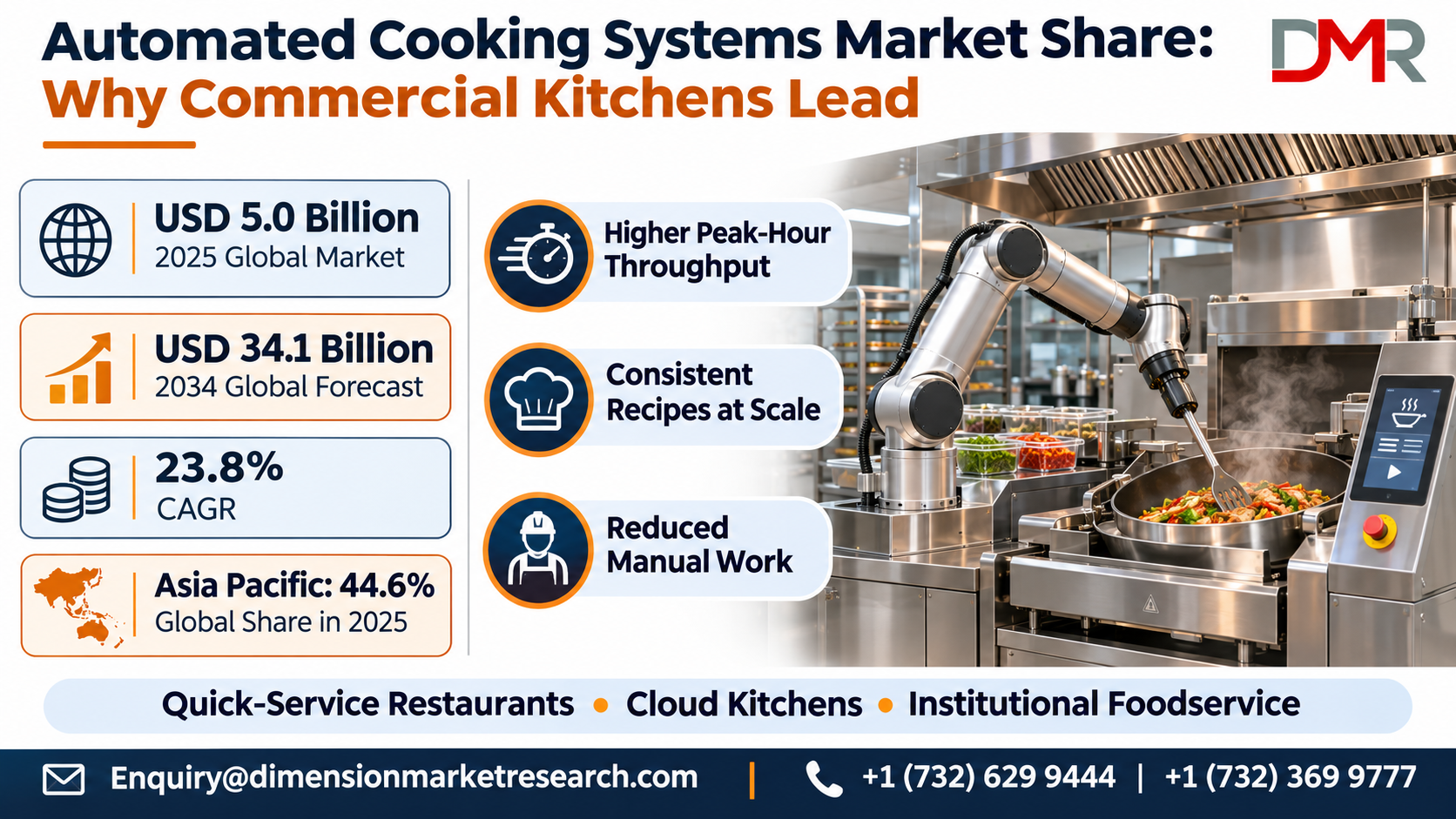
The Automated Cooking Systems Market Share outlook reflects a practical problem in foodservice. Restaurants need to produce the same dish at the same standard during a quiet shift and a rush. Automated cooking systems can make repetitive steps such as stirring, frying, and ingredient dispensing more consistent. For chains, that consistency matters across locations as well as across shifts.
According to Dimension Market Research, the global market was estimated at USD 5.0 billion in 2025 and is forecast to reach USD 34.1 billion by 2034, at a CAGR of 23.8%. Staffing pressures, demand for standardized meals, and investment in commercial kitchen automation support the outlook. Upfront costs and the work required to integrate new equipment into existing kitchens can slow adoption.
What Is the Automated Cooking Systems Market?
The market covers equipment, software, and services that automate cooking tasks. Hardware includes sensors, frying modules, induction heaters, dispensing units, and robotic arms. Control software can manage recipe settings and monitor cooking in progress. Installation and integration services help fit those systems into a kitchen’s existing layout and processes.
A programmable stir-fry station illustrates how the pieces fit together. Sensors track temperature, a mechanical stirrer keeps ingredients moving, and programmed controls govern timing. The kitchen team still has to coordinate preparation, loading, cleaning, and service. For an operator, the value of the station depends partly on how well those surrounding tasks fit the automated step.
Get a Free Customized Sample of This or Any Other Market Research Report
https://dimensionmarketresearch.com/request-sample/automated-cooking-systems-market/
Which Applications and Buyers Lead Demand?
● Commercial kitchens lead by end user. Quick-service restaurants, food courts, hospitality businesses, and delivery-focused kitchens handle repeat orders and need consistent preparation. A chain can apply the same cooking settings across several outlets.
● Stir-frying and sautéing lead by application. These techniques involve repeated movement, controlled heat, and precise timing. That makes them suitable for programmable stations used to prepare dishes such as noodles, rice, and vegetables.
● Asian cuisine leads by cuisine type. The report links its position to frequent demand and the need to prepare dishes quickly, supported by a regional manufacturing base for cooking equipment.
Why Does Asia-Pacific Lead While North America Grows Fastest?
Asia-Pacific was projected to account for 44.6% of global revenue in 2025. The report’s regional coverage includes Japan, where compact equipment and automated cooking are relevant to space-constrained kitchens. Its Japan forecast also points to distinct opportunities across commercial and residential settings. For suppliers, equipment footprint and the cooking methods a system supports help determine where it fits.
North America is projected to record the highest CAGR. The report links that outlook to foodservice digitization and pressure on operators to manage staffing shortages and wage costs. The U.S. market was estimated at USD 1.2 billion in 2025 and is projected to reach USD 7.2 billion by 2034. For a restaurant group, one way to assess the investment is to identify the station that slows service during busy periods and evaluate whether automation improves throughput there.
Where Do Digital, Smart, and Connected Cooking Fit?
The Digital Cooking Technology Market includes products such as induction cooktops, smart ovens, and digital air fryers. The Smart Cooking Technology Market examines areas such as AI-enabled controls, connected appliances, and cloud integration. These reports offer context for the controls that make cooking programs easier to configure, repeat, and monitor.
The Connected Cooking Devices Market adds a view of appliances that use connectivity for features such as remote monitoring. A restaurant operator comparing equipment can ask two questions. Which cooking step does the machine perform automatically? Which information can the kitchen team monitor without standing at the station? The answers help clarify how the equipment would change daily work.
What Can Slow Adoption in Existing Kitchens?
Equipment cost is only part of the investment. A kitchen may need to change its layout or rearrange prep and service work to accommodate a new station. That can make a full installation difficult for smaller operators. A modular system gives an operator a way to test a high-volume task first and judge whether the change justifies a wider rollout.
Frequently Asked Questions
How large is the Automated Cooking Systems Market?
The global market was estimated at USD 5.0 billion in 2025 and is forecast to reach USD 34.1 billion by 2034.
What is the projected CAGR?
The market overview projects a CAGR of 23.8% from 2025 to 2034.
Which end user leads the market?
Commercial kitchens lead, supported by demand for repeatable, high-volume preparation.
Which region holds the largest share?
Asia-Pacific was projected to lead with 44.6% of global revenue in 2025.
Which region is expected to grow fastest?
North America is projected to register the highest CAGR, supported by labor pressures and increased foodservice automation.
Conclusion
Commercial kitchens are the main market for automated cooking systems through 2034. The opportunity is clearest where a repeatable task affects service speed or consistency. For equipment suppliers, systems that fit around existing prep and service routines can address one of the main barriers to adoption.
Related Cooking Technology Market Insights
The Digital Cooking Technology Market Size report projects growth from USD 14.4 billion in 2025 to USD 53.8 billion by 2034. Induction-based cooking was projected to lead by cooking method with a 41.0% share in 2025.
The Smart Cooking Technology Market Share report identifies smart ovens as the leading product type, with an estimated 35.0% share in 2025. Wi-Fi-enabled devices were projected to lead by connectivity.
The Connected Cooking Devices Market Growth report projects revenue to reach USD 43.1 billion by 2034. Residential use and electric power were the leading segments in their respective categories in the 2025 outlook.

 English
 Arabic
 French
 Spanish
 Portuguese
 Deutsch
 Turkish
 Dutch
 Russian
 Romaian
 Portuguese (Brazil)
 Greek
