

How to Optimize Electrospinning Parameters for Nanofiber Production
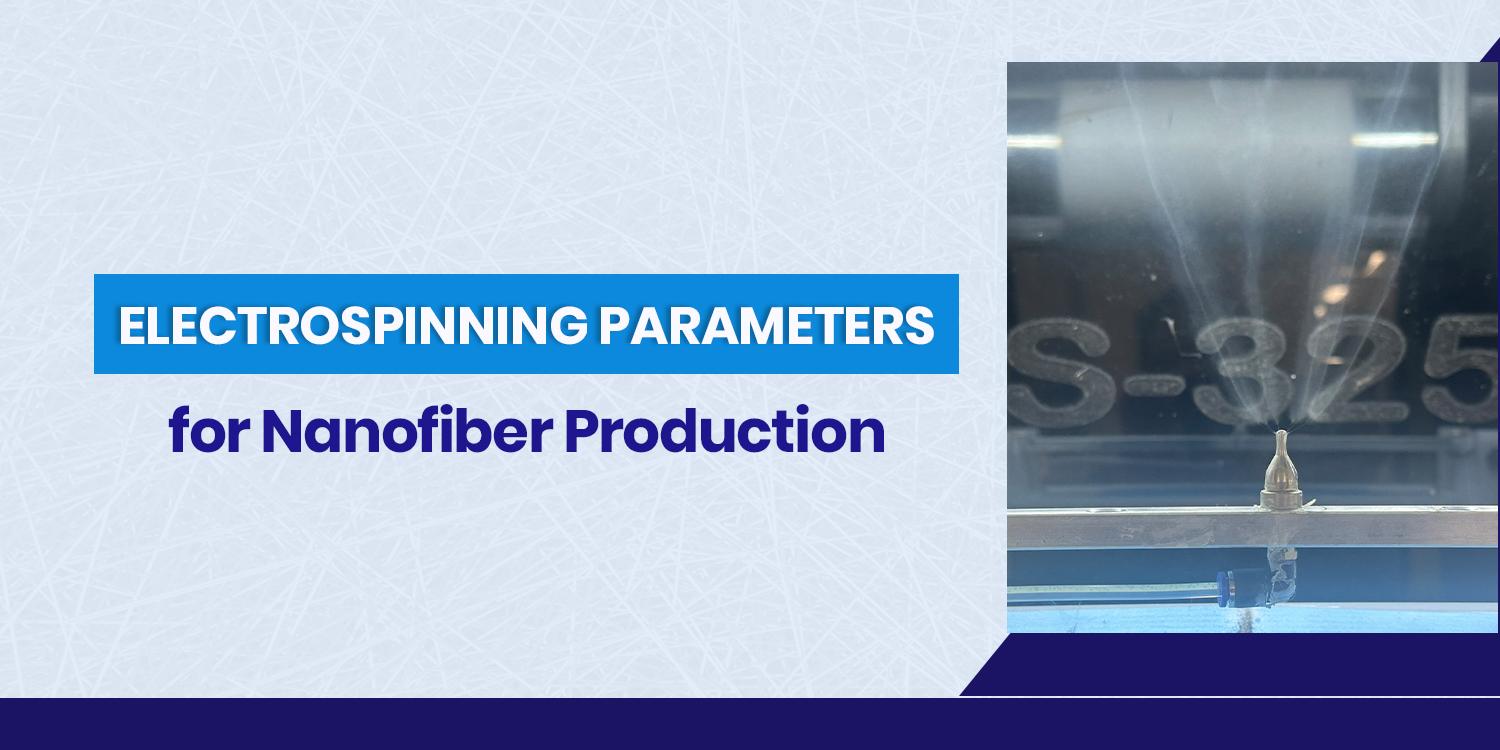
Electrospinning is a versatile manufacturing technique for producing ultrafine fibers with diameters ranging from the nanometer to micrometer scale. These fibers are increasingly used in filtration, biomedical materials, energy storage, protective textiles, and other advanced applications. However, producing consistent, high-quality nanofibers requires careful control of the Electrospinning Parameters for Nanofiber Production.
Small changes in voltage, flow rate, polymer concentration, temperature, or collector distance can significantly affect fiber diameter and morphology. Understanding how these variables interact helps manufacturers and researchers develop more reliable Nanofiber Technology and application-specific Nanofiber Solutions.
Understanding the Electrospinning Process
Electrospinning uses a strong electric field to draw a polymer solution or melt into extremely fine fibers. Typically, a polymer solution is delivered through a needle or spinneret while high voltage is applied between the spinneret and a grounded or oppositely charged collector.
When the electrical force becomes strong enough to overcome the surface tension of the solution, a charged liquid jet forms. The jet stretches and undergoes rapid solvent evaporation before reaching the collector as a fine fiber.
Optimizing the Electrospinning Parameters for Nanofiber Production is essential because both material properties and operating conditions influence this process.
1. Optimize Polymer Solution Concentration
Polymer concentration is one of the most important parameters affecting nanofiber formation. If the concentration is too low, insufficient polymer-chain entanglement can cause droplets, beads, or unstable fibers.
When concentration is too high, the solution may become excessively viscous, making it difficult to pump and stretch properly.
An appropriate concentration provides enough molecular entanglement to form continuous, uniform fibers. The ideal range varies depending on the polymer, molecular weight, solvent system, and desired fiber characteristics.
Researchers should therefore test several concentrations rather than assuming that one concentration will work for every polymer system.
2. Adjust the Applied Voltage
Applied voltage provides the electrical force responsible for drawing the polymer solution toward the collector.
If the voltage is too low, the electrostatic force may not be sufficient to create a stable jet. Increasing voltage can improve jet formation and stretching. However, excessively high voltage may increase instability, promote bead formation, or create inconsistent fiber morphology.
The ideal voltage should maintain a stable Taylor cone and continuous jet.
When optimizing Electrospinning Parameters for Nanofiber Production, voltage should be adjusted gradually while monitoring fiber diameter and surface structure.
3. Control the Solution Flow Rate
Flow rate determines how much polymer solution reaches the spinneret during electrospinning.
A flow rate that is too high can deliver more solution than the electric field can effectively stretch and dry. This may result in wet fibers, beads, fused structures, or irregular fiber diameters.
A very low flow rate may interrupt continuous production.
The goal is to establish a stable flow that provides enough material for continuous fiber formation while allowing sufficient time for solvent evaporation. Proper flow-rate optimization can improve both fiber uniformity and production reliability.
4. Set the Correct Spinneret-to-Collector Distance
The distance between the spinneret and collector determines how much time the electrospinning jet has to stretch and for solvent to evaporate.
When the distance is too short, fibers may reach the collector before they are completely dry. This can produce flattened, fused, or irregular fibers.
Increasing the distance can provide additional flight time, although excessive distance may reduce deposition efficiency or alter the electric field.
The optimal distance depends on the polymer solution, applied voltage, solvent volatility, environmental conditions, and equipment configuration.
5. Monitor Temperature and Humidity
Environmental conditions are sometimes overlooked when optimizing Electrospinning Parameters for Nanofiber Production.
Temperature influences solution viscosity and solvent evaporation. Higher temperatures can reduce viscosity and accelerate drying, while lower temperatures may slow solvent evaporation.
Humidity can also influence fiber morphology. Depending on the polymer and solvent, high humidity may create pores, surface defects, or inconsistent fibers.
For reproducible Nanofiber Technology, manufacturers should carefully monitor and, where necessary, control temperature and relative humidity throughout production.
6. Consider Solution Conductivity and Surface Tension
Conductivity determines how effectively electrical charges move through the electrospinning solution. Increasing conductivity can increase electrical stretching of the jet, which may influence fiber diameter and morphology.
Surface tension works in the opposite direction by encouraging the liquid to maintain a droplet shape. Excessive surface tension may contribute to bead formation.
Selecting suitable solvents and properly preparing polymer formulations can help achieve the right balance among conductivity, viscosity, and surface tension.
These solution properties should be evaluated together rather than independently.
7. Optimize Collector Design and Speed
The collector plays an important role in determining the final arrangement of electrospun fibers.
A stationary flat collector generally produces randomly oriented nanofibers. Rotating drums or mandrels can be used when greater fiber alignment is required. Collector speed, geometry, and electrical characteristics can affect fiber orientation and membrane structure.
For applications such as tissue engineering, filtration, sensors, and advanced textiles, controlling fiber orientation can be just as important as controlling fiber diameter.
Why Parameter Optimization Requires a Systematic Approach
There is no universal combination of Electrospinning Parameters for Nanofiber Production that works for every polymer or application.
Changing one variable can influence several others. For example, increasing polymer concentration changes viscosity, while changing temperature can influence both viscosity and solvent evaporation.
A systematic optimization process should therefore evaluate parameters in controlled experiments and measure outcomes such as:
- Average fiber diameter and diameter distribution
- Bead and defect formation
- Fiber orientation
- Porosity and pore structure
- Surface morphology
- Membrane thickness
- Mechanical properties
- Production consistency
More advanced approaches can also use design of experiments, automated monitoring, machine learning, and statistical modeling to identify relationships between processing conditions and final fiber properties.
Developing Better Nanofiber Solutions with Matregenix
Optimizing Electrospinning Parameters for Nanofiber Production is essential for moving from experimental fiber formation toward consistent and scalable manufacturing. Polymer concentration, applied voltage, flow rate, spinneret distance, temperature, humidity, conductivity, and collector design all contribute to final nanofiber quality.
Careful control of these variables enables organizations to develop Nanofiber Solutions with properties tailored to filtration, healthcare, energy, textiles, and other demanding applications.
Matregenix specializes in advanced Nanofiber Technology and electrospinning-based material development. By combining material science expertise with controlled manufacturing processes, Matregenix helps organizations explore and develop customized nanofiber solutions designed around specific performance requirements.

 English
 Arabic
 Spanish
 Portuguese
 Deutsch
 Turkish
 Dutch
Dutch
 Italiano
 Russian
 Romaian
 Portuguese (Brazil)
 Greek
Greek
