

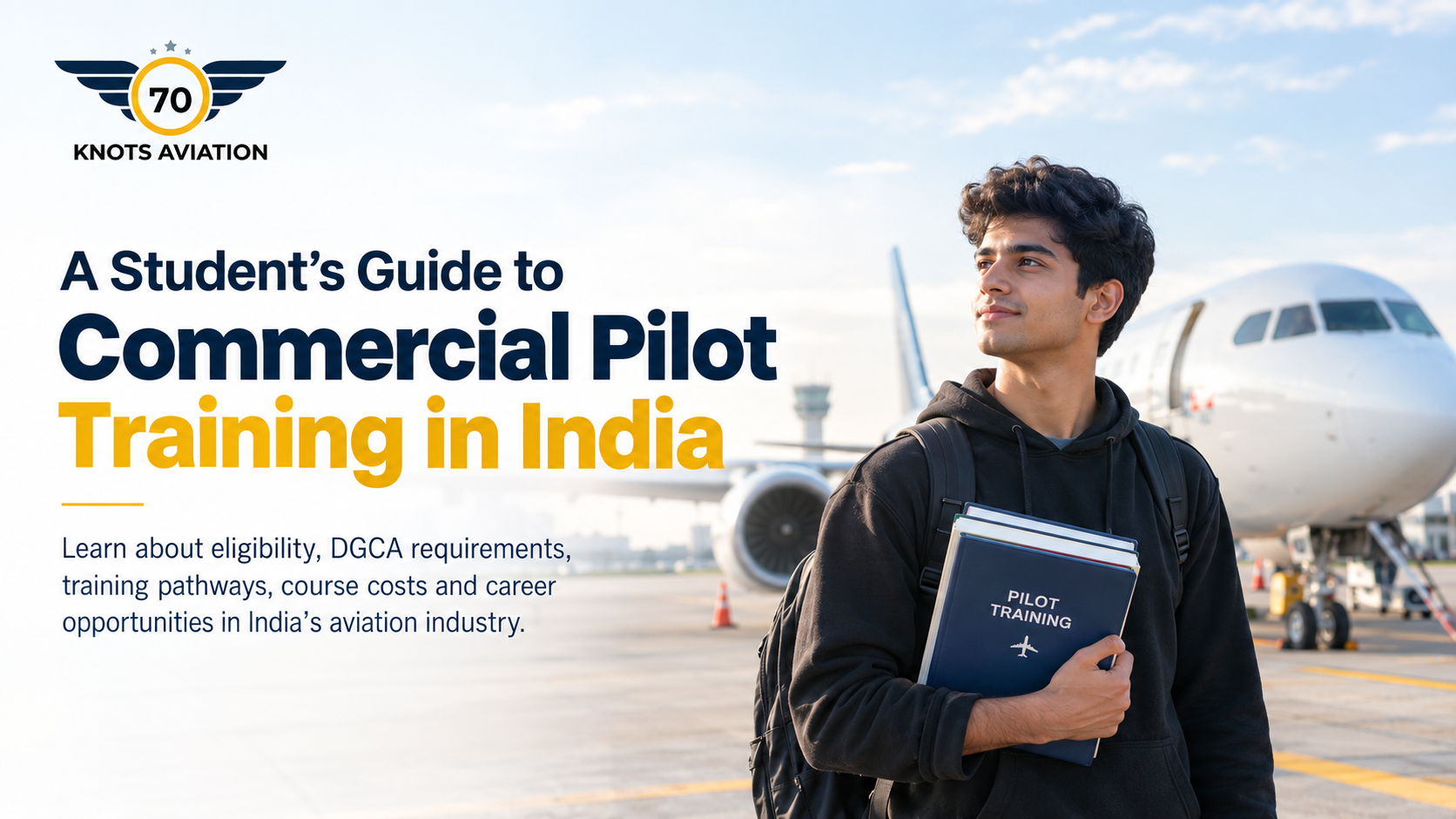
A Student’s Guide to Commercial Pilot Training in India
Introduction
Becoming a commercial pilot is an exciting career goal, but the journey requires careful planning, academic preparation and consistent effort. Students must understand the eligibility requirements, medical standards, DGCA examinations and practical flying experience before they begin their training. A clear roadmap helps aspiring pilots make informed decisions and avoid unnecessary confusion during the process.
At 70Knots Aviation, we help students understand the theoretical side of pilot training and prepare for the DGCA examinations required during their aviation journey. Our team includes pilots and aviation professionals who guide students through important aspects of ground school, exam preparation and the steps involved in pursuing a Commercial Pilot Licence (CPL).
Whether you have just completed school or have already started exploring aviation, understanding each stage will help you plan your next steps with greater confidence.
How to Choose the Right Pilot Training Academy
Students often focus on finding a Top pilot training academy in India when they begin researching their options. However, the right choice depends on more than the reputation of an institution. You should examine its training structure, teaching approach, course coverage and support system before making a decision.
Start by identifying the type of training you need. Ground school develops your theoretical knowledge and helps you prepare for the relevant DGCA examinations. Flight training, on the other hand, provides practical experience under qualified flight instructors at an appropriate training organisation.
These two stages work together, but they serve different purposes. A ground school can help you strengthen your subject knowledge, while an approved flying training organisation provides the practical instruction needed to build flying experience.
Before enrolling, consider the following factors:
-
Experienced instructors: Look for teachers who can explain aviation concepts clearly and connect theory with practical operations.
-
Well-structured lessons: A planned timetable helps you cover the syllabus, revise difficult topics and prepare for examinations.
-
Study materials: Notes, practice questions and mock tests can support your preparation when they align with the applicable syllabus.
-
Doubt-clearing sessions: Regular opportunities to ask questions help you identify gaps in your understanding.
-
Transparent guidance: A reliable training provider should explain the course scope, expected commitments and limitations without promising guaranteed examination results or airline employment.
Take time to compare these factors rather than making a decision based only on advertisements. A suitable learning environment can help you develop the discipline and knowledge that aviation training demands.
Understanding the Eligibility Requirements for CPL Training
Before committing to pilot training, check whether you meet the applicable educational and medical requirements. In India, candidates pursuing a Commercial Pilot Licence generally need to complete Class 12 with Physics and Mathematics, or an accepted equivalent qualification, and meet the relevant age and medical requirements.
Candidates should review the current Directorate General of Civil Aviation (DGCA) requirements before beginning the licensing process. The medical assessment deserves particular attention because medical fitness forms an essential part of pilot licensing. Seek guidance on the applicable Class 2 and Class 1 medical procedures early, and confirm the requirements for your stage of training.
You should also organise your educational documents, identity records and other supporting paperwork. Candidates need to follow the applicable DGCA procedures for examination registration and related formalities.
Planning these steps early can help you make better decisions about your training schedule and finances. It also reduces the risk of overlooking an important requirement after you have already invested significant time and money.
What Do Students Learn During DGCA Ground Classes?
Ground school prepares aspiring pilots to understand the principles, rules and procedures that support safe aircraft operations. Students study aviation theory before and alongside their practical training, depending on their individual training plan.
Common areas of study include the following:
Air Navigation: Students learn how to understand charts, directions, flight planning, navigation principles and calculations relevant to aircraft operations.
Aviation Meteorology: This subject explains weather conditions, atmospheric processes, forecasts and reports. Pilots use this knowledge to assess weather information and understand its influence on flight operations.
Air Regulations: Students study the rules and regulatory framework that govern aviation. A sound understanding of these requirements helps pilots recognise their responsibilities and operational limitations.
Technical General: This subject develops knowledge of aircraft systems, engines, basic aerodynamics and the principles behind aircraft operation.
Technical Specific: Depending on the applicable examination and licensing requirements, students may need to prepare for aircraft-specific technical knowledge.
Radio Telephony: Aviation communication training helps students understand standard phraseology and communication procedures. Candidates should verify the applicable examination and certification requirements for their licensing pathway.
The exact examination requirements can vary according to the candidate's stage and the latest DGCA syllabus. Students should therefore confirm the subjects they need to complete instead of relying solely on an old checklist.
At 70Knots Aviation, we help students approach theoretical subjects systematically, understand difficult concepts and build a regular preparation routine. Students should combine classroom learning with independent revision and practice to strengthen their understanding.
Why Consider a Pilot Training Institute in Delhi?
Location can influence a student's training experience. Access to accommodation, transport, learning resources and regular academic support can make it easier to follow a consistent study schedule.
Students searching for a Pilot training institute in Delhi should compare the available programmes carefully and determine whether each institution offers the training they actually need. Some institutions focus on DGCA ground preparation, while others coordinate or provide practical flying training through separate arrangements. Students must understand this distinction before enrolling.
Delhi can be a convenient option for students who want to attend ground classes in the capital. However, the location alone should not determine the final decision. Review the course structure, instructor support, class timings, study resources and overall costs.
Students should also ask how the ground school prepares learners for examinations, how instructors address doubts and how the programme handles revision. These questions provide a clearer picture of the learning experience than broad promotional claims.
70Knots Aviation operates its ground school in Dwarka, New Delhi, and supports aspiring flight crew members preparing for DGCA CPL and ATPL examinations. Our aim is to help students understand the theoretical requirements and approach their preparation with a structured plan.
Planning Your Training Timeline and Budget
Pilot training requires a financial commitment as well as academic effort. Your total expenditure will depend on several factors, including the ground school, flying training organisation, aircraft and training rates, accommodation, travel, medical assessments, examination fees and other applicable charges.
Ground school costs and flying training costs should be considered separately. Completing a ground course does not automatically provide the practical flying experience or licence required to work as a commercial pilot.
Before you enrol, request a clear breakdown of the fees and identify which services the quoted amount includes. Ask about additional charges, payment schedules, the availability of study materials and any costs that may arise during further preparation.
You should also create a realistic study schedule. Some students progress quickly through theoretical subjects, while others need more revision in areas such as navigation calculations, meteorology or technical concepts. Your timeline will depend on your preparation, examination availability and progress through the other licensing requirements.
Rather than selecting a programme based only on the shortest advertised duration, choose one that gives you a practical plan for completing the necessary learning and examination stages.
How to Compare the Best CPL Ground Classes in India
Choosing the Best CPL Ground Classes in India requires students to assess the quality of the learning experience and the support available throughout the course. A useful programme should help you build a strong conceptual foundation instead of encouraging you to memorise answers without understanding the underlying principles.
Begin by examining the syllabus coverage. Ask whether the programme follows the applicable examination requirements and how it handles syllabus updates. Check whether the instructors provide clear explanations, regular practice and opportunities to review difficult topics.
You should also consider the teaching format. Classroom sessions, individual doubt-clearing opportunities, practice tests and structured revision may suit different students in different ways. Select a format that fits your learning needs and allows you to maintain a consistent routine.
At 70Knots Aviation, we focus on DGCA ground examination preparation and help students work through important theoretical subjects. Our teaching approach aims to make complex topics easier to understand through organised lessons, study resources and regular practice.
Remember that classroom participation alone cannot replace independent study. Students should revise after every lesson, solve practice questions, review mistakes and ask instructors to clarify concepts they find difficult. This approach helps develop a deeper understanding of aviation theory.
No ground school can remove the need for personal effort or guarantee a particular examination result. Your progress will depend on your preparation, understanding and consistency.
Student–Counsellor Conversation: Planning a Pilot Career
Student: I have completed Class 12 and want to become a commercial pilot. What should I do first?
Counsellor: Start by checking your educational eligibility and the current DGCA medical requirements. Organise your documents and understand the broad stages of ground school, examinations and practical flying training before choosing a programme.
Student: Do I need to complete ground classes before starting flying training?
Counsellor: Your training sequence depends on the applicable requirements and your individual plan. Ground school develops the theoretical knowledge you need, while flight training develops your practical flying skills. Discuss the correct sequence with your training providers and verify the relevant DGCA requirements.
Student: Which subjects should I prepare for during ground school?
Counsellor: You may need to study Air Navigation, Aviation Meteorology, Air Regulations and technical subjects, along with the applicable radio telephony requirements. Confirm your current examination subjects before starting so you can organise your study plan correctly.
Student: How can I prepare if I find Air Navigation difficult?
Counsellor: Build your understanding step by step. Review the basic concepts, practise calculations regularly and work through questions that test different applications of the same principle. Ask your instructor to explain any errors you repeatedly make, and revisit those topics during revision.
Student: Will completing ground classes guarantee my CPL or an airline job?
Counsellor: No. Ground classes help you prepare for the theoretical examination stage, but you must also meet the applicable licensing, medical, documentation and practical flying requirements. Airline recruitment has separate selection criteria. Consistent preparation and realistic planning can help you progress, but no training provider should guarantee a licence or job.
Student: How can 70Knots Aviation help me?
Counsellor: We help students prepare for DGCA ground examinations through subject-focused teaching and guidance. We encourage students to understand the syllabus, maintain a regular study routine and seek clarification whenever they encounter difficult concepts. You should also plan your medical assessments and flying training with the appropriate authorities and training organisations.
Building a Consistent Preparation Routine
Students can improve their learning experience by following a realistic weekly schedule. Begin by setting clear goals for each subject and dividing large topics into smaller sections. This makes it easier to track your progress and identify areas that require additional attention.
After every class, review your notes and write down any questions that remain unanswered. Use practice questions to test your understanding rather than relying on reading alone. When you make a mistake, identify its cause and revise the relevant concept before attempting similar questions again.
You should also balance your preparation across different subjects. Spending too much time on one area may leave you with limited time to revise others. A balanced timetable, regular practice and periodic self-assessment can help you prepare more effectively.
Keep your official documents organised and monitor examination announcements through the relevant DGCA channels. Always check current instructions for registration, examination schedules and administrative procedures.
Most importantly, remember that pilot training requires patience and responsibility. Students who approach the process with realistic expectations can make more informed decisions at each stage of their journey.
Frequently Asked Questions
1. What qualifications do I need to pursue CPL training in India?
Candidates generally need Class 12 with Physics and Mathematics, or an accepted equivalent qualification, and must satisfy the applicable age, medical, examination and licensing requirements. Always verify the latest DGCA rules before enrolling.
2. What is the difference between ground school and flying training?
Ground school develops theoretical knowledge of navigation, weather, regulations and aircraft systems. Flying training provides practical experience under qualified flight instructors at an appropriate training organisation. Students need to complete the applicable requirements for their chosen licence.
3. How long does DGCA ground training take?
The duration varies according to the course structure, teaching schedule, examination requirements and the student's progress. Ask the training provider for its current timetable and allow additional time for revision or further examination attempts when planning your journey.
4. Can I complete my CPL ground classes in Delhi and do my flying training elsewhere?
Yes, students can explore separate ground school and flying training arrangements, subject to the applicable requirements. Before enrolling, confirm what each provider offers and ensure that you complete your practical training through an appropriately approved flying training organisation.
5. Does completing DGCA ground classes guarantee a CPL or an airline placement?
No. Ground classes support theoretical examination preparation, but a CPL requires candidates to meet all applicable licensing conditions. Airline employment involves separate recruitment and selection processes, and neither a licence nor a job is guaranteed by completing a ground course.
Conclusion
A commercial pilot career begins with informed decisions, strong theoretical knowledge and a clear understanding of the licensing process. Students should check their eligibility, understand the medical requirements, compare ground school options and plan their practical flying training carefully.
With structured preparation, regular revision and suitable guidance, aspiring pilots can approach the DGCA examination stage with greater clarity. At 70Knots Aviation, we support students preparing for CPL and ATPL ground examinations and encourage them to build the knowledge and discipline required for their next steps in aviation.
Take time to understand each stage, confirm the current requirements and choose a training plan that matches your goals, circumstances and learning needs.

 English
 Arabic
 French
 Spanish
 Portuguese
 Deutsch
 Turkish
 Dutch
 Italiano
 Russian
 Portuguese (Brazil)
 Greek
