

Why RO Recovery Should Never Be Increased Without Reviewing Feed-Water Chemistry
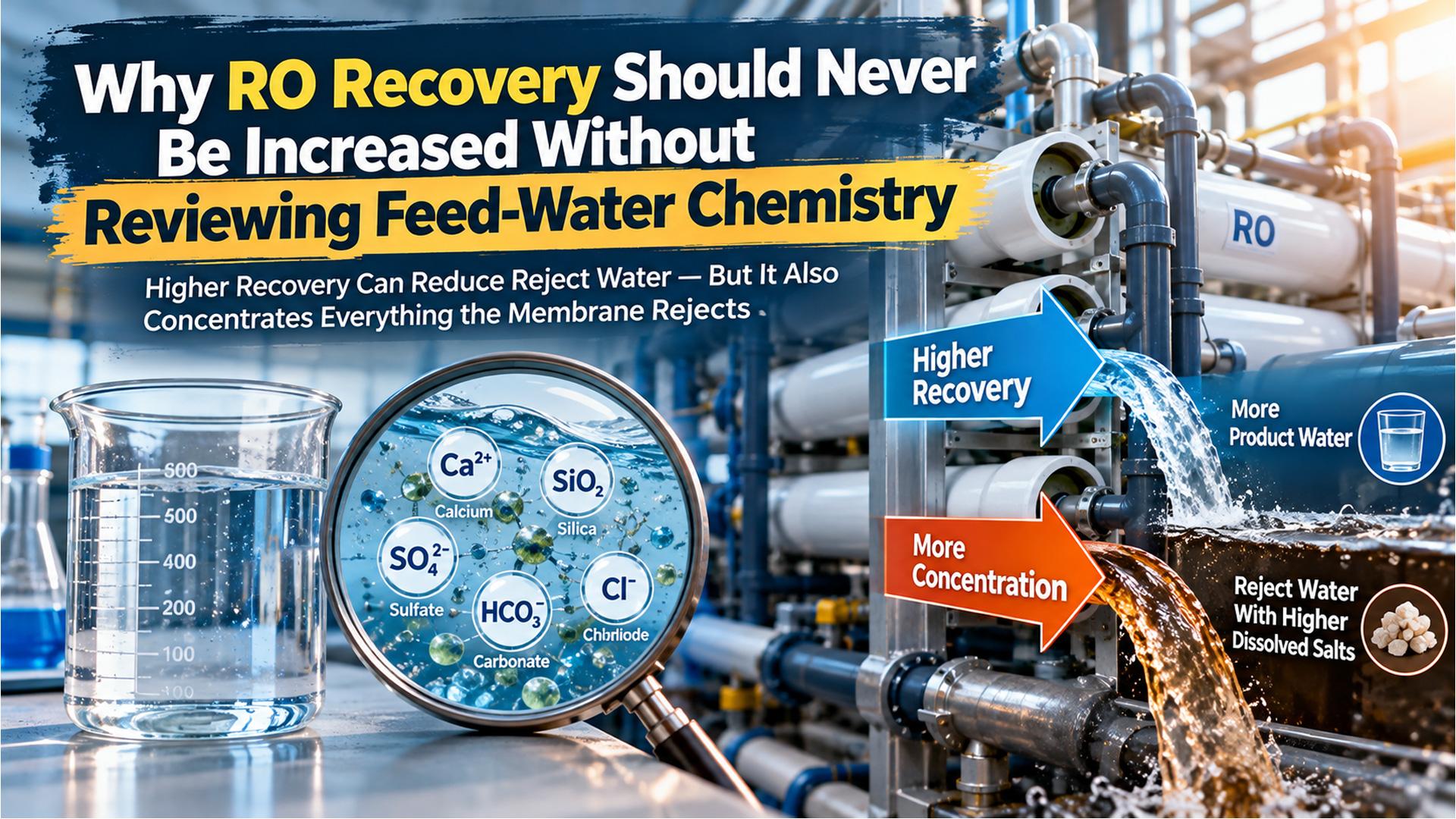
Higher Recovery Can Reduce Reject Water — But It Also Concentrates Everything the Membrane Rejects
Industrial RO buyers naturally want more product water and less reject water.
This makes recovery percentage one of the most frequently discussed figures during reverse-osmosis plant selection and optimisation.
Increasing recovery can be beneficial when the system and feed-water chemistry support it.
But increasing recovery without understanding what is dissolved in the incoming water can create membrane scaling, fouling, higher operating pressure and more frequent cleaning.
For businesses evaluating an Industrial RO Plant Oman, recovery should therefore be treated as an engineering result — not as a number to maximise at any cost.
What Does RO Recovery Mean?
Recovery describes how much incoming feed water becomes product water.
If an RO system receives 100 units of feed water and produces 70 units of permeate, the remaining water leaves primarily as reject or concentrate.
Increasing recovery means producing more permeate from the same feed-water volume.
That sounds automatically positive.
But there is another side to the equation.
Salts Do Not Disappear When Recovery Increases
The membrane rejects a large proportion of dissolved substances from the product-water stream.
Those substances remain concentrated in the reject stream.
As recovery increases, the concentration inside the membrane system can become progressively higher.
This is why feed-water chemistry is directly connected to safe recovery.
Scaling Risk Can Increase at Higher Recovery
Some dissolved constituents can become problematic when their concentration increases beyond suitable limits.
Depending on feed-water conditions, scaling concerns may involve:
-
calcium compounds;
-
silica;
-
sulphates;
-
carbonates;
-
and other mineral constituents.
The exact risk depends on the complete water chemistry rather than one parameter in isolation.
A Low-TDS Feed Does Not Automatically Mean Recovery Can Be Pushed Higher
Total dissolved solids are useful, but TDS alone does not describe every scaling risk.
Two water sources with similar TDS can contain very different proportions of hardness, silica and other dissolved constituents.
That means recovery decisions should not be based only on a conductivity or TDS reading.
Start With a Representative Water Analysis
Before increasing recovery, project teams should review current feed-water information.
Depending on the source, relevant parameters may include:
-
TDS;
-
hardness;
-
alkalinity;
-
silica;
-
chlorides;
-
sulphates;
-
iron;
-
pH;
-
temperature;
-
and other relevant constituents.
Water conditions may also change over time, making an old analysis less useful for current optimisation decisions.
Pretreatment Changes What Recovery the RO System Can Sustain
Recovery cannot be evaluated independently from pretreatment.
Depending on the feed water, the treatment train may use:
-
multimedia filtration;
-
softening;
-
activated carbon;
-
cartridge filtration;
-
ultrafiltration;
-
antiscalant dosing;
-
or other conditioning.
Improving pretreatment may allow the RO system to operate more reliably, but every modification should still be evaluated technically.
Antiscalant Is Not Permission to Ignore Water Chemistry
Antiscalant dosing can form part of membrane-scale control.
However, chemical dosing should not become an excuse to push recovery beyond a technically justified range.
The dosage, water chemistry, membrane system and operating conditions should be considered together.
Membrane Configuration Influences Recovery
RO system design may use several pressure vessels and membrane stages.
The way feed water moves through those stages affects concentration and membrane loading.
A recovery target that is realistic for one membrane configuration may not be suitable for another.
This is why buyers should avoid comparing recovery percentages without understanding the plant design behind them.
Higher Recovery Can Increase Operating Pressure
As the concentrate becomes stronger, membrane operating conditions can change.
Depending on the water and system, maintaining product-water output may require increased pressure.
Higher operating pressure can influence:
-
energy consumption;
-
pump duty;
-
membrane stress;
-
and lifecycle operating cost.
Watch Normalised Performance, Not Just Daily Production
An RO plant can continue producing water while gradually losing performance.
Operators should monitor trends in:
-
permeate flow;
-
feed pressure;
-
operating pressure;
-
differential pressure;
-
permeate conductivity;
-
reject flow;
-
and membrane-cleaning frequency.
A plant that requires steadily increasing pressure to maintain output may be signalling a developing problem.
Frequent Cleaning Can Be a Warning Sign
Cleaning membranes occasionally may be part of normal plant operation.
But cleaning too frequently can indicate that:
-
pretreatment is inadequate;
-
recovery is too aggressive;
-
feed-water quality has changed;
-
dosing is incorrect;
-
or the membranes are experiencing another form of fouling.
Increasing recovery further in this situation is unlikely to solve the underlying issue.
Reject Water Reduction Should Be Evaluated Across the Whole Project
A project may want to increase recovery primarily to reduce reject-water volume.
That goal is reasonable, but it should be compared with the possible consequences.
For example:
-
Will membrane cleaning increase?
-
Will chemical consumption rise?
-
Will operating pressure increase?
-
Will membrane life be affected?
-
Will additional pretreatment be needed?
The lowest reject volume does not automatically produce the lowest operating cost.
Sometimes Improving the Feed Is Better Than Pushing the RO Harder
If the project needs more usable water, it may be worth investigating the complete treatment train rather than changing RO recovery alone.
Possible improvements may include:
-
better pretreatment;
-
improved filtration;
-
more consistent chemical dosing;
-
removing a specific scaling risk;
-
or adjusting membrane configuration.
The most effective solution depends on the water analysis.
Capacity Expansion and Recovery Optimisation Are Different Projects
If a facility needs more permeate because water demand has grown, increasing recovery may not be the correct way to add capacity.
Additional membrane area, increased operating hours, larger storage or other plant modifications may provide a better approach.
The project should first identify whether the actual objective is:
-
more product water;
-
less reject water;
-
lower energy use;
-
or better membrane reliability.
These goals are related but not identical.
Feed-Water Temperature Can Also Affect Performance
Membrane performance can change with water temperature.
Project teams should therefore be careful when comparing plant output or recovery across significantly different operating conditions.
Seasonal or source-related temperature changes should be interpreted alongside other performance data.
A Better Way to Discuss RO Recovery With Suppliers
Instead of asking, “What is the highest recovery you can give us?” ask:
-
What recovery do you recommend for this water analysis?
-
What is limiting higher recovery?
-
What pretreatment is assumed?
-
What scaling risks have been considered?
-
What reject concentration is expected?
-
What operating pressure is required?
-
How will the system behave if feed-water quality changes?
These questions reveal far more about the quality of the design.
Choose Sustainable Recovery, Not Maximum Recovery
Businesses reviewing an industrial RO plant in Oman should evaluate recovery against feed-water chemistry, pretreatment and long-term membrane operation.
A slightly lower recovery that operates reliably may deliver better lifecycle performance than a higher recovery that creates repeated scaling and cleaning problems.
Final Thoughts
RO recovery is important, but it should never be treated as a standalone sales number.
The technically correct recovery is the one the feed water, membrane design and pretreatment can support consistently.
More product water is valuable only when the system can produce it without turning today's recovery gain into tomorrow's membrane problem.

 Arabic
 French
 Spanish
 Portuguese
 Deutsch
 Turkish
 Dutch
 Italiano
 Russian
 Romaian
 Portuguese (Brazil)
 Greek
