

What Makes an Explosion Proof Heater Different From a Standard Industrial Heater?
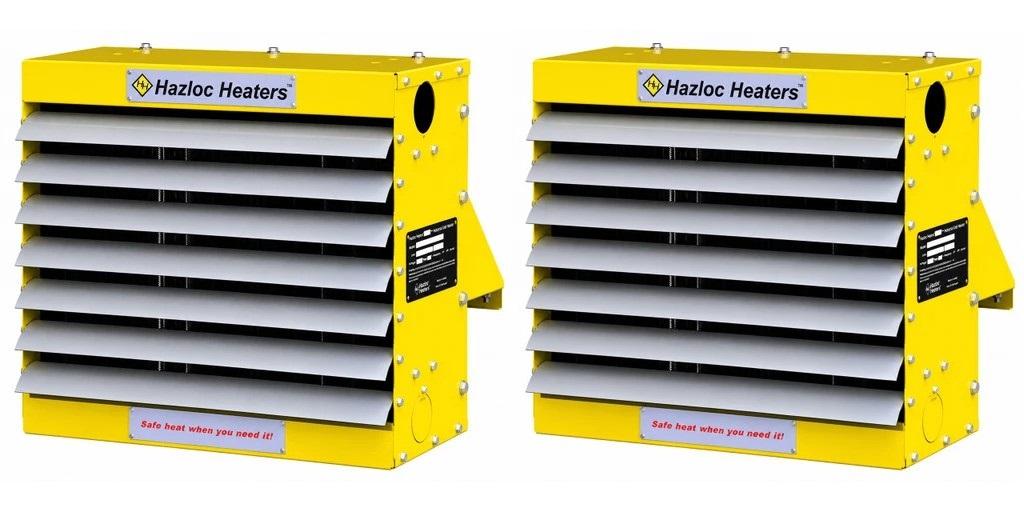
At a glance, an explosion proof heater and a standard industrial unit heater can look similar. Both create warm air, both mount on a wall or ceiling, and both are built for tough commercial spaces. But in a refinery, paint booth, or grain facility, the differences between them decide whether a heater keeps workers comfortable or becomes an ignition source.
Here’s what separates explosion proof heaters from typical industrial and commercial heating units, and why facility managers in classified areas can’t substitute one for the other.
Standard Heaters Are Built for Ordinary Air
Typical commercial and industrial heaters are designed for spaces where the atmosphere is safe. Their heating elements may be exposed, their motors and thermostats can produce small sparks during normal operation, and their outer surfaces can get very hot. In a warehouse or workshop, none of that is a problem.
In an environment with flammable gases, vapors, or combustible dust, every one of those features is a potential ignition point. A spark from a relay or a hot element surface is enough to ignite the right concentration of fuel in the air.
Explosion Proof Heaters Contain the Ignition Source
An explosion proof heater isn’t designed to stop hazardous materials from ever reaching its internals. It’s designed so that if an ignition happens inside the enclosure, it stays there. Key differences include:
- Heavy-duty enclosures. Housings are built to withstand an internal explosion without rupturing.
- Engineered flame paths. Precisely machined joints cool escaping gases so they can’t ignite the surrounding atmosphere.
- Sealed components. Heating elements, motors, thermostats, and wiring connections are enclosed and rated for hazardous use.
- Controlled surface temperatures. Units carry a temperature code (T-code) indicating the maximum surface temperature, which must stay below the ignition temperature of the gases or dust present.
- Corrosion resistance. Many models use heavy-gauge steel and protective finishes built for chemical plants, wastewater facilities, and offshore-style conditions.
Certification Is the Real Dividing Line
The most important difference is certification. Explosion proof heaters are listed by organizations like UL or CSA for specific hazardous locations defined in NEC Article 500:
- Class I: Flammable gases or vapors
- Class II: Combustible dust
- Division 1: Hazard present during normal operation
- Division 2: Hazard present only under abnormal conditions
- Groups A–G: The specific substance involved, such as hydrogen, propane, or grain dust
A heater rated for Class I, Division 2 isn’t automatically suitable for Division 1. Specifying the wrong unit can mean failed inspections, project delays, and equipment that has to be pulled and replaced. Always confirm your area classification with site drawings or a qualified engineer before ordering.
Where Explosion Proof Heaters Are Required
Facilities that commonly need hazardous location heaters include oil and gas sites, refineries, chemical processing plants, paint spray booths, grain elevators, wastewater treatment plants, aircraft hangars, and fuel or solvent storage areas. They’re used for space heating, freeze protection, and supplemental heat wherever a standard unit would introduce risk.
Source Certified Explosion Proof Heaters From NorthStock
For facility managers who need the spec right the first time, NorthStock’s hazardous location heaters are a strong place to start. NorthStock carries explosion proof unit heaters and convectors from trusted manufacturers including Chromalox, Ruffneck/Thermon, Markel, and Berko/QMark, all UL-listed or CSA-approved for Class I and II, Division 1 and 2 locations.
Their team helps with classification questions, T-code ratings, and code compliance, and can quote custom configurations for voltage, kW, mounting, and controls. NorthStock also stocks replacement parts like thermostats, contactors, and motors, offers free ground shipping to the lower 48, and has no order minimums.
Share your area classification and heating requirements with NorthStock, and get a certified explosion proof heater matched to your facility.
For more information about Washdown Heater and Modine Unit Heaters Please visit: NorthStock Inc.

 English
 Arabic
 French
 Spanish
 Portuguese
 Deutsch
 Turkish
 Dutch
 Italiano
 Russian
 Romaian
 Portuguese (Brazil)
