

Fish Tags: Choosing the Right Identification Method
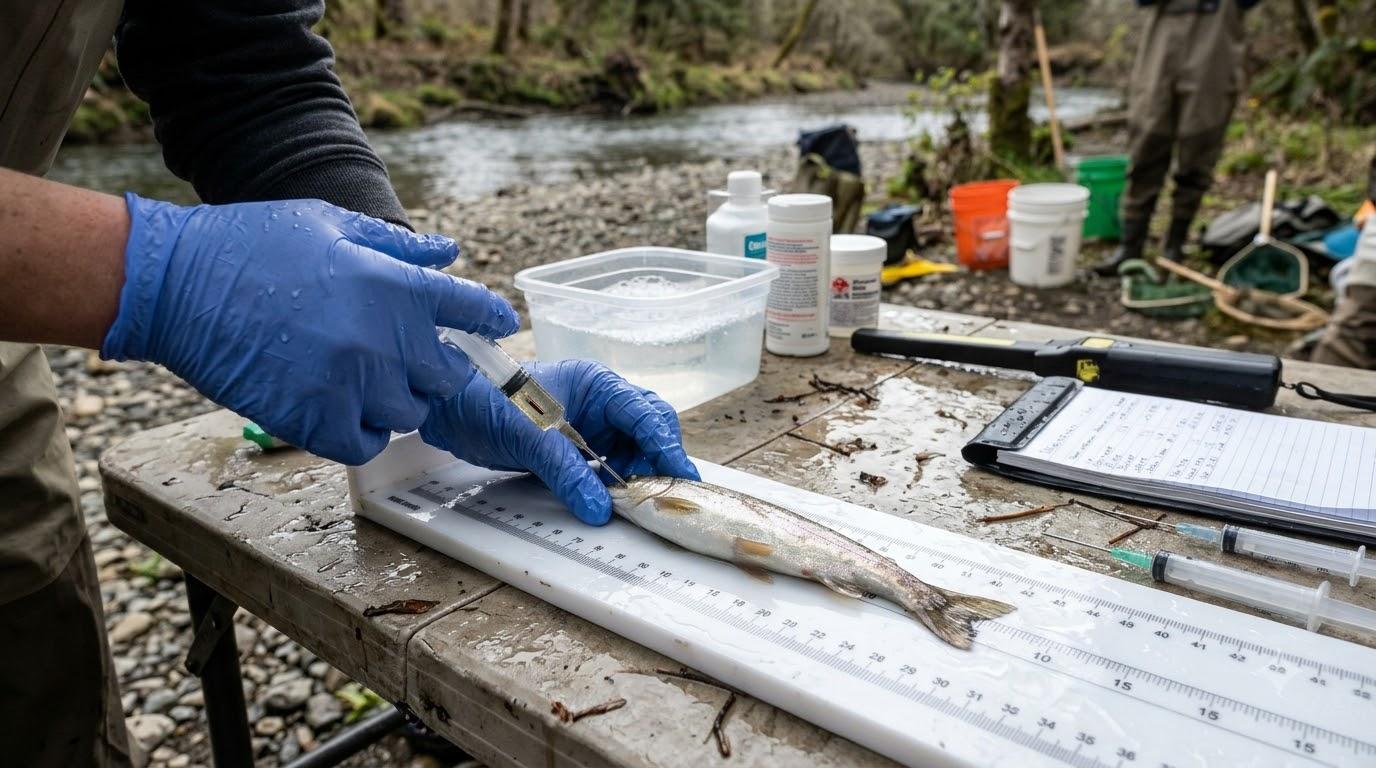
Fish Tags: How to Choose an Identification Method That Fits Your Research or Hatchery Operation
Choosing an identification method for fish is not simply a matter of finding a tag that can be attached to an animal. The right approach depends on what the project needs to identify, how often fish will be observed, which measurements must be recorded, and what equipment is available. Before selecting fish tags for a research or hatchery identification programme, decide whether the priority is individual identification, repeated monitoring, operational traceability, or a combination of these objectives.
Fish identification systems can support research, conservation, hatchery management, and other fisheries activities. However, different projects have different constraints. A small study may need a straightforward manual scanning process, while a larger programme may require compatible readers, digital data capture, and a consistent method across multiple staff members.
Passive Integrated Transponder (PIT) technology is one option. A PIT tag contains an electronic identification code and is detected by a compatible reader when it is within the effective reading range. The tag is passive, meaning it does not require its own battery.
This guide explains how to assess identification needs, compare important tag characteristics, and avoid selecting equipment that does not fit the actual workflow.
First decide what you need to identify
The phrase “fish identification” can describe several different tasks. A project may need to distinguish one fish from another, associate measurements with individual animals, monitor detections at a particular location, or maintain records across repeated sampling sessions.
These objectives should be written down before a product is selected.
Individual identification
If the project needs to recognise the same fish during multiple sampling events, an individual identification code can help connect observations over time.
For example, a hatchery may measure fish at the beginning of a monitoring period and then repeat those measurements later. The identification system must make it possible to connect the later record with the correct individual.
Group or batch identification
Some operations mainly need to distinguish groups, batches, or production units. Individual electronic identification may still be useful, but it may not be necessary for every fish.
A team should compare the cost and administrative effort of individual identification with the actual information required by the operation.
Movement and detection studies
A research project may want to record when tagged fish pass a particular detection point. In that situation, tag-reader compatibility and the design of the detection arrangement become especially important.
A tag alone does not provide continuous location tracking. Researchers need an appropriate detection system and a study design that explains what each reading represents.
Compare identification options by the job they need to perform
There is no single identification method that is best for every fish-related project. The decision should account for the expected frequency of identification, the environment, animal characteristics, and the level of detail required in the records.
|
Project requirement |
What to consider |
Important limitation |
|
Repeated identification of individuals |
Unique electronic codes and compatible readers |
A reading only occurs when the tag is within the reader's effective range |
|
Visual recognition during handling |
Whether an external identification method is appropriate |
Visibility and retention may vary with the method and conditions |
|
Recording fish measurements |
Ability to connect identification with measurement records |
A tag does not automatically collect every biological measurement |
|
Monitoring at fixed locations |
Reader and detection-system configuration |
Detection coverage depends on system design and placement |
|
Large-scale data collection |
Digital records, exports, and staff procedures |
Software compatibility and data governance must be checked |
The table is a decision aid, not a claim that one method is suitable for every species or research protocol.
Understand the main PIT tag characteristics
When considering electronic identification, pay attention to the details that determine whether a tag fits the intended application.
Tag dimensions
Tag dimensions are among the first specifications to review. A product that is physically suitable for one animal may not be appropriate for another.
Voda IQ lists multiple PIT tag formats, including smaller options and larger formats. Its published range includes an 8 mm nano tag, 9 mm and 10 mm formats, 12 mm options, and larger tags.
The smallest animals in the study deserve particular attention. Do not select a tag solely by comparing the average size of the fish with the length of the tag. Suitability also depends on the species, anatomy, approved application site, and professional guidance.
Communication format
PIT tags may use different communication formats, including full-duplex and half-duplex designs. These terms describe how the tag and reader communicate.
The research team should check the exact format supported by the reader. A tag and reader should not be assumed to work together simply because both are described as RFID equipment.
Frequency and standards
Voda IQ lists several tags operating at 134.2 kHz and identifies ISO 11784 and ISO 11785 on relevant product descriptions. These details are useful when checking compatibility, but they should be reviewed against the exact reader specification.
A procurement team should keep the product model and its technical documentation in the equipment record. This avoids relying on a broad product description when staff later need to replace or add equipment.
Housing material and intended application
The product range includes bioglass injectable transponders and a food-safe plastic tag option. The intended application matters: a tag designed for one use should not automatically be treated as appropriate for another.
For example, a food-safe product description does not remove the need to check applicable food, animal welfare, and regulatory requirements. The team should confirm the manufacturer's stated intended use and the requirements of its own operation.
When a food-safe tag may be relevant
Some fisheries and aquaculture operations need to consider what happens to an animal after identification. If fish are intended for consumption, the team must evaluate whether the identification method is appropriate for the complete production and handling process.
Voda IQ lists an FS12 food-safe full-duplex PIT tag. Its product information describes a 12 mm by 2.12 mm plastic-housed option intended as an alternative to a standard glass-encapsulated tag for consumable applications.
This is a product-specific description, not blanket approval for every food-production environment. Before selecting such a product, ask:
-
Is the product intended for the operation being planned?
-
Are there local rules governing identification devices in food-producing animals?
-
Does the relevant processing or inspection procedure permit the proposed method?
-
Can the tag be read using the available equipment?
-
Are the handling and record-keeping procedures documented?
A purchasing decision should be made only after these questions are answered.
Match the tag with its application equipment
The tag and application equipment should be assessed as a set. The needle, applicator, connection type, and tag dimensions need to be compatible.
For example, Voda IQ's published product information identifies 15-gauge needles for certain smaller tag formats and 12-gauge needles for some 9 mm and 12 mm formats. The precise combination must be confirmed against the selected product and its instructions.
A practical procurement check should include:
-
Record the exact tag model.
-
Confirm the tag dimensions and communication format.
-
Identify the manufacturer's recommended application equipment.
-
Check the needle and applicator connection.
-
Confirm reader compatibility.
-
Obtain the current product instructions.
-
Ensure that the proposed application is covered by the appropriate animal-care protocol.
This is an equipment-planning checklist, not an implantation guide. Tagging should be performed by appropriately trained personnel under approved procedures.
Example 1: A hatchery choosing an identification approach
A hatchery wants to compare individual growth measurements over several months. It initially considers using one identification method for all fish.
During planning, the team realises that the fish vary significantly in size. It therefore separates the population into suitable assessment groups and reviews the tag dimensions and application requirements for each group.
The team then checks reader compatibility and tests the process for associating a detected code with length and weight measurements.
The key decision is not to choose the smallest or least expensive product. It is to choose an approved system that supports the intended monitoring process for the animals involved.
Example 2: A fisheries operation with a consumable end product
A hypothetical aquaculture business wants to maintain individual records while also considering the eventual food-production process.
The team reviews the intended use of the identification product, relevant regulatory requirements, processing procedures, and reader compatibility. It asks the supplier for product documentation rather than relying only on a general description.
This allows the business to identify questions that must be resolved before adopting the system. The example demonstrates why the final use of the fish should be considered at the beginning of the selection process.
A practical selection checklist
Use this checklist before requesting a quotation or placing an order.
|
Selection question |
Why it matters |
Evidence to obtain |
|
What is the research or operational objective? |
Prevents buying equipment that does not meet the real need |
Written project requirements |
|
Which species and size range are involved? |
Helps assess physical suitability |
Species and size information |
|
Which tag format is needed? |
Determines reader compatibility |
Product specification |
|
What application equipment is required? |
Prevents mismatched needles and applicators |
Manufacturer's compatibility guidance |
|
Which reader will be used? |
Confirms that tags can be detected |
Reader specification and test results |
|
How will records be stored? |
Supports traceability and later analysis |
Data-management procedure |
|
Are there special regulatory requirements? |
Helps avoid unsuitable applications |
Relevant approvals and professional advice |
Illustrative Case Study: Selecting a system for a mixed-size fish population
Situation: A hypothetical research team plans to identify fish from several size groups during a multi-season study.
Problem: The team has shortlisted a single tag format because it is already familiar with that product. However, the smallest fish in the study may have different requirements from the larger individuals.
Assessment: The team reviews tag dimensions, application equipment, reader compatibility, and the approved handling protocol. It also checks how identification codes will be connected to the project's measurement records.
Decision: Rather than assuming one format is appropriate for all fish, the team requests confirmation of suitable options for the different groups and tests the proposed workflow before full implementation.
Expected outcome: The project begins with a better-defined equipment plan and a clearer process for handling individual records.
Lesson: Product selection should follow the research requirements. Familiarity and convenience are useful considerations, but they should not replace suitability checks.
Plan for data collection before purchasing
An identification system becomes much more useful when the associated data can be managed consistently.
Decide whether the project will use paper forms, spreadsheets, or dedicated data-management software. Consider how staff will record the tag code, sampling date, location, and biological measurements.
Voda IQ describes VodaTrak as Android-based data-management software for fisheries and wildlife research. Its published information describes customisable fields, data export, and integration with selected Voda IQ readers and measuring equipment.
A team considering digital collection should verify the current supported devices and workflow. It should also decide who can edit records, how corrections are documented, and how backups are maintained.
For product information and available options, researchers can review fish tags and identification products for fisheries projects from Voda IQ. The final choice should still be based on the project's own requirements and applicable approvals.
Conclusion: Choose an identification system, not just a tag
A suitable fish identification method should solve a clearly defined problem. Start by deciding whether the project needs individual identification, repeated monitoring, movement observations, or production records. Then evaluate tag dimensions, communication format, housing, application equipment, reader compatibility, and data management.
Do not assume that one product is suitable for every species or operational setting. Confirm the relevant specifications, obtain current instructions, and follow appropriate professional and regulatory guidance.
A careful selection process helps prevent avoidable compatibility problems and gives researchers a more dependable foundation for collecting useful fish data.
Frequently Asked Questions
1. What are fish identification tags used for?
They help researchers or fisheries operators distinguish individual fish or groups, depending on the method selected. Electronic tags can provide codes that compatible readers detect and associate with individual records.
2. Are PIT tags suitable for every fish species?
No. Suitability depends on species, size, tag dimensions, application method, and the relevant animal-care requirements. A qualified assessment should be completed before use.
3. What is the difference between a full-duplex and half-duplex PIT tag?
They use different communication approaches. The important practical point is to check which format the intended reader supports rather than assuming that all RFID equipment is interchangeable.
4. Do fish identification tags record length or weight?
A standard identification tag provides an identification code; it does not independently measure length or weight. Those measurements must be collected using suitable equipment and linked to the correct individual record.
5. What should be checked before buying fish tags?
Review the research objective, species and size range, tag dimensions, communication format, application equipment, reader compatibility, data-management needs, and applicable approvals.
6. Can a food-safe PIT tag be used in any fish production system?
Not automatically. The product's intended use and the applicable regulatory and processing requirements must be checked for the specific operation.

 English
 Arabic
 French
 Spanish
 Portuguese
 Deutsch
 Turkish
 Dutch
 Russian
 Romaian
 Portuguese (Brazil)
 Greek
