

Fish Tagging: How to Organise a Safe, Consistent Workflow for Research Teams
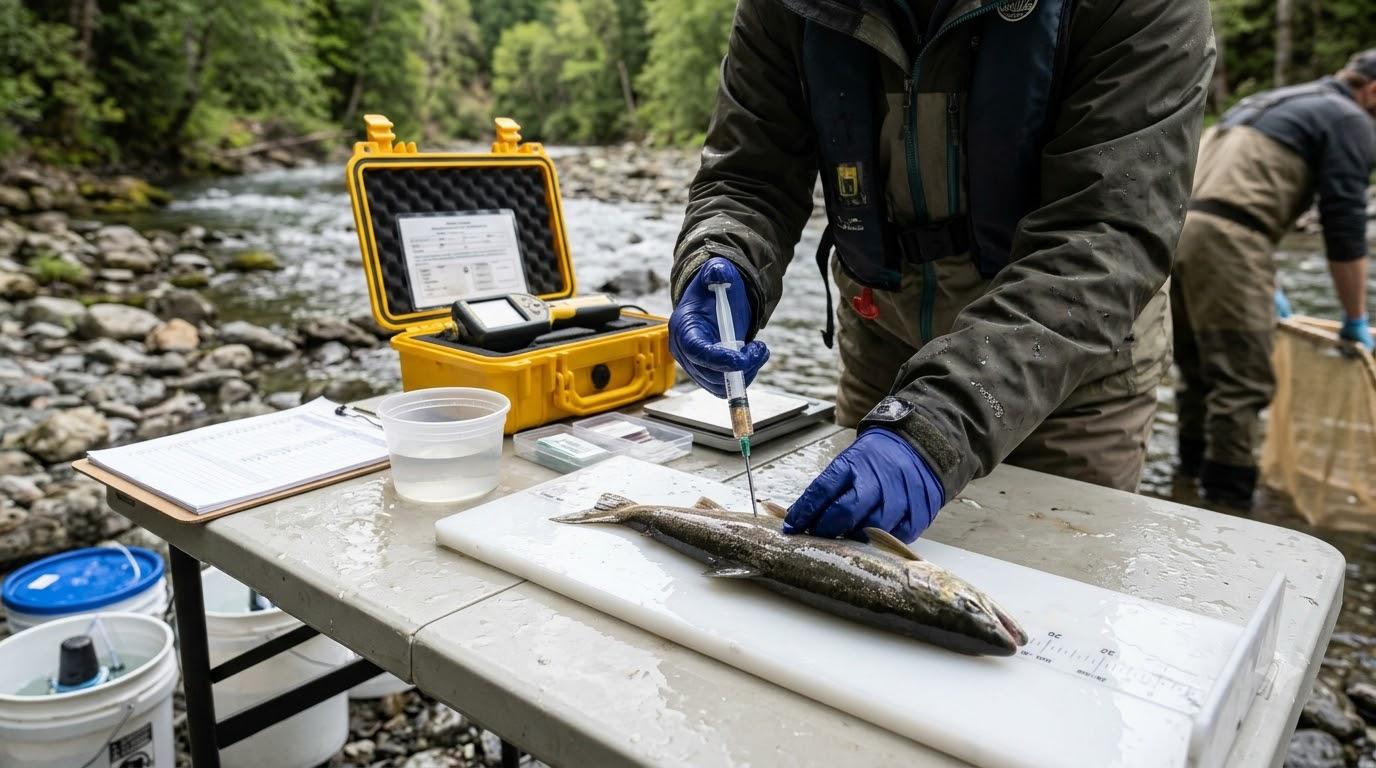
A fish tagging project can become difficult to manage when several people handle animals, operate equipment, and record observations in different ways. Even when the selected identification technology is appropriate, inconsistent preparation and documentation can lead to avoidable errors. A well-organised fish tagging workflow for research teams should therefore define responsibilities, equipment checks, approved handling procedures, identification records, and data review before the first fish is processed.
Tagging is used in fisheries research, conservation, hatchery operations, and other settings where identifying individual fish can help researchers connect observations over time. Passive Integrated Transponder (PIT) technology is one available approach. A PIT tag carries an electronic identification code that a compatible reader can detect when the tag is within its effective range.
The technology itself is only one part of the project. The team must also decide which fish are suitable for the study, how the approved tagging procedure will be carried out, how identification codes will be recorded, and how unexpected events will be handled.
This guide focuses on the operational side of organising a project: how to prepare people, equipment, and records so that the process is consistent and responsibly managed.
Why a written workflow matters
A small team may initially feel that formal procedures are unnecessary. Everyone knows the project, the equipment is familiar, and there may be only a few fish to process.
That approach can become unreliable when the project expands or when different staff members take part.
One person may record a sampling location using its full name, while another uses an abbreviation. A second researcher may save a tag code in a spreadsheet, while a colleague writes it on paper for later entry. A third person may use a different method to document an unsuccessful reading.
These differences can create problems when records are combined.
A written workflow gives the team a common reference. It also makes it easier to train new staff, identify where a mistake occurred, and explain how data were collected.
A useful procedure should answer five questions:
-
Who is authorised to handle and tag the fish?
-
Which equipment and tag combinations are approved?
-
What checks must be completed before work begins?
-
How will identification codes and observations be recorded?
-
What should happen when a reading, procedure, or record is incomplete?
The document does not need to be complicated. It needs to be clear enough that every team member can follow it.
Assign responsibilities before the first sampling session
A common organisational mistake is allowing everyone to perform every task without defining who is responsible for the final record.
A better approach is to assign clear responsibilities. The exact arrangement will depend on the project size and institutional requirements.
|
Role |
Main responsibility |
Important boundary |
|
Project lead |
Approves the study workflow and oversees records |
Should ensure procedures match project approvals |
|
Trained tagging personnel |
Carry out authorised procedures |
Must follow approved training and protocols |
|
Reader operator |
Checks equipment and captures identification codes |
Must use a compatible reader and documented settings |
|
Data recorder |
Links codes with sampling information and measurements |
Must not guess missing information |
|
Quality reviewer |
Checks records and investigates exceptions |
Should document corrections and unresolved issues |
In a small project, one person may hold more than one role. However, the responsibilities should still be clear.
Where possible, important data corrections should be reviewed by someone other than the person who originally entered the record. This creates a useful additional check.
Prepare the equipment as a complete system
A tagging project may involve several connected items:
-
Identification tags.
-
Appropriate application equipment.
-
Needles or other approved components.
-
RFID readers.
-
Power supplies and charging equipment.
-
Data collection devices.
-
Recording software or forms.
-
Cleaning and handling supplies required by the approved protocol.
The team should not treat these items as interchangeable. A tag must be compatible with the reader, and application equipment must match the tag model and its instructions.
Check tag specifications
Voda IQ's published range includes several PIT tag formats, such as 8 mm, 9 mm, 10 mm, and 12 mm options, alongside larger formats. Product descriptions also identify different communication formats and housing materials.
The team should record the exact product model rather than writing only “PIT tag” on an equipment checklist. This makes it easier to verify compatibility and order the correct replacement supplies.
Check reader compatibility
Confirm the reader's supported frequencies and communication protocols. A reader that supports one format may not support every other tag format.
If multiple tag types are being used, create a compatibility record for each combination. This avoids relying on memory when equipment is shared between teams.
Check the application components
The needle and applicator must be suitable for the selected tag. Use the manufacturer's current instructions to confirm dimensions, connections, and recommended components.
These checks should be completed before the approved animal-handling procedure begins. They are not a substitute for training or veterinary and institutional guidance.
Make animal welfare part of the project plan
Animal welfare should not be treated as a final checklist item. It should influence the study design, choice of tag, staff preparation, and decision to proceed.
The research team must follow applicable regulations, institutional animal-care approval, and species-specific professional guidance. Only trained and authorised personnel should carry out tagging.
Before the project begins, establish:
-
Which animals are eligible for inclusion.
-
Which individuals should be excluded or assessed further.
-
What handling and monitoring procedures are approved.
-
Who is responsible for recognising and responding to complications.
-
How unexpected events will be documented.
-
What conditions require the procedure to stop or be reviewed.
Do not assume that a tag suitable for one fish species or size group is automatically appropriate for another.
The smallest fish in a study may require particular attention when evaluating tag dimensions and application suitability. The final decision should be made through the approved protocol, not by an informal size comparison alone.
Create a repeatable preparation routine
The start of a sampling session is an important opportunity to catch problems before they affect the records.
A preparation routine can be divided into four stages.
Stage 1: Confirm the day's plan
Check the sampling location, expected number of fish, staff responsibilities, and the relevant approval or protocol. Make sure the team is using the correct version of its procedure.
Stage 2: Verify the equipment
Confirm that the selected tags, reader, and application equipment match the project's approved specifications. Check battery levels, connections, settings, and any required accessories.
Stage 3: Prepare the record system
Open the correct project or sampling session. Confirm that the date, site identifiers, and required data fields are correct.
If paper forms are used, make sure the correct forms are available and that completed records can be securely transferred into the main database.
Stage 4: Brief the team
Review the division of responsibilities, the procedure for unusual readings, and the process for reporting an incident or incomplete record.
A short briefing can prevent confusion when several people are working together.
Standardise how identification records are created
A good record should be understandable after the sampling session has ended. It should not depend on the person who collected the data remembering what a particular code or abbreviation meant.
At minimum, the record should connect the electronic tag code with the relevant individual fish and the sampling event.
Useful fields may include:
-
Original tag code.
-
Internal study ID.
-
Species or group.
-
Sampling date.
-
Sampling location.
-
Relevant measurements.
-
Equipment used.
-
Staff member responsible for the observation.
-
Notes about unusual circumstances.
Avoid changing the original tag code to make it look shorter or easier to read. If an internal reference is needed, create a separate study ID.
Decide how to handle incomplete records
The team should agree on what happens if a reading is missed, a measurement is not collected, or a record cannot be matched confidently.
Use a clear status such as “not recorded” or “requires review” rather than entering an estimated value.
This matters because missing information and measured zero values are not the same thing. Mixing them can create misleading results during later analysis.
A step-by-step operational planning process
The following process helps a project move from preparation to routine monitoring. It is a management framework, not an instruction for performing an invasive procedure.
-
Define the study objective. State what individual identification will help the project measure or understand.
-
Confirm the approved protocol. Check animal-care approval, regulatory requirements, and the authorised procedure.
-
Select the identification equipment. Match tag specifications, application equipment, and reader compatibility to the project.
-
Assign trained personnel. Identify who is authorised to perform each task.
-
Prepare the data structure. Establish required fields, unique study IDs, and site naming conventions.
-
Test the complete workflow. Confirm that equipment readings can be captured and associated with the correct records.
-
Run a controlled pilot. Use the approved process to identify practical issues before expanding the project.
-
Review and document changes. Record any revisions to equipment, procedures, or data handling.
The project should not move to full-scale implementation simply because the reader successfully detects one test tag. The entire process needs to be reviewed.
Common workflow problems and how to address them
Problem 1: Staff use different record formats
Why it happens: The project has not defined required fields or standard names.
Better approach: Use a shared form or digital template. Keep field names and site identifiers consistent.
Problem 2: Equipment is checked only after work begins
Why it happens: The team assumes that equipment used successfully during the previous session will always be ready.
Better approach: Introduce a pre-session check and document any equipment changes or faults.
Problem 3: Unusual readings are ignored
Why it happens: Staff may be unsure whether an unexpected result is important.
Better approach: Define an exception-reporting process. Record the original observation and refer it for review rather than silently changing it.
Problem 4: Corrections overwrite original records
Why it happens: The database or spreadsheet does not preserve a clear history of changes.
Better approach: Use an audit trail or correction log that identifies what changed, when, and why.
Problem 5: Training is informal
Why it happens: Experienced staff assume that new team members will learn by watching.
Better approach: Provide documented training, supervised practice, and a clear authorisation process.
Example 1: A hatchery with rotating staff
A hatchery operates a monitoring programme throughout the year. Staff members work in shifts, so the person who records an observation may not be the person who reviews the data later.
The hatchery creates a shared workflow with a standard identification record, equipment checklist, and exception-reporting process. It also assigns one person to review incomplete or duplicate records at the end of each sampling session.
This reduces reliance on informal communication and makes it easier for different staff members to follow the same process.
Example 2: A research project working across field locations
A research group collects fish data at several locations. Each site has different practical conditions, but the project needs a consistent record format.
The team keeps the core identification and measurement fields the same while allowing a separate location field for site-specific information. It also records which reader was used and how unusual readings were handled.
This approach allows the project to retain a common dataset without pretending that every field location is identical.
Illustrative Case Study: Preventing errors during a change of research staff
Situation: A hypothetical monitoring programme has been running for several months. An experienced technician is leaving, and two new team members will take over routine data collection.
Problem: Much of the existing workflow has been passed on verbally. The project manager is concerned that equipment checks, record naming, and exception handling may change when the new staff begin.
Actions: The manager documents the approved procedure, prepares a role checklist, and arranges supervised training. The new team members practise using the reader and recording system with test data. They also review examples of duplicate records and missed readings.
Expected outcome: The transition should be more consistent because the new staff have a shared procedure and know when to escalate an issue. The project still needs ongoing review, but it is less dependent on one individual's memory.
Transferable lesson: Documented processes protect continuity when people, locations, or project responsibilities change.
Digital tools can support consistent field records
When several people collect information, digital tools may help standardise data entry and reduce repeated manual transcription.
Voda IQ describes VodaTrak as Android-based data-management software for fisheries and wildlife research. Its published information describes customisable fields, data export, and integration with selected Voda IQ readers and measuring equipment.
A team considering this type of platform should verify the supported hardware, operating requirements, export options, and suitability for its own data-management rules.
The software should support the project's approved process, not dictate an unsuitable procedure. Researchers should also establish access permissions, backup arrangements, and a way to review corrections.
For information about available identification equipment, readers, and related products, teams can explore fish tagging products and PIT tag options from Voda IQ.
Conclusion: Consistency comes from preparation
A successful tagging programme depends on trained people, appropriate equipment, approved animal-care procedures, and reliable records. When those elements are planned separately, small inconsistencies can develop into larger problems.
Create a written workflow, assign responsibilities, check equipment before each session, and standardise how identification records are handled. Include a clear process for incomplete readings and corrections, and review the procedure whenever staff or equipment changes.
The aim is not to make every research project identical. It is to make each project consistent with its own objectives, approvals, and operating conditions.
Frequently Asked Questions
1. Why does a fish tagging project need a written procedure?
A written procedure helps staff follow the same approved process, record information consistently, and understand how to handle unusual situations. It is especially useful when teams or responsibilities change.
2. Who should perform fish tagging?
Tagging should be carried out only by trained and authorised personnel following the approved animal-care protocol and applicable regulations. The required qualifications and supervision depend on the project and jurisdiction.
3. What equipment should be checked before a tagging session?
The team should check the selected tags, compatible reader, application equipment, power supplies, data collection devices, and any other items required by the approved procedure.
4. What information should be recorded for an identified fish?
Records commonly connect the original tag code with an internal study ID, species, sampling date, location, measurements, and relevant notes. The exact fields should match the study's objectives.
5. How should a team handle a missed tag reading?
Record the missed reading as an incomplete observation and investigate possible causes under the project's procedure. Do not automatically interpret it as proof that the fish is absent or the tag has failed.
6. How often should a tagging workflow be reviewed?
Review it when equipment, staff, study objectives, or approvals change. It is also sensible to conduct periodic checks during a long-running project to identify recurring errors.

 English
 Arabic
 Spanish
 Portuguese
 Deutsch
 Turkish
 Dutch
 Italiano
 Russian
 Romaian
 Portuguese (Brazil)
 Greek
