

Why a Regenerative Desiccant Air Dryer Keeps Outdoor Air Lines From Freezing
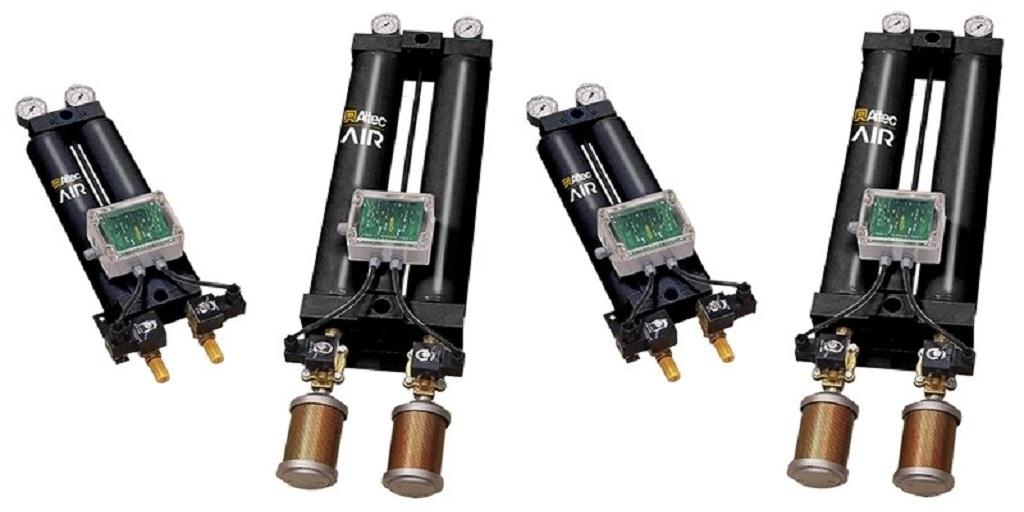
Outdoor compressed air lines freeze for one reason: the air inside them carries more water vapor than the pipe temperature allows. A regenerative desiccant air dryer removes that vapor before it reaches exposed piping, loading docks, and unheated buildings. Plant managers who wait for the first frozen drip leg end up with stalled actuators, burst fittings, and crews thawing lines with heat guns. Late October gives them enough lead time to fix the problem before temperatures drop.
Install a Regenerative Desiccant Air Dryer Before Winter
Refrigerated dryers can’t protect pipes that run below freezing. They chill compressed air to drop out moisture, but they only reach a pressure dew point of about 35°F to 38°F, so any line colder than that condenses water and builds ice. Running those lines off a regenerative desiccant air dryer drops their dew point to -40°F or lower, which keeps vapor in the air stream through a hard freeze. Drip legs and instrument lines stop icing because no liquid forms inside them. Map every line that leaves a heated building and put those branches on the desiccant system first.
Spec a Regenerative Desiccant Air Dryer by Class
The air quality standards in ISO 8573-1 give you a clear way to write dew point control into a purchase order. The standard ranks water vapor by maximum pressure dew point, with Class 4 at 37°F, Class 2 at -40°F, and Class 1 at -94°F. Twin towers let a regenerative desiccant air dryer reach Class 2 or better, since one tower of activated alumina or molecular sieve adsorbs moisture while the other regenerates. A refrigerated dryer condenses water instead of working as an adsorbent air dryer, so it lands near Class 4, above freezing. List Class 2 as the minimum on every quote request for outdoor service.
Pick Heatless or Heated by Outdoor Flow
Desiccant air dryer operation differs most in how each unit regenerates its saturated tower, and that choice drives your operating cost. A heatless desiccant dryer bleeds dried compressed air back through the wet tower and uses about 15% to 18% of its rated flow as purge. An externally heated desiccant dryer adds a heater and drops purge to roughly 7% to 8%. Blower purge models cut it to 2% to 3% by pulling in ambient air. Heatless units fit small outdoor branches where purge loss stays minor. Add up the SCFM your outdoor lines draw before choosing a regeneration type.
Check Each Supplier’s Range and Dew Point Ratings
A supplier with a narrow catalog tends to fit the dryer it stocks instead of the dryer your site needs. A useful range runs from small heatless units to large heated models and includes replacement desiccant and parts. Air & Vacuum Process, a Texas supplier of industrial air dryers since 1997, offers one example: its Aircel and Van Air regenerative lines reach -40°F to -100°F dew points, and the Van Air D-Series runs from 7 SCFM up to 10,000 SCFM+. Ask every supplier for the rated dew point at your actual inlet temperature and pressure.
Install Drains and Alarms Along Outdoor Runs
Outdoor piping needs backup protection for the day a desiccant bed saturates or a valve sticks open. Slope horizontal runs about 1 inch per 10 feet toward drip legs, and fit each drip leg with an automatic drain valve such as the Van Air MDV-400i. An Altec high-humidity alarm flags wet air before it reaches instruments. A COSA Xentaur dew point meter confirms the dryer still holds its rating. Put the alarm and a dew point reading in place before the first hard freeze.
Compare Regenerative Desiccant Air Dryer Operating Costs
Purchase price says little about what a dryer costs over a decade. A heatless unit on a fixed cycle purges against its rated flow, so at half load it can consume 30% to 40% of the air actually passing through it. One manufacturer’s 10-year comparison puts heated blower purge dryers about 40% ahead of heatless models on total cost of ownership. Plants that dry only their outdoor branches to -40°F cut that bill further. Request a 10-year ownership estimate on both designs before you approve a quote.
Refrigerated dryers stop at about 35°F, which leaves outdoor air lines open to ice every winter. A regenerative desiccant air dryer that meets ISO 8573-1 Class 2 keeps those lines dry until spring, and drains and dew point checks catch anything it misses.
For more information About Breathing Air System and Natural Gas Dehydration Unit please visit: Air & Vacuum Process Inc.

 English
 Arabic
 French
 Spanish
 Deutsch
 Turkish
 Dutch
 Italiano
 Russian
 Romaian
 Portuguese (Brazil)
 Greek
