

How do Modular Cardiac OT Manufacturers ensure timely project delivery?
Introduction
Altus Airflow understands that timely project execution is essential when developing advanced cardiac operation theatres for modern hospitals. Modular Cardiac OT Manufacturers play an important role in ensuring that every stage, from initial planning and designing to installation and final validation, is completed within the scheduled timeframe. A well-organised project approach helps hospitals minimise construction delays, coordinate multiple activities, and prepare their surgical facilities for safe and efficient operations.
Delivering a cardiac modular operation theatre on time requires technical expertise, proper resource management, quality materials, and coordination between different project teams. With structured planning and continuous monitoring, hospitals can achieve functional, compliant, and technologically advanced surgical environments without unnecessary delays.
1. Detailed Project Planning and Scheduling
Proper project planning is the foundation of timely delivery. Before beginning construction or installation, manufacturers evaluate the hospital's requirements, available space, infrastructure, and expected operational needs.
A detailed project schedule divides the entire process into manageable stages, including:
-
Initial site assessment and feasibility study.
-
Architectural and engineering design.
-
Material selection and procurement.
-
Manufacturing of modular wall and ceiling panels.
-
HVAC and electrical system planning.
-
Equipment installation and integration.
-
Testing, validation, and final handover.
Each stage receives a specific timeline and completion target. Project managers monitor these milestones to identify potential delays before they affect the overall delivery schedule.
A structured project plan also helps hospitals understand the expected completion date and prepare their internal teams accordingly.
2. Accurate Site Assessment Before Installation
An accurate site assessment prevents unexpected complications during project execution. Before starting installation, manufacturers inspect the existing hospital infrastructure and identify any technical limitations.
Important assessment areas include:
-
Available floor space and room dimensions.
-
Existing electrical distribution systems.
-
HVAC infrastructure and ventilation requirements.
-
Ceiling height and structural conditions.
-
Plumbing and medical gas connections.
-
Equipment movement and accessibility.
-
Entry points for transporting modular components.
Identifying these requirements early reduces the possibility of design changes during installation.
For renovation projects, site assessment becomes particularly important because existing structures may require modifications. Manufacturers can plan these changes in advance and coordinate the necessary activities without disrupting the project schedule.
3. Standardised Modular Manufacturing Processes
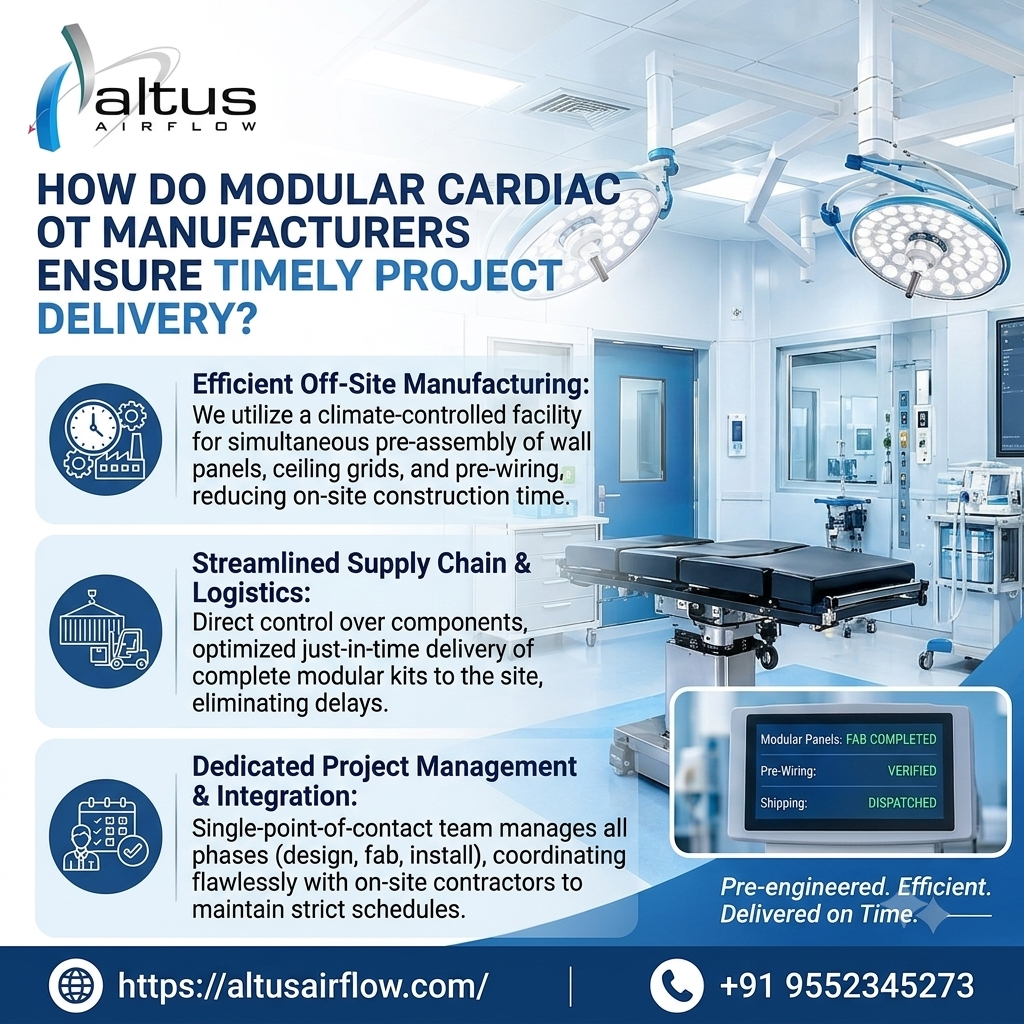
Off-site manufacturing is one of the most effective ways to improve project timelines. Instead of completing every construction activity at the hospital, manufacturers prepare several modular components in a controlled production facility.
These components may include:
-
Modular wall panels.
-
Ceiling panels and structural supports.
-
Hermetically sealed doors.
-
Viewing windows.
-
Medical equipment panels.
-
Service panels and integrated accessories.
Standardised manufacturing processes help maintain consistent product dimensions and quality. Components can be produced while other teams prepare the hospital site.
This parallel working approach reduces the time required for on-site construction and installation.
Experienced Modular Cardiac OT Manufacturers also use production schedules to coordinate component availability with installation requirements. This helps prevent delays caused by incomplete materials or incorrect component specifications.
4. Efficient Material Procurement and Inventory Management
Material shortages can significantly affect project completion. Delayed deliveries of specialised equipment, modular panels, HVAC components, and electrical accessories may interrupt installation activities.
To avoid these problems, manufacturers establish procurement plans based on the approved project design.
Effective procurement management involves:
-
Identifying critical materials at the beginning.
-
Selecting reliable and qualified suppliers.
-
Maintaining appropriate inventory levels.
-
Monitoring supplier delivery schedules.
-
Checking material specifications before dispatch.
-
Arranging alternative suppliers for critical components where appropriate.
Long-lead items should be identified early because they may require additional manufacturing or transportation time.
Proper inventory management also ensures that materials are available when installation teams need them. This reduces unnecessary waiting periods and improves coordination between procurement and construction activities.
5. Coordination Between Multiple Project Teams
A cardiac operation theatre involves several technical systems that must work together. These include modular infrastructure, HVAC, electrical installations, medical gas systems, surgical lighting, and monitoring equipment.
Poor coordination between teams can result in repeated work, installation conflicts, and unnecessary delays.
To improve project efficiency, manufacturers establish clear communication between:
-
Architects and design consultants.
-
Civil and structural engineering teams.
-
HVAC specialists.
-
Electrical engineers.
-
Medical gas installation teams.
-
Equipment suppliers.
-
Site supervisors and installation technicians.
-
Hospital representatives.
Regular project meetings help track progress and resolve technical issues quickly.
A clearly defined responsibility structure also ensures that every team understands its tasks, deadlines, and dependencies. This makes the entire execution process more organised.
6. Advanced HVAC and Airflow Planning
Ventilation is an essential part of cardiac operation theatre development. The HVAC system must be designed according to the room's clinical requirements, applicable standards, and approved engineering specifications.
Late changes to airflow layouts can affect ceiling installation, duct routing, electrical coordination, and equipment positioning. Therefore, HVAC planning should be completed during the initial design stage.
Important considerations include:
-
Air handling unit capacity.
-
HEPA filtration requirements.
-
Airflow distribution.
-
Temperature and humidity control.
-
Pressure differentials.
-
Air changes per hour.
-
Duct routing and accessibility.
-
Monitoring and control systems.
Manufacturers coordinate HVAC installation with modular ceiling and wall systems to avoid clashes between different services.
Early planning helps minimise modifications and ensures that the ventilation infrastructure is ready for testing within the planned project timeline.
7. Skilled Installation Teams and Site Supervision
Even well-designed modular components require experienced professionals for proper installation. Skilled installation teams understand the technical requirements of modular operation theatre construction and can complete activities more efficiently.
Site supervisors monitor daily work and ensure that installation follows approved drawings and specifications.
Their responsibilities include:
-
Assigning tasks to installation teams.
-
Monitoring daily productivity.
-
Checking material availability.
-
Inspecting installation quality.
-
Coordinating technical teams.
-
Resolving site-related challenges.
-
Reporting project progress.
Regular supervision helps identify mistakes at an early stage. Correcting installation issues immediately prevents expensive rework and delays during the final stages.
Experienced teams also understand the importance of maintaining cleanliness and protecting installed components throughout the project.
8. Integration of Medical Equipment and Technology
Modern cardiac operation theatres require several specialised medical devices and technological systems. Equipment integration must be planned carefully to avoid compatibility problems and installation delays.
Common equipment and systems include:
-
Surgical lights.
-
Medical pendants.
-
Anaesthesia workstations.
-
Patient monitoring systems.
-
Integrated operating room displays.
-
Electrical control panels.
-
Medical gas outlets.
-
Communication and data connections.
Manufacturers coordinate with equipment suppliers and hospital technical teams to confirm installation requirements before the infrastructure is completed.
Equipment dimensions, mounting arrangements, electrical loads, and service connections should be finalised during the design stage.
This reduces the risk of drilling additional openings, modifying modular panels, or changing electrical arrangements after installation.
9. Quality Control at Every Project Stage
Quality control is essential for avoiding defects that could delay final handover. Instead of inspecting the project only after installation, manufacturers should conduct checks throughout the execution process.
Quality inspections may cover:
Manufacturing stage: Checking panel dimensions, surface finishes, material specifications, and component quality.
Installation stage: Verifying panel alignment, joint sealing, door installation, and ceiling arrangements.
Electrical stage: Inspecting wiring, earthing, power distribution, and safety provisions.
HVAC stage: Checking filtration arrangements, airflow performance, pressure differentials, and environmental controls.
Equipment stage: Verifying equipment mounting, electrical connections, and functional integration.
Early identification of defects reduces the possibility of major corrections during commissioning.
Quality documentation also helps project teams track inspection results and confirm that installation activities meet approved specifications.
10. Testing, Validation, and Commissioning
Completing physical installation does not mean that a cardiac operation theatre is ready for clinical use. All essential systems must undergo appropriate testing and commissioning.
Depending on the project specifications, these activities may include:
-
HEPA filter integrity testing.
-
Airflow velocity measurements.
-
Air changes per hour verification.
-
Room pressure differential testing.
-
Temperature and humidity verification.
-
Electrical safety testing.
-
Door interlock and sealing checks.
-
Medical gas system testing.
-
Functional checks of integrated equipment.
Testing requirements should be identified during the planning stage rather than postponed until the end of the project.
If any system fails to meet its specified performance criteria, the responsible team must investigate and complete corrective work.
Modular Cardiac OT Manufacturers that incorporate testing and validation into their project schedules can reduce last-minute complications and support a smoother handover process.
11. Project Monitoring and Risk Management
Unexpected challenges can arise during hospital construction and renovation. These may include delayed material deliveries, infrastructure problems, equipment compatibility issues, or changes in hospital requirements.
Effective risk management helps project teams respond without allowing minor issues to become major delays.
Common project management practices include:
-
Maintaining a detailed project progress report.
-
Tracking milestone completion.
-
Identifying critical-path activities.
-
Reviewing supplier commitments.
-
Maintaining contingency plans.
-
Documenting design modifications.
-
Conducting regular coordination meetings.
Project managers should also maintain a clear communication channel with hospital management.
When a potential delay is identified, the team can evaluate alternative arrangements, adjust work sequences, or allocate additional resources where practical.
This proactive approach improves project predictability and supports timely execution.
12. Transparent Communication and Final Handover
Clear communication between the manufacturer and hospital management is important throughout the project.
Hospitals should receive regular updates regarding completed activities, pending work, procurement status, and upcoming installation requirements.
Before handover, manufacturers should ensure that all agreed project deliverables are completed.
The final handover process generally includes:
-
Completion of installation activities.
-
Testing and commissioning reports.
-
Equipment integration verification.
-
Quality inspection documentation.
-
Operation and maintenance manuals.
-
Warranty information.
-
Staff orientation and system demonstrations, where included in the scope.
Proper documentation helps hospital engineering teams understand the installed systems and maintain them effectively.
A transparent handover process also reduces confusion and allows hospitals to plan their operational readiness.
Conclusion
Timely cardiac operation theatre development depends on detailed planning, efficient manufacturing, reliable procurement, skilled installation, and systematic quality control. Every project stage must be coordinated to prevent avoidable delays and ensure that all technical requirements are addressed before final handover.
Choosing experienced Modular Cardiac OT Manufacturers helps hospitals benefit from organised project execution, effective resource management, and carefully coordinated system integration. Altus Airflow focuses on structured project planning and technical coordination to support the development of modern modular operation theatres. With the right execution strategy, Altus Airflow helps hospitals work towards completing their cardiac OT projects efficiently while maintaining quality, safety, and performance expectations.
Frequently Asked Questions (FAQs)
1. How do Modular Cardiac OT Manufacturers ensure timely project delivery?
Modular Cardiac OT Manufacturers ensure timely project delivery through detailed planning, standardised manufacturing, early material procurement, skilled installation teams, and regular progress monitoring.
2. How does site assessment help prevent project delays?
Site assessment identifies infrastructure limitations, electrical requirements, HVAC conditions, and space-related challenges before installation begins.
3. Why is off-site modular manufacturing beneficial?
Off-site manufacturing allows modular components to be prepared while hospital site preparation takes place, reducing on-site construction time.
4. What causes delays in cardiac OT projects?
Common causes include material shortages, design modifications, poor coordination, equipment compatibility issues, and unexpected infrastructure problems.
5. How does HVAC planning affect project completion?
Early HVAC planning prevents installation conflicts, reduces design changes, and ensures that ventilation systems are ready for scheduled testing.
Read Our Previous Blog ---------------> What monitoring systems are included in a Cardiac Modular Operation Theatre?

 English
 Arabic
 French
 Spanish
 Portuguese
 Deutsch
 Turkish
 Dutch
 Italiano
 Russian
 Portuguese (Brazil)
 Greek
