

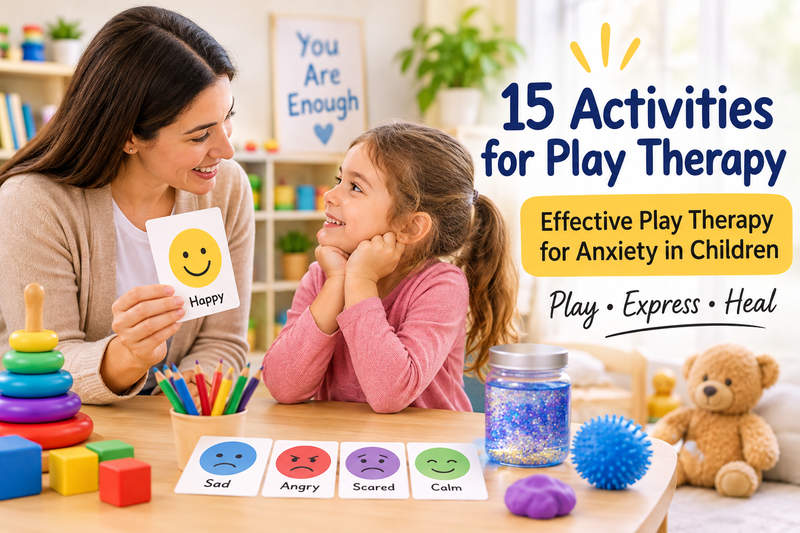
15 Activities for Play Therapy: Effective Play Therapy for Anxiety in Children
Children do not always have the words to explain what they are feeling. A child experiencing anxiety may become unusually quiet, avoid certain situations, struggle with separation, or express worries through behavior rather than conversation. For many children, play offers a more comfortable way to communicate these experiences.
Play therapy provides a supportive environment where children can explore emotions, express difficult experiences, and develop healthier ways of coping. Through toys, storytelling, drawing, movement, and creative expression, children can communicate feelings that may be difficult to put into words.
For therapists, understanding different activities for play therapy can help create meaningful opportunities for emotional expression and connection. These activities can also support children experiencing anxiety by encouraging confidence, emotional awareness, and relaxation.
In this guide, we explore 15 practical activities that therapists can adapt to children's developmental needs and emotional experiences.
What Is Play Therapy and How Does It Help Children With Anxiety?
Play therapy is a therapeutic approach that uses play as a primary way for children to express themselves and explore emotional challenges. Instead of relying entirely on direct conversations, therapists use developmentally appropriate play materials and activities to help children communicate.
Children experiencing anxiety may have difficulty explaining their fears or identifying what makes them uncomfortable. Through play therapy for anxiety, therapists can provide opportunities for children to explore worries in a safe, supportive, and nonjudgmental environment.
Play therapy may help children:
-
Recognize and communicate their emotions.
-
Develop healthy coping strategies.
-
Build confidence and self-esteem.
-
Practice problem-solving skills.
-
Express fears in developmentally appropriate ways.
-
Improve emotional regulation.
The activities below are examples that trained therapists can adapt according to each child's needs, age, and treatment goals.
15 Activities for Play Therapy to Help Children Manage Anxiety
1. Feelings Identification Cards
Feelings cards help children recognize and name different emotions, including fear, sadness, anger, excitement, and happiness.
How to do it:
-
Introduce cards showing different facial expressions.
-
Ask the child to choose a card that represents how they feel.
-
Invite them to explain what might make someone feel that way.
-
Encourage them to identify situations that trigger particular emotions.
Therapeutic benefit: Supports emotional awareness and helps children develop a vocabulary for communicating feelings.
2. Worry Monster Craft
A worry monster gives children a creative way to express their fears. They can imagine the monster collecting worries that feel too difficult to discuss.
How to do it:
-
Provide paper, cardboard, craft materials, and markers.
-
Ask the child to create a friendly or funny worry monster.
-
Invite them to write or draw worries on small pieces of paper.
-
Discuss the worries together and explore possible coping strategies.
Therapeutic benefit: Encourages emotional expression and makes conversations about anxiety more approachable.
3. Calm-Down Glitter Jar
A glitter jar is a simple sensory activity that can introduce children to mindfulness and calming techniques.
How to do it:
-
Fill a clear, securely sealed jar with water and glitter.
-
Shake it gently and ask the child to watch the glitter move.
-
Encourage slow breathing while the glitter settles.
-
Discuss how emotions can feel intense before gradually becoming calmer.
Therapeutic benefit: Helps children practice mindful attention, patience, and relaxation.
4. Drawing My Safe Place
Drawing a safe place allows children to imagine an environment where they feel comfortable, protected, and relaxed.
How to do it:
-
Give the child paper, crayons, or colored pencils.
-
Ask them to draw a place where they feel safe.
-
Invite them to describe the people, objects, or surroundings in the picture.
-
Discuss how they might remember this comforting place during stressful moments.
Therapeutic benefit: Encourages emotional security, self-expression, and the development of calming imagery.
5. Storytelling With Puppets
Puppet storytelling gives children an opportunity to explore difficult situations through imaginary characters.
How to do it:
-
Provide different puppets representing characters.
-
Invite the child to create a short story.
-
Introduce situations involving nervousness, friendship, separation, or change.
-
Explore how the characters might respond to challenging emotions.
Therapeutic benefit: Supports communication, emotional exploration, and problem-solving.
6. Emotion Color Wheel
Some children find it easier to express emotions through colors than words. An emotion color wheel makes this process creative and accessible.
How to do it:
-
Draw a large circle divided into sections.
-
Assign different colors to emotions.
-
Ask the child to choose colors that match their feelings.
-
Discuss why they selected those colors.
Therapeutic benefit: Encourages emotional identification and self-awareness.
7. Sensory Play With Kinetic Sand
Sensory play provides opportunities for children to explore textures, shapes, and movement in a relaxed environment.
How to do it:
-
Provide kinetic sand and child-safe shaping tools.
-
Allow the child to build shapes, patterns, or imaginary environments.
-
Observe how they interact with the materials.
-
Invite conversation without forcing the child to explain their actions.
Therapeutic benefit: Offers sensory exploration and opportunities for relaxed engagement.
8. Anxiety Thermometer
An anxiety thermometer helps children understand that anxiety can have different levels of intensity.
How to do it:
-
Draw a thermometer with levels from 1 to 5.
-
Explain that each number represents a different level of worry.
-
Ask the child to identify situations that match each level.
-
Discuss which coping strategies might help at different levels.
Therapeutic benefit: Helps children recognize emotional intensity and communicate when they need support.
9. Build a Worry-Free World With Blocks
Building blocks encourage creativity while allowing children to create environments that represent safety, control, and confidence.
How to do it:
-
Provide building blocks or construction toys.
-
Invite the child to create an ideal world or safe environment.
-
Ask what makes the environment comfortable.
-
Explore how the child might handle challenges in their imaginary world.
Therapeutic benefit: Encourages creativity, problem-solving, and a sense of personal control.
10. Breathing With Bubbles
Bubble blowing can introduce children to slow, controlled breathing through a playful experience.
How to do it:
-
Provide a child-safe bubble solution and wand.
-
Ask the child to take a gentle breath.
-
Encourage them to blow slowly to create larger bubbles.
-
Repeat while keeping the activity relaxed and enjoyable.
Therapeutic benefit: Introduces controlled breathing and mindful attention.
11. My Strengths Treasure Box
Children experiencing anxiety may sometimes focus more on their fears than their abilities. A strengths treasure box helps them recognize positive qualities.
How to do it:
-
Give the child a small box and decorating materials.
-
Invite them to write or draw personal strengths.
-
Add examples of accomplishments, helpful actions, or positive experiences.
-
Revisit the box when the child needs encouragement.
Therapeutic benefit: Supports self-confidence and positive self-perception.
12. Role-Playing Brave Moments
Role-playing gives children opportunities to practice responding to situations that make them nervous.
How to do it:
-
Choose a familiar situation, such as meeting someone new or entering a classroom.
-
Use dolls, toy figures, or imaginative characters.
-
Let the child act out different responses.
-
Practice helpful communication and coping strategies.
Therapeutic benefit: Encourages confidence, social skills, and problem-solving.
13. Music and Movement Expression
Movement and music can give children another way to express feelings when verbal communication feels difficult.
How to do it:
-
Play age-appropriate music.
-
Provide scarves or other safe movement materials.
-
Invite children to move in ways that represent different emotions.
-
Ask how different types of music or movement make them feel.
Therapeutic benefit: Encourages emotional expression, body awareness, and creative engagement.
14. The Worry-to-Solution Game
This activity helps children explore worries while identifying practical ways to respond to everyday challenges.
How to do it:
-
Create simple cards describing common childhood worries.
-
Let the child select a card.
-
Discuss what the character might be thinking or feeling.
-
Brainstorm supportive and realistic solutions together.
Therapeutic benefit: Develops problem-solving skills and encourages flexible thinking.
15. Gratitude and Positive Memory Journal
A positive memory journal encourages children to recognize meaningful and comforting experiences.
How to do it:
-
Provide a notebook, stickers, and colored pencils.
-
Invite the child to draw or write about something positive.
-
Encourage them to record enjoyable activities, supportive relationships, or personal accomplishments.
-
Revisit previous entries during later sessions.
Therapeutic benefit: Encourages reflection, emotional awareness, and recognition of positive experiences.
How Therapists Can Choose the Right Play Therapy Activities
Not every activity works for every child. A therapist should consider the child's age, developmental stage, communication style, interests, and individual experiences before selecting an intervention.
Here are a few important considerations:
-
Understand the child's needs: Identify whether the child needs support with emotional expression, anxiety management, confidence, or social interaction.
-
Consider developmental abilities: Select activities that match the child's cognitive, emotional, and physical development.
-
Create a supportive environment: Children should feel comfortable participating without pressure or judgment.
-
Follow the child's pace: Allow children to engage with activities at a speed that feels appropriate.
-
Observe and adapt: Pay attention to the child's responses and modify activities when necessary.
-
Maintain professional boundaries: Use clinical judgment and appropriate therapeutic methods when addressing complex emotional concerns.
Why Professional Training Matters in Play Therapy
Effective play therapy involves more than providing toys and creative materials. Therapists need an understanding of child development, therapeutic relationships, emotional regulation, and appropriate clinical interventions.
Professional development and specialized Play Therapy Training can help mental health professionals strengthen their knowledge and improve their ability to support children.
Continuing education also gives social workers, counselors, and therapists opportunities to explore new approaches, expand their clinical skills, and stay informed about developments in mental health practice.
Professionals interested in improving their knowledge can explore relevant training opportunities and continuing education for mental health professionals through Core Wellness.
Frequently Asked Questions About Play Therapy
1. What are the best activities for play therapy?
Some useful activities include feelings identification cards, puppet storytelling, sensory play, drawing a safe place, worry monsters, and storytelling games. The right activity depends on the child's emotional needs and developmental stage.
2. How does play therapy help children with anxiety?
Play therapy provides children with opportunities to express worries through creative activities rather than relying entirely on verbal communication. It can help them develop emotional awareness, confidence, and coping strategies.
3. At what age can children benefit from play therapy?
Play therapy is commonly used with young children, particularly those between 3 and 12 years old. However, techniques can also be adapted for older children and adolescents.
4. Can play therapy help children with separation anxiety?
Play therapy may help children explore feelings associated with separation, practice coping strategies, and develop a greater sense of security. Treatment should be tailored to the child's individual needs.
5. How often should children participate in play therapy?
Frequency depends on the child's needs, treatment goals, and therapist's recommendations. Sessions are often scheduled weekly, but the appropriate schedule varies.
6. Are play therapy activities suitable for children with social anxiety?
Yes. Activities such as puppet storytelling, role-playing, cooperative games, and creative expression can provide opportunities to practice social interaction in a supportive environment.
7. Do parents participate in play therapy sessions?
Parent involvement varies depending on the therapeutic approach and child's needs. Therapists may involve parents through consultations, guidance, or specific family-based activities.
8. What qualifications should a play therapist have?
A play therapist should have appropriate mental health qualifications, relevant clinical experience, and specialized training in play therapy. Professional requirements vary by location and credential.
9. Can play therapy be used alongside other anxiety treatments?
Yes. A qualified mental health professional may incorporate play therapy alongside other appropriate approaches depending on the child's needs and treatment plan.
10. How can therapists improve their play therapy skills?
Therapists can strengthen their skills through specialized training, professional development workshops, clinical supervision, and continuing education opportunities.
Conclusion: Helping Children Feel Safe Through Play
Children experience and communicate emotions differently from adults. When anxiety becomes difficult to explain, play can provide an important opportunity for expression, exploration, and emotional growth.
These 15 activities for play therapy offer practical ways to encourage children to identify feelings, explore worries, develop confidence, and practice healthy coping strategies.
For mental health professionals, learning how to adapt play therapy for anxiety can support more thoughtful and developmentally appropriate therapeutic experiences.
Continued professional learning, specialized training, and evidence-informed clinical approaches can help therapists build stronger skills and provide meaningful support to children and families.
Explore Core Wellness for professional development and continuing education opportunities designed for mental health professionals.

 English
 Arabic
 French
 Spanish
 Portuguese
 Deutsch
 Turkish
 Dutch
 Italiano
 Russian
 Portuguese (Brazil)
 Greek
