

Compressed Air Dryer Systems Are a Great Fit for Analytical Instrument Labs
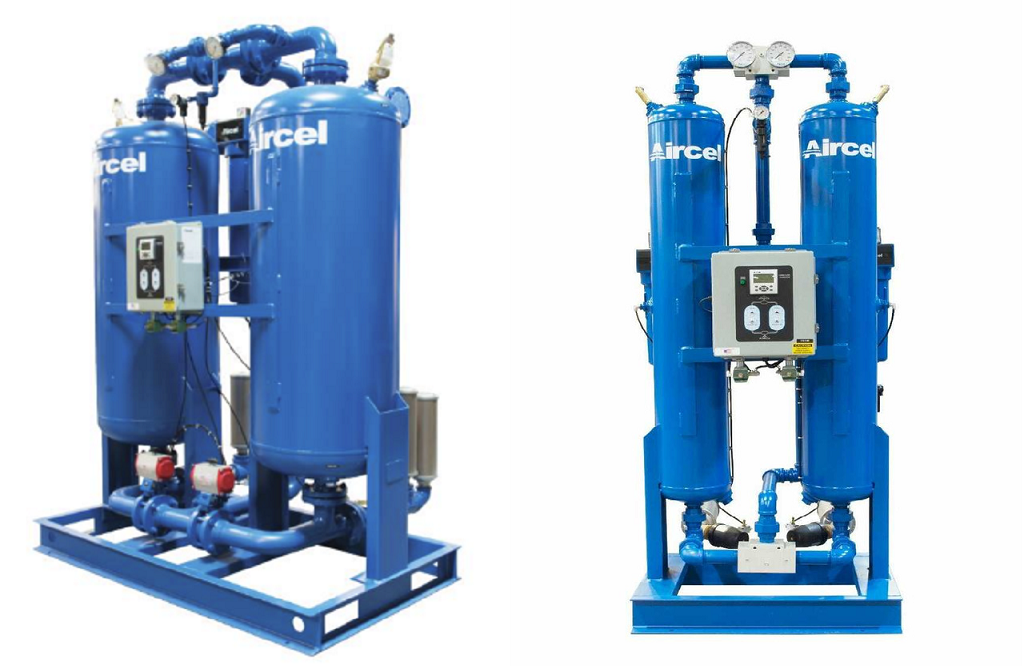
Analytical instruments are more sensitive to moisture and CO2 than most equipment in a building. A compressed air dryer at the bench keeps water vapor, CO2, and hydrocarbons out of the air feeding FTIR benches, TOC analyzers, and gas chromatographs. Most buildings don’t deliver the compressed air quality those instruments need. Labs that treat air as a reagent get steadier baselines, fewer repeated runs, and smaller gas bills.
Match Your Compressed Air Dryer to Instrument Specs
Building air rarely meets the dew point an analytical instrument expects. Facilities teams usually size an industrial air dryer for the whole plant, and that’s often a refrigerated air dryer that can’t cool air below freezing. It holds about a 37°F pressure dew point, the ISO 8573-1 Class 4 limit, while Class 2 calls for minus 40°F. A compressed air dryer that stops at Class 4 lets water condense anywhere the line runs colder than that. Pull each instrument’s site prep guide and compare its air spec to the building’s.
Install a Compressed Air Dryer at Each Instrument
A small heatless desiccant air dryer at the bench covers what the building can’t. Two towers alternate on a timer, with one drying incoming air while a slice of dry outlet air purges moisture from the other. The PureGas MDH series handles 0.1 to 3.2 SCFM at 30 to 120 psig and draws 6 watts or less, so a compressed air dryer that size fits inside an equipment cabinet. It doubles as pneumatic system protection for sampling valves downstream. Size it to the instrument’s flow, and step up to the VSA series for 2.8 to 12 SCFM.
Strip CO2 From FTIR and TOC Purge Air
FTIR and TOC instruments need purge air that’s free of CO2 as well as dry. Both gases absorb infrared light, and CO2 leaves a sharp band near 2,350 wavenumbers that grows or fades as room air leaks into the optics, so baselines drift and analysts repeat runs. The CO2-PG series uses 13X molecular sieve to cut CO2 below 1 ppm and dew point below minus 100°F. The PG14, PG28, and PG80 deliver 14, 32, and 80 L/min, and the TOC-PG3 supplies 7.7 L/min for TOC analyzers. Match the unit to the purge flow in the instrument manual.
Check Published Specs Before You Buy
Datasheets show whether a dryer will hold spec in a real lab. Dew point and purge flow matter most, because a heatless dryer spends part of its inlet air on regeneration. Air & Vacuum Process, for example, lists the MDH at minus 40°F pressure dew point with a 100°F saturated inlet and shows the 3.2 SCFM MDH6 sending 0.8 SCFM to purge. Atmospheric dew point ratings read lower than pressure ratings for the same air, so compare like with like. Ask every supplier for the datasheet and check both numbers at your compressor’s pressure.
Remove Hydrocarbons Before Air Reaches the GC
Hydrocarbons in house air raise the baseline on a flame ionization detector and spoil zero air. Compressor oil carryover and dirty intake air both put hydrocarbon vapor in the line, and a standard desiccant bed won’t reliably catch it. PHCA hydrocarbon adsorbers bring hydrocarbons below 1 ppm, and the PHCA120M takes 27 L/min in and delivers 7.5 L/min out. Feed the adsorber dry, filtered air so its bed doesn’t spend capacity on water, and size it from the outlet flow.
Retire Nitrogen Cylinders With a Compressed Air Dryer
An onsite purge generator ends the cylinder swap routine. A continuous purge drains a cylinder on a fixed schedule, and someone has to change it out. A 300 cubic foot nitrogen cylinder holds about 8,500 liters, which lasts roughly 10 hours at a 14 L/min purge. A dual tower compressed air dryer like the CO2-PG14 delivers that flow around the clock from house air or a small air compressor dryer package. Total last year’s cylinder rentals, deliveries, and gas charges, then compare that figure to a one time generator purchase.
Analytical labs get stable baselines when every instrument gets air that’s dry, CO2 free, and clean of hydrocarbons. A compressed air dryer at the bench, backed by the right adsorber, turns house air into a reagent the data can trust.
For More Information About Portable Compressed Air Dryers and Air Compressor Desiccant Dryer Please Visit: Air & Vacuum Process Inc.

 English
 Arabic
 French
 Spanish
 Portuguese
 Deutsch
 Turkish
 Dutch
 Italiano
 Russian
 Portuguese (Brazil)
 Greek
