

The Importance of Temperature Control for Brazing Machines
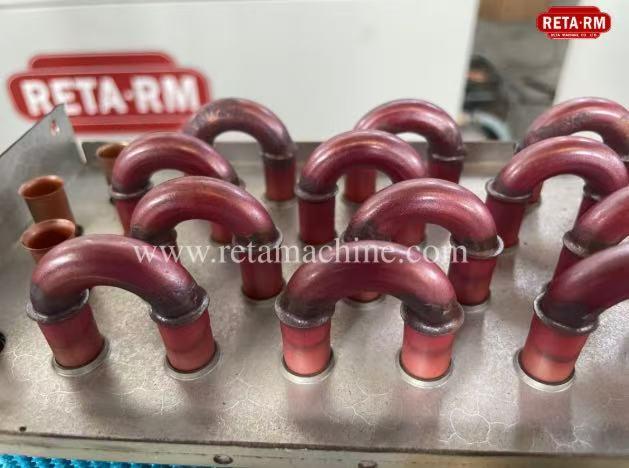
Brazing is a widely adopted joining process in the manufacturing of heat exchangers, refrigeration parts and precision metal assemblies. Unlike fusion welding, brazing relies on filler metal melting and wetting the base metal surface while keeping the base material unmelted. Within this narrow operating window, accurate temperature control of brazing machines becomes the most decisive factor that separates qualified joints from defective products.
If the working temperature is too low, the brazing filler cannot fully melt and spread evenly along the joint gap. Poor wetting leads to incomplete bonding, hidden gaps and low mechanical strength. Such joints easily leak or break under pressure and vibration, which is fatal for HVAC and fluid system components. On the contrary, excessive temperature brings a series of risks. The base metal may suffer grain coarsening, softening or thermal distortion. The flux will burn out prematurely, and heavy oxidation films form rapidly on metal surfaces, further preventing the filler metal from adhering firmly. In some alloys, overheating also causes volatile elements to evaporate and changes the original metallurgical property of the base material.
Stable temperature control also guarantees batch consistency in mass production. Modern brazing machines are equipped with thermocouples, PID closed-loop systems and real-time temperature profiling to regulate heating rate, holding time and cooling curve. Uniform temperature distribution across the brazing zone eliminates local hot spots and cold spots. Every workpiece follows the same thermal cycle, so tensile strength, air tightness and corrosion resistance stay repeatable. This greatly reduces rework rate, scrap loss and inspection pressure for manufacturers.
Moreover, precise thermal management extends service life and optimizes energy consumption. Uncontrolled frequent overheating accelerates ageing of heating elements and furnace lining. Well-calibrated temperature profiles cut unnecessary heat input and save power. For high-end applications such as aluminum and stainless steel brazing, the allowable temperature tolerance is extremely tight. Even a small temperature drift can ruin the whole batch.
In conclusion, temperature control is the core capability of a brazing machine. It directly determines joint integrity, production stability and operational economy. As industrial products keep raising higher standards for reliability, manufacturers must prioritize accurate, responsive and stable temperature systems to maintain competitive brazing quality.

 English
 French
 Spanish
 Portuguese
 Deutsch
 Turkish
 Dutch
 Italiano
 Russian
 Romaian
 Portuguese (Brazil)
 Greek
