

ICH M13A Guideline: Streamlining Bioequivalence for Oral Dosage Forms
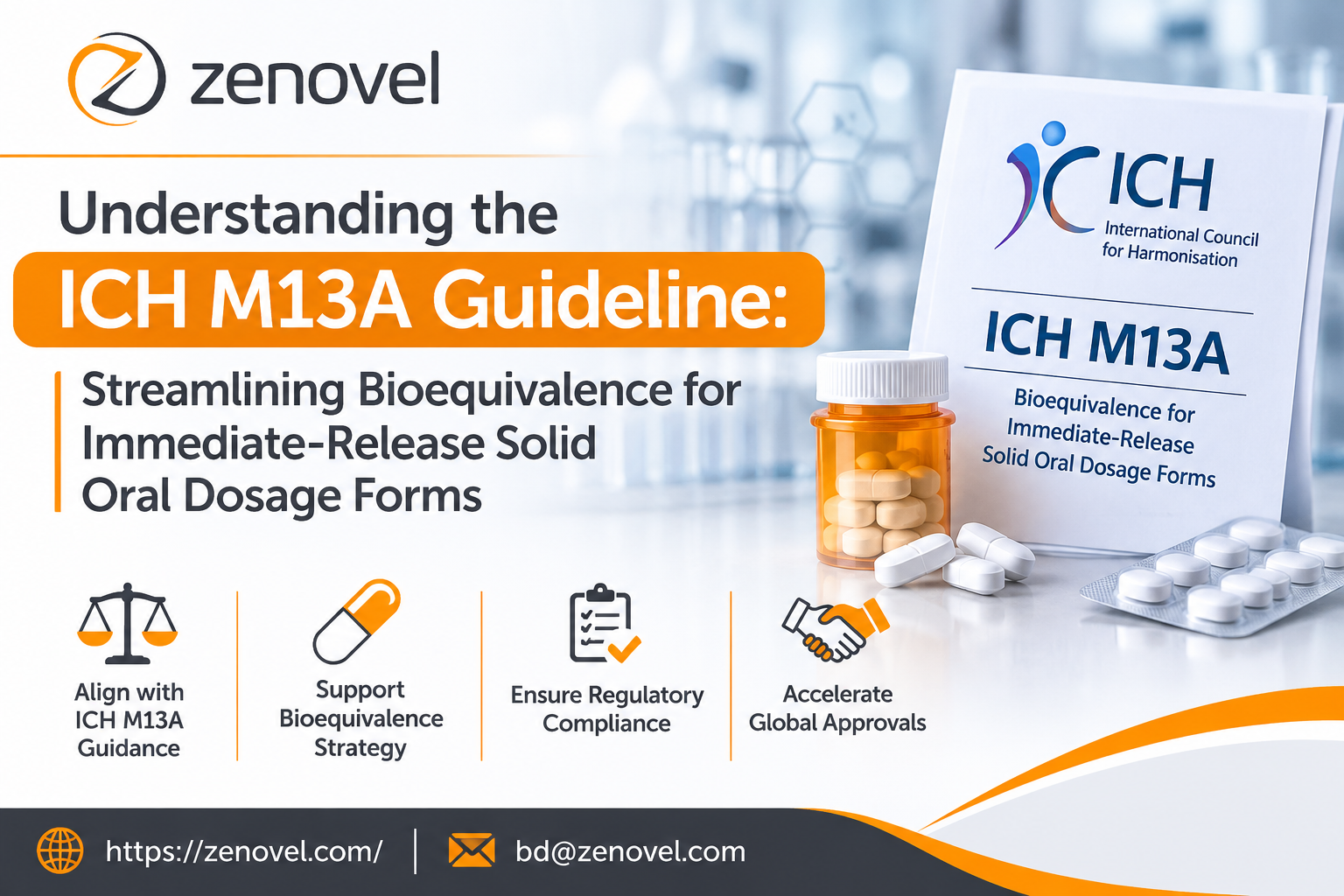
Navigating the global regulatory landscape for generic and innovative drug development requires continuous alignment with harmonized international standards. Adopted across major regulatory authorities—including the U.S. FDA, European Medicines Agency (EMA), and Health Canada—the ICH M13A guideline establishes unified global criteria for conducting bioequivalence (BE) studies on immediate-release (IR) solid oral dosage forms.
For pharmaceutical sponsors, contract research organizations (CROs), and regulatory affairs teams, understanding this framework is essential to reducing redundant clinical testing and accelerating global market access.
What is the ICH M13A Guideline?
Developed by the International Council for Harmonisation (ICH), the M13A guideline provides comprehensive, globally unified recommendations for designing, conducting, and analyzing pharmacokinetic (PK) bioequivalence studies during both drug development and post-approval phases.
Focused specifically on orally administered IR solid oral dosage forms designed for systemic action—such as tablets, capsules, and granules or powders for oral suspension—M13A eliminates longstanding regional discrepancies. By standardizing technical expectations across ICH member regions, the guideline minimizes the need for duplicate in vivo studies and streamlines multi-regional regulatory submissions.
Key Principles and Study Design Standards
The ICH M13A framework outlines rigorous scientific and operational parameters to establish therapeutic equivalence between test (generic) and comparator (reference) products:
-
Study Design and Sample Size: A randomized, single-dose, two-period, two-sequence crossover design is typically recommended under standardized fasting conditions. Studies must be adequately powered, with a minimum of 12 evaluable subjects required for crossover designs (or 12 per arm for parallel designs).
-
Washout Periods: Treatment periods must be separated by a sufficient washout interval—typically exceeding 5 elimination half-lives—to ensure complete drug clearance and prevent carryover effects.
-
Standardized Fasting and Fed Conditions: Fasting studies require at least an 8-hour fast prior to dosing, accompanied by standardized water intake (150–250 mL). When fed studies are required, high-risk products (such as complex formulations or poorly soluble drugs) must be evaluated using a standardized high-fat, high-calorie meal, whereas non-high-risk products may use a low-fat, low-calorie meal or follow the comparator product's labeling.
-
Test Batch and Assay Requirements: The test batch used in pivotal BE studies must generally represent at least 1/10 of the proposed production scale or 100,000 units (whichever is greater), with an assay content difference of no more than 5% compared to the selected comparator batch.
-
Statistical Evaluation Criteria: Bioequivalence is demonstrated when the 90% confidence intervals for the geometric mean ratios (test-to-comparator) of primary pharmacokinetic parameters—specifically maximum plasma concentration ($C_{max}$) and area under the concentration-time curve ($AUC$)—fall strictly within the 80.00% to 125.00% acceptance range.
Practical Impact on Global Drug Development
Implementing the ICH M13A standard delivers measurable operational advantages for pharmaceutical organizations:
-
Reduced Development Costs: Sponsors can design a single pivotal bioequivalence study acceptable across multiple major regulatory jurisdictions rather than running separate region-specific trials.
-
Clearer Protocol Alignment: Standardized definitions for comparator selection, strength selection in multi-strength product lines, and pH-dependent drug interactions reduce regulatory queries during dossier review.
-
Faster Time-to-Market: Harmonized technical criteria minimize delays during pre-submission consultations and post-approval change evaluations.
Overcoming Compliance Hurdles with Expert Guidance
While the ICH M13A guideline simplifies multi-regional regulatory alignment, executing compliant bioequivalence programs still presents complex challenges. Evaluating high-risk formulations, justifying biowaivers for additional strengths, managing CRO oversight, and compiling audit-ready CTD dossiers require deep clinical pharmacology and regulatory expertise.
Organizations looking to optimize their bioequivalence strategies partner with specialized regulatory affairs and GxP compliance experts—such as Zenovel—to ensure end-to-end data integrity, robust protocol design, and seamless global regulatory submissions under current ICH standards.

 English
 Arabic
 French
 Spanish
 Deutsch
 Turkish
 Dutch
 Italiano
 Russian
 Romaian
 Portuguese (Brazil)
 Greek