

ICH Q14 Guideline: Science-Based Analytical Procedure Development
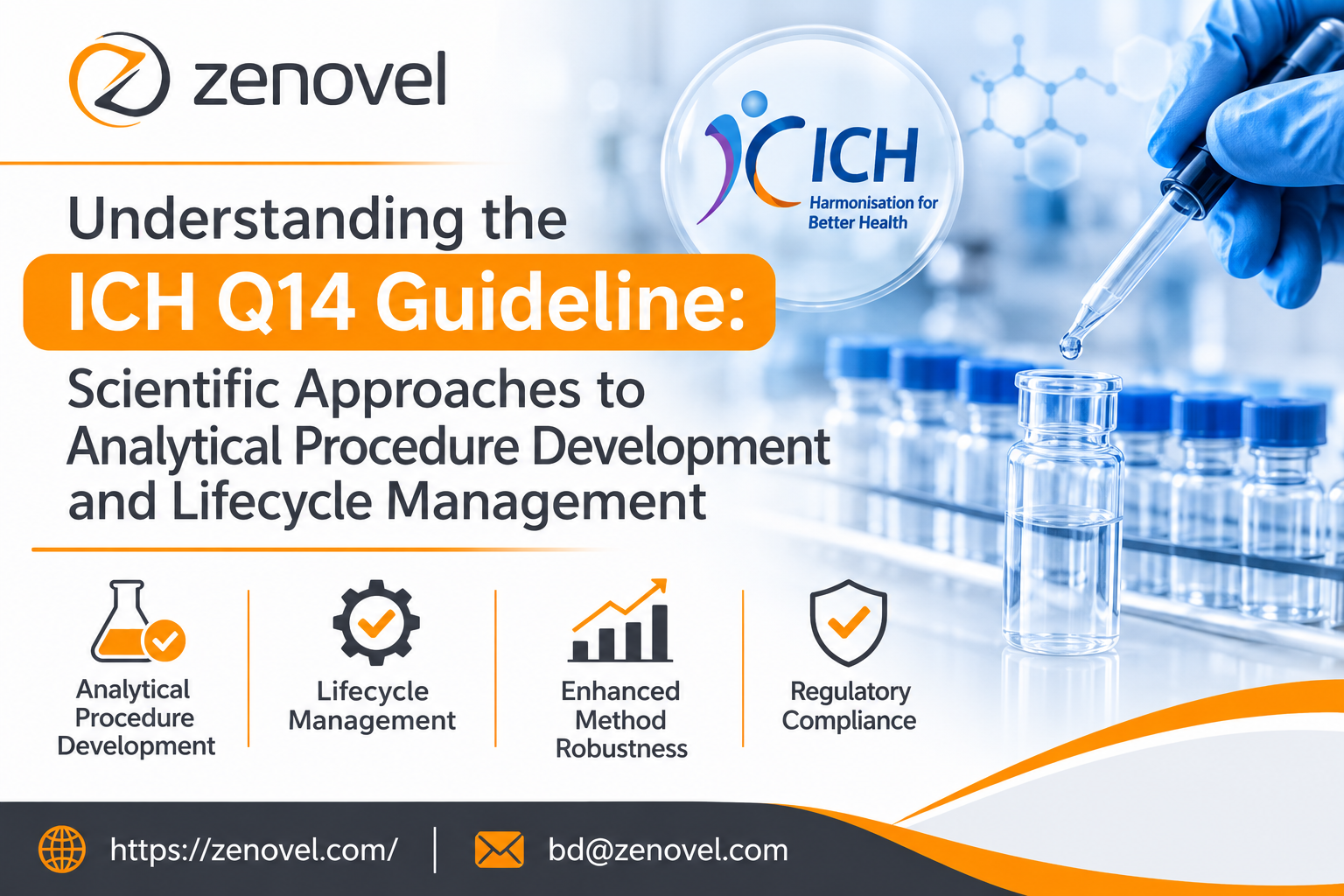
In the highly regulated pharmaceutical and life sciences sector, the quality of a drug substance or drug product is only as reliable as the analytical procedures used to test it. Historically, analytical methods were developed using empirical, trial-and-error "minimal" approaches, often resulting in rigid methods that triggered extensive regulatory hurdles whenever a minor change was required post-approval.
To modernize and harmonize how analytical methods are built, evaluated, and managed throughout their lifecycle, the International Council for Harmonisation (ICH) introduced the ICH Q14 guideline, complementing the updated ICH Q2(R2) validation standard.
What is the ICH Q14 Guideline?
The ICH Q14 guideline establishes a standardized, science- and risk-based framework for developing and maintaining analytical procedures. Aligned with the systematic quality principles of ICH Q8 (Pharmaceutical Development) and ICH Q9 (Quality Risk Management), Q14 shifts industry culture away from rigid method description toward a comprehensive, mechanistic understanding of how an analytical procedure works.
While companion guideline ICH Q2(R2) focuses on proving that an analytical procedure is suitable for its intended purpose (validation), ICH Q14 focuses on how that procedure was designed, optimized, and controlled over its entire lifecycle (development and change management).
Core Principles and Approaches to Method Development
ICH Q14 outlines two primary pathways for developing analytical procedures, giving organizations the flexibility to choose the depth of their development strategy:
-
Minimal (Traditional) Approach: Relies heavily on empirical optimization, final testing, and traditional method performance testing. While fully acceptable under regulatory standards, changes made post-approval typically require prior regulatory approval depending on regional variations.
-
Enhanced Approach: Employs systematic risk assessment, prior knowledge, and Design of Experiments (DoE) to understand the relationship between analytical procedure parameters (e.g., flow rate, column temperature, extraction time) and method performance. An enhanced approach builds deep scientific understanding, enabling more efficient post-approval change management.
Key Technical Elements of the Framework
-
Analytical Target Profile (ATP): Defines the objective of the analytical procedure—what needs to be measured and the required performance criteria (such as precision and accuracy)—guiding method design from inception.
-
Robustness Evaluation: Assesses the capacity of a method to remain unaffected by small, deliberate variations in method parameters. Under Q14, robustness data generated during the enhanced development phase does not need to be repeated during formal validation.
-
Established Conditions (ECs) and Flexibility: By understanding which parameters critically impact performance, organizations can propose scientifically justified Established Conditions and design spaces (such as Method Operable Design Regions or MODRs), allowing for smooth procedural adjustments without filing major regulatory variations.
Strategic Benefits for Pharmaceutical Organizations
Adopting the principles of ICH Q14 offers substantial regulatory and operational advantages across a drug product's lifecycle:
-
Streamlined Change Management: Comprehensive method understanding and risk assessments enable lower-risk reporting categories for post-approval changes, reducing costly agency review cycles.
-
Enhanced Data Integrity and Compliance: Minimizes out-of-specification (OOS) investigations caused by poorly understood method sensitivity or drift.
-
Support for Advanced Technologies: Provides clear regulatory expectations for complex analytical procedures, multivariate models, and Real-Time Release Testing (RTRT).
Ensuring Compliance Through Expert Partnership
Translating the principles of ICH Q14 and ICH Q2(R2) into routine laboratory practice requires cross-functional expertise spanning analytical chemistry, quality assurance, and global regulatory affairs.
Organizations looking to future-proof their analytical lifecycle management, optimize method validation protocols, and align with international expectations frequently partner with specialized GxP compliance experts—such as Zenovel—to secure robust, audit-ready regulatory submissions.

 English
 Arabic
 French
 Spanish
 Portuguese
 Deutsch
 Turkish
 Dutch
 Italiano
 Romaian
 Portuguese (Brazil)
 Greek
