

Beyond Automation: How AI-Powered School ERP Is Transforming Smart School Management
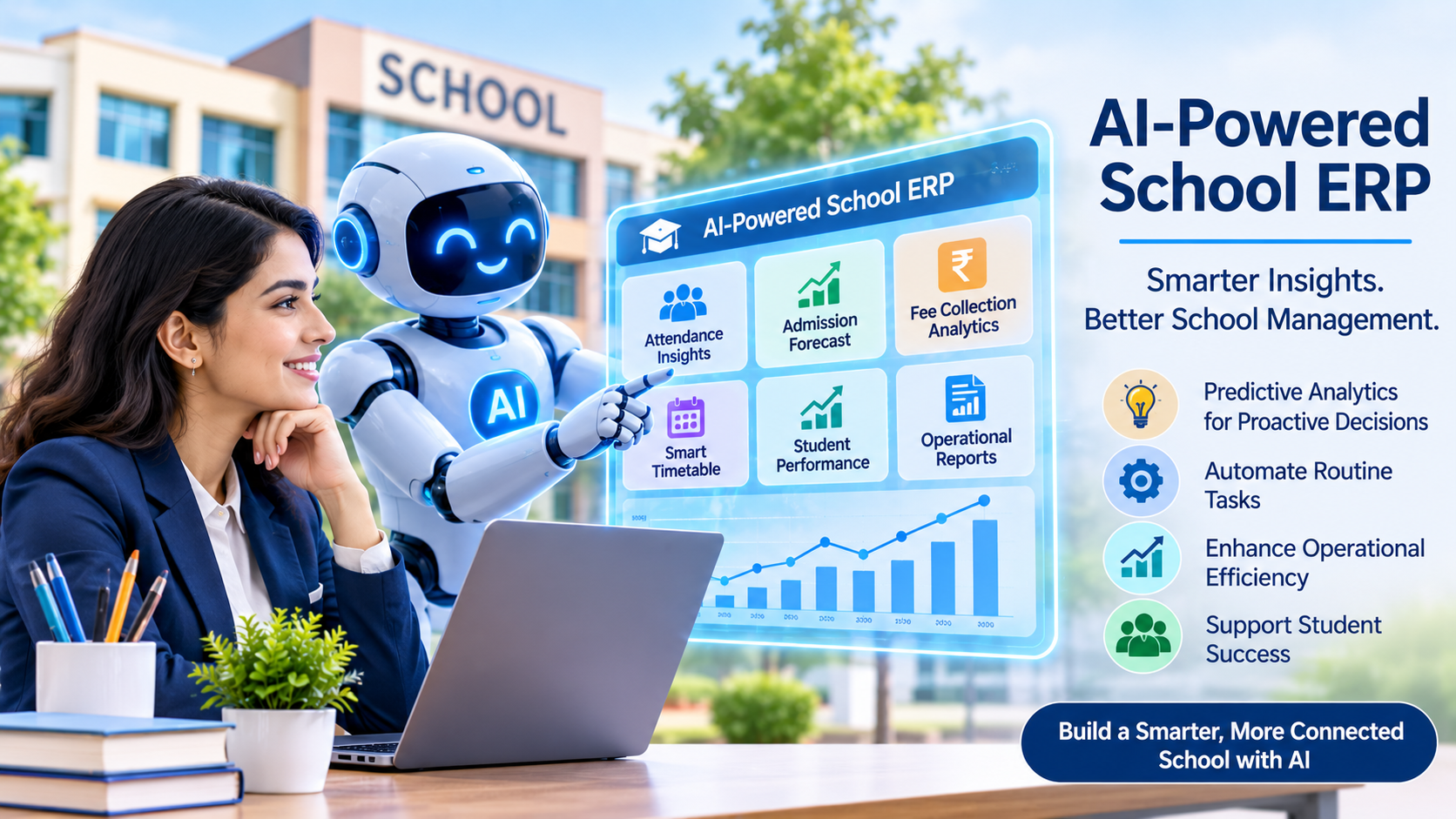
School administration involves hundreds of interconnected activities, from student admissions and attendance to fee collection, timetable preparation, staff coordination, and academic reporting. Managing these responsibilities manually or through disconnected applications can make it difficult for school administrators to access accurate information and respond quickly to operational challenges.
Artificial Intelligence (AI) is creating new opportunities to make these processes more intelligent. Instead of simply recording information, AI-enabled systems can analyze data, identify patterns, automate repetitive activities, and provide useful recommendations.
An AI-Powered School ERP brings these capabilities into the school management environment, helping institutions move from reactive administration towards more proactive, data-informed decision-making.
Why Is AI Becoming Important in School Management?
Traditional school management software primarily helps institutions store information and automate predefined workflows. AI introduces an additional layer by helping systems interpret information and identify patterns that may require attention.
For example, administrators can use attendance trends to identify recurring absenteeism, examine fee payment patterns, and evaluate scheduling constraints before making operational decisions.
Some important opportunities include:
-
Reducing repetitive administrative activities.
-
Identifying unusual attendance patterns.
-
Supporting data-driven admission planning.
-
Optimizing teacher and classroom schedules.
-
Monitoring fee collection trends.
-
Generating useful management insights.
-
Supporting more personalized academic planning.
The objective is not to replace teachers or school administrators. It is to provide better information and reduce routine work so that school teams can focus on students and institutional priorities.
7 AI Applications Transforming School ERP Operations
1. Predictive Analytics for Smarter School Decisions
Schools generate large amounts of information through attendance, admissions, examinations, fees, and academic activities. Reviewing this information manually can make it difficult to identify important patterns.
AI-powered analytics can examine historical and current data to identify trends and generate useful insights.
For example, attendance analysis may help administrators identify recurring absenteeism patterns, while admission analytics can support enrolment forecasting and resource planning.
With better visibility into institutional data, school management can make more informed decisions rather than relying entirely on manual reports.
2. AI-Based Attendance Monitoring
Traditional attendance methods can involve manual roll calls, registers, or separate biometric devices. These approaches may create additional administrative work and delays in accessing attendance information.
AI-based attendance systems can use facial recognition and automated monitoring to record attendance more efficiently.
With AI-powered attendance capabilities, schools can:
-
Automate student and staff check-ins.
-
Identify attendance irregularities.
-
Monitor late arrivals and absences.
-
Generate attendance reports.
-
Send relevant notifications.
-
Review attendance patterns through analytics.
Vidyalaya's AI-Based Attendance System supports facial recognition, real-time monitoring, automated alerts, and attendance analytics.
3. Intelligent Timetable Generation
Preparing a school timetable requires balancing teacher availability, subjects, classrooms, academic periods, and institutional scheduling rules.
Manual scheduling can lead to overlapping classes, uneven teacher workloads, and repeated adjustments.
An AI timetable generator can consider scheduling constraints and suggest suitable arrangements. It can also help identify timetable conflicts and support adjustments when teachers are unavailable.
Vidyalaya's AI Timetable Generator for Schools focuses on automated scheduling, workload distribution, conflict detection, and calendar integration.
4. AI-Powered Admission Management
Admission teams handle enquiries, application details, follow-ups, document collection, and enrolment confirmation. During peak admission seasons, managing these activities manually can become challenging.
AI-enabled admission workflows can help organize enquiry information, support communication, prioritize follow-ups, and analyze admission trends.
Schools can use these insights to understand enquiry patterns, monitor conversion stages, and plan admission activities more effectively.
The result is a more structured admission process and better visibility for admission administrators.
5. AI-Based Fee Management and Financial Insights
Fee administration involves payment schedules, outstanding balances, reminders, reconciliation, and financial reporting.
AI-powered fee management can analyze payment patterns, automate reminders, monitor incoming payments, and provide insights into collection trends.
For example, administrators can review outstanding dues and identify payment patterns that require additional follow-up.
Vidyalaya's AI-Powered Fees Management Software supports automated fee collection workflows, payment tracking, reminders, and data-driven financial insights.
6. AI-Assisted Academic Planning and Student Support
Student performance depends on several factors, including attendance, classroom participation, assessments, and access to learning resources.
AI can help analyze academic information and identify areas where students may need additional support.
Teachers can use AI-assisted tools to organize lesson plans, prepare learning materials, and review assessment information. Predictive insights may also help identify students who require closer academic attention.
However, AI-generated recommendations should support—not replace—teacher evaluation and professional judgment.
7. AI-Driven Transportation and Resource Management
Managing school transportation and campus resources involves multiple operational decisions. Schools need to coordinate bus routes, vehicle availability, maintenance, inventory, and resource allocation.
AI-enabled systems can analyze relevant operational data and support planning decisions.
In transportation, intelligent scheduling can help review routes and vehicle utilization. In resource management, analytics can help identify usage patterns and support better planning.
Vidyalaya also offers AI-Powered School Transport Management Software to support technology-driven transportation operations.
What Should Schools Consider Before Adopting AI-Powered ERP?
AI adoption requires more than adding intelligent features to existing software. Schools should evaluate how these capabilities fit their workflows, data requirements, and institutional policies.
Consider these factors:
-
Data quality: Are student, staff, attendance, and financial records accurate and consistent?
-
Integration: Can AI-enabled modules work with existing ERP processes?
-
Data privacy: Are student and employee records protected through appropriate access controls?
-
Transparency: Can administrators understand why an AI system provides a particular recommendation?
-
Human oversight: Can teachers and administrators review AI-generated outputs before taking important decisions?
-
Scalability: Can the platform support additional departments, students, and campuses?
-
Implementation support: Does the provider offer onboarding, training, and technical assistance?
Schools should also establish clear guidelines for responsible AI usage, particularly when systems process student information or contribute to decisions affecting learners.
How Vidyalaya Is Bringing AI Into School Management
Vidyalaya offers an integrated AI-Powered School Management Software solution designed to support modern school administration through intelligent technology.
Its AI-focused solutions cover multiple institutional activities, including:
-
AI-based attendance monitoring.
-
Intelligent timetable generation.
-
AI-powered admission management.
-
AI-based accounting and fee management.
-
AI-powered school transportation.
-
AI-driven management information systems.
-
AI-supported academic and administrative workflows.
Vidyalaya's AI-Powered Management Information System also focuses on data processing, analytics, predictive insights, and administrative decision support.
These capabilities complement the wider School ERP Software platform, helping institutions connect academic, financial, administrative, and operational activities.
The Future of School Management Is Intelligent and Connected
AI is changing how schools approach administration, data analysis, scheduling, attendance, and financial management. The next stage of digital school management will focus not only on automating routine tasks but also on using information to anticipate requirements and support better decisions.
However, successful AI adoption depends on reliable data, responsible implementation, transparency, and human supervision.
Schools looking to modernize their operations can evaluate an AI-powered ERP platform that connects intelligent capabilities with everyday administrative workflows.
Ready to explore smarter school management? Visit Vidyalaya School Software and request a product demonstration to understand how AI-enabled school management can support your institution.


 English
 Arabic
 French
 Spanish
 Portuguese
 Deutsch
 Dutch
 Italiano
 Russian
 Romaian
 Portuguese (Brazil)
 Greek
