

KI Detector: When a Piece of Writing Just Feels Different
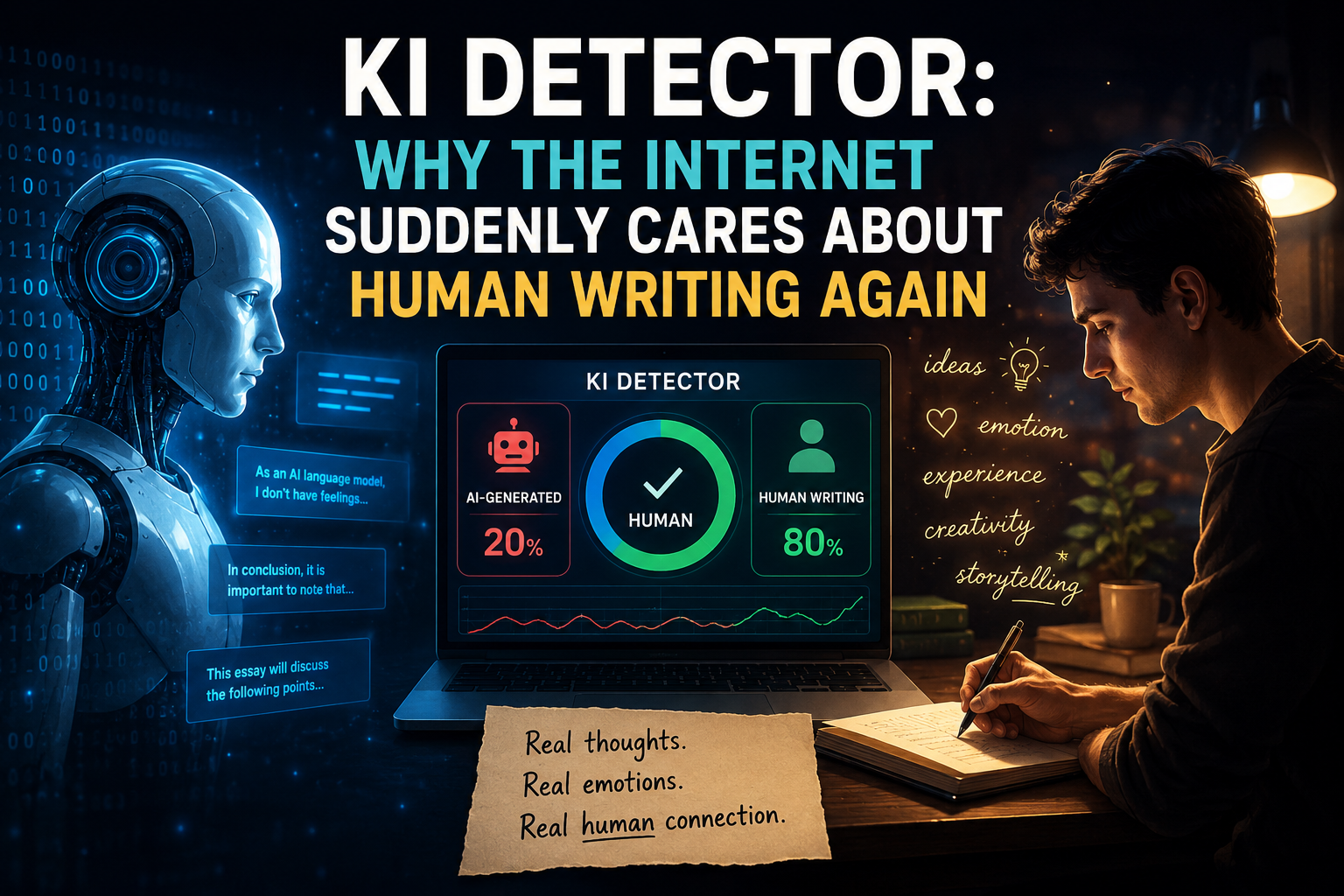
You have probably read something online that looked perfectly fine at first glance. The grammar was clean. The paragraphs were neatly arranged. Every point seemed to lead to the next one.
Yet something felt off.
Maybe the sentences sounded too similar. Maybe every paragraph seemed to have the same pace. Or perhaps the article was full of polished phrases but did not really say anything memorable.
That is one reason people turn to a KI detector.
A KI detector looks at written material and searches for patterns that can sometimes appear in machine-produced text. It does not read a document the way a person does. Instead, it studies the language and makes an estimate based on characteristics found throughout the writing.
What Makes Writing Look Machine-Made?
There is no single sentence that announces, “A computer wrote this.”
The clues are usually scattered across the page.
Computer-generated writing can sometimes be unusually even. Sentences may follow a predictable pattern, paragraphs can be almost identical in size, and transitions may appear where a human writer would simply move to the next thought.
Another clue is wording.
Some generated articles lean heavily on broad expressions such as “in today's digital landscape,” “it is important to note,” or “plays a crucial role.” None of these phrases are automatically bad. People use them too. The problem starts when the same style appears again and again without adding anything specific.
Real people are usually messier writers.
They change direction. They use a short sentence after a long one. They explain something in an unexpected way. They may even leave a sentence slightly informal because that is how they naturally communicate.
That unevenness can make writing feel alive.
How a KI Detector Looks at Text
A KI detector may examine several features of a passage rather than hunting for a secret list of AI words.
It can look at how predictable the next word appears to be, how sentences are arranged, how frequently certain structures occur, and whether the writing maintains an unusually consistent pattern.
The result is generally an estimate.
That distinction matters.
A detector cannot know with complete certainty who typed every sentence. A person can write in a highly formal style and receive an AI-related result. Likewise, somebody can edit machine-produced material until it looks considerably more natural.
For that reason, a detector is better treated as a signal that deserves a closer look, not as a judge handing down a final decision.
Why Writers Check Their Own Work
Some writers use a KI detector before sending an article to a client or publishing it online.
They are not necessarily trying to “beat” a detector. Sometimes they simply want another perspective on the draft.
Imagine writing a 1,000-word article and discovering that several sections have the same sentence pattern. You might read the piece yourself and not notice it because you have already spent hours looking at those words.
A detection tool can encourage you to stop and reconsider those sections.
You might replace a vague statement with an actual example. You might cut three unnecessary sentences. You might explain an idea using your own experience rather than relying on a generic description.
The result is usually better writing, whether or not a detector's score changes.
Human Editing Still Matters
Good content should not be built around a percentage on a detection report.
Suppose an article receives a low AI score but contains incorrect information and offers readers nothing useful. That is not successful content.
Now imagine another article receives an unusual detection result but contains original research, clear explanations, useful examples, and a genuine voice. Throwing it away based on one number would make little sense.
Human review adds the missing context.
A person can ask questions that software cannot answer as easily: Does this sound like the intended writer? Is the explanation actually helpful? Does the article contain real substance? Are the examples believable? Would a reader remember anything after finishing it?
Those questions are just as important as pattern analysis.
Writing That Sounds Like Someone Actually Wrote It
If your draft feels stiff, changing every word into a more complicated synonym is rarely the answer.
Natural writing usually comes from saying something clearly.
Give the reader a reason to care. Use an example that fits the subject. Mention the small detail that makes the situation understandable. Let some sentences be brief. Do not force a transition between every paragraph.
Most importantly, write for the person reading the page rather than for a detection tool.
A real reader does not care whether a sentence contains an impressive phrase. They want the answer, the explanation, or the information they came looking for.
Where KI Detectors Fit
A detector IA can be useful when it is treated as part of a wider review process.
It can point toward patterns that deserve attention, especially when a long document feels unusually uniform. But the final assessment should consider the writing itself, its context, the author's process, and the quality of the information.
As AI-assisted writing becomes more common, the conversation around originality will become more complicated. People will use software for research, brainstorming, translation, proofreading, and drafting.
The real challenge will not simply be identifying whether a machine touched a piece of text.
It will be knowing whether the finished work has something worthwhile to say — and whether it sounds like someone actually meant it.

 English
 Arabic
 Spanish
 Portuguese
 Deutsch
 Turkish
 Dutch
Dutch
 Italiano
 Russian
 Romaian
 Portuguese (Brazil)
 Greek
Greek
