

How Can Manufacturers Apply for ISI Mark Registration in India?
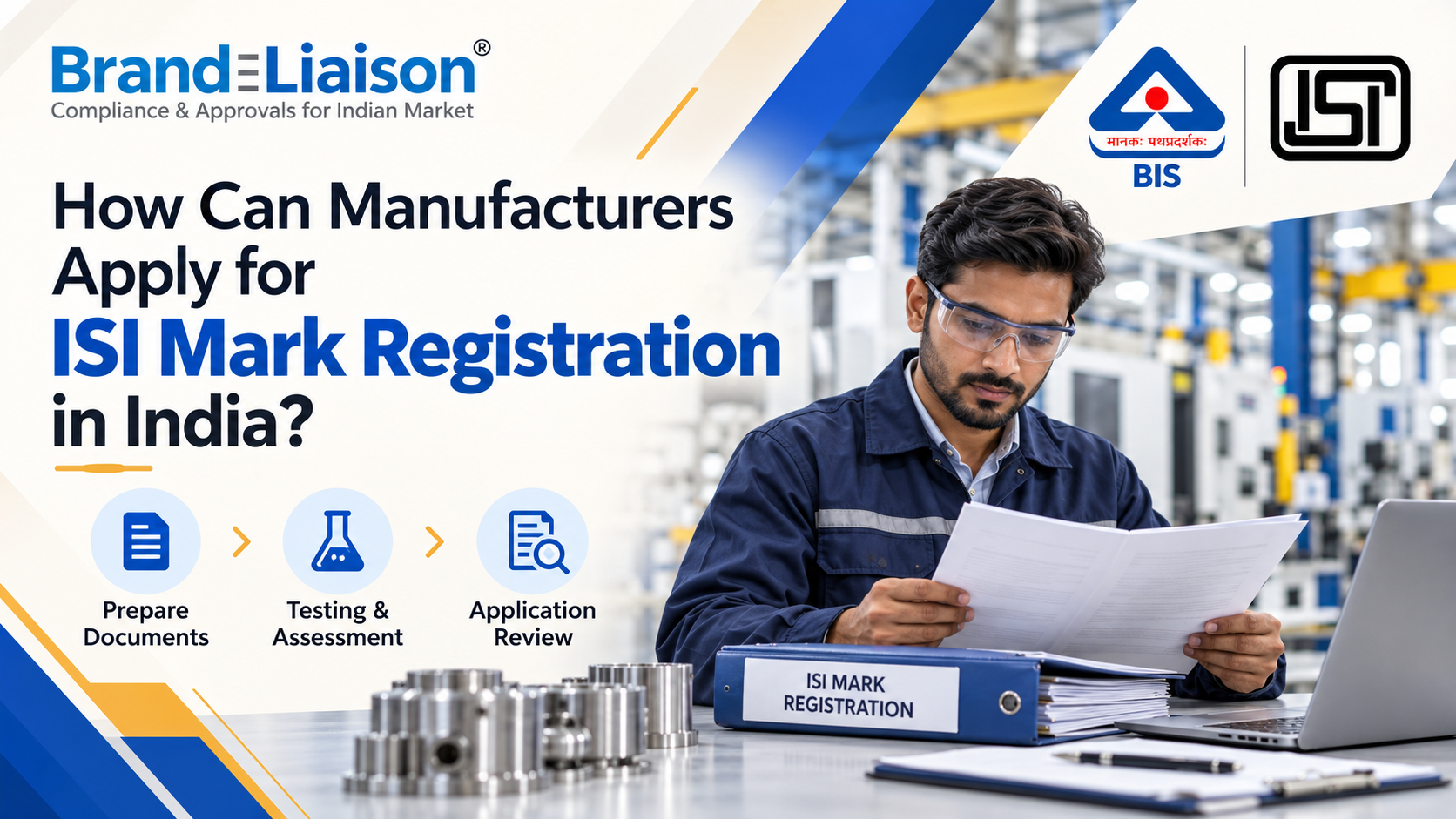
Manufacturers who want to sell notified products in India must follow Indian quality and safety standards. The Bureau of Indian Standards (BIS) sets these standards and provides product certification. Manufacturers must obtain an ISI licence for products covered under mandatory BIS certification before selling them in India.
ISI Mark Registration confirms that a product meets the required Indian Standards. The process includes preparing documents, submitting an application, product testing and factory inspection, wherever required. As the process involves several steps, professional guidance can help manufacturers understand the requirements and complete the process more easily.
Brand Liaison is a BIS compliance consultant that helps manufacturers understand BIS rules and guides them through the ISI Mark Registration process.
What is ISI Mark Registration?
BIS ISI Mark Registration is a certification process provided by the Bureau of Indian Standards (BIS). It shows that products covered under the applicable BIS product list meet the required Indian quality and safety standards.
ISI Mark Certification is mandatory for products covered under the relevant BIS rules and government notifications. Manufacturers must obtain the required BIS licence before selling these products in the Indian market.
Both Indian and foreign manufacturers can apply for BIS certification under the applicable scheme. Foreign manufacturers can apply through the Foreign Manufacturers Certification Scheme (FMCS) and must appoint an AIR (Authorized Indian Representative), as required under the applicable rules.
How to Apply for ISI Mark Registration in India?
Manufacturers need to follow the steps below to apply for ISI Mark Registration in India.
1. Prepare the Required Documents
First, manufacturers must collect all the documents required by BIS. These may include:
-
Factory legal address proof
-
Product specifications
-
Details of raw materials and machinery
-
Testing equipment details
-
Quality Control (QC) staff details
-
Product laboratory test reports
-
Main Application Form V
-
Applicable ISI application fees
-
AIR appointment documents for foreign manufacturers
Foreign manufacturers must appoint an Authorized Indian Representative (AIR) as required under the applicable BIS certification scheme.
2. Submit the BIS Application
After preparing the documents, manufacturers must submit the application to BIS along with the required information and fees.
The application must include correct details about the company, manufacturing factory and product. All required documents should also be submitted with the application.
3. Factory Inspection by BIS Officials
BIS officials visit the manufacturing factory to check its facilities and production system. During the inspection, they examine the manufacturing process, machinery, quality control system and testing facilities.
Manufacturers must make sure that their factory meets the applicable BIS requirements.
4. Product Testing
During the factory inspection, a BIS official selects product samples for testing according to the applicable procedure.
The samples are sent to a BIS-recognized laboratory for testing. The laboratory checks whether the product meets the requirements of the relevant Indian Standard.
5. Grant of BIS ISI Certification
After the application, factory inspection and product testing are completed, BIS reviews all the reports and documents.
If the manufacturer meets all the required conditions, BIS grants the ISI licence under the applicable certification scheme. Eligible foreign manufacturers receive certification under FMCS.
Why Do Manufacturers Need a BIS ISI Consultant?
The BIS ISI Certification process involves several steps. Manufacturers who are not familiar with Indian rules may find it difficult to complete the process.
A professional BIS ISI Consultant helps manufacturers understand the certification requirements and guides them through the application process.
A consultant can help manufacturers with:
-
Finding the correct Indian Standard for their products
-
Preparing the required documents
-
Understanding product testing requirements
-
Submitting the BIS application
-
Preparing for factory inspection
-
Responding to BIS queries
-
Understanding licence renewal and other requirements
Professional guidance helps manufacturers understand the process, prepare documents correctly and avoid common mistakes. However, BIS is responsible for reviewing applications and granting the ISI licence.
How Brand Liaison Helps with ISI Mark Registration?
Brand Liaison is an Indian regulatory compliance consultant that helps manufacturers understand and follow Indian certification requirements.
As an experienced BIS Consultant in India, Brand Liaison provides guidance throughout the ISI certification process. This includes document preparation, application submission, product testing and factory inspection coordination.
Brand Liaison also supports foreign manufacturers who want to sell their products in India. The company helps them understand the applicable BIS requirements and certification procedures based on their products and the relevant certification scheme.
Conclusion
ISI Mark Registration is important for manufacturers whose products come under mandatory BIS certification in India. The process includes document preparation, application submission, product testing and factory inspection, wherever required.
A professional consultant can help manufacturers understand the certification requirements and complete the necessary steps. Brand Liaison provides guidance throughout the ISI Mark Registration process and helps manufacturers understand the applicable BIS rules in India.
Read More:
FAQs
1. What is ISI Mark Registration?
ISI Mark Registration is a certification process provided by BIS. It shows that a product meets the required Indian quality and safety standards.
2. Is ISI Mark Registration mandatory for all products?
No. ISI Mark Certification is mandatory only for products covered under the applicable BIS product list and government rules. Manufacturers should check the certification requirements for their products.
3. Who can apply for ISI Mark Registration?
Both Indian and foreign manufacturers can apply for ISI Mark Certification under the applicable BIS scheme. The process depends on the product and the location of the manufacturing factory.
4. What documents are required for ISI Mark Registration?
Manufacturers need to submit company registration documents, factory details, product information, machinery details, testing equipment information and quality control records. Other documents may also be required by BIS.
5. Can foreign manufacturers get an ISI licence?
Yes. Foreign manufacturers can apply for an ISI licence under the applicable BIS certification scheme. They must appoint an Authorized Indian Representative (AIR) as required.
6. Why should manufacturers hire a BIS ISI Consultant?
A BIS ISI Consultant helps manufacturers understand certification requirements, prepare documents, complete application procedures, coordinate product testing and respond to BIS queries.
7. How can Brand Liaison help manufacturers?
Brand Liaison provides guidance on BIS requirements, document preparation, application submission, product testing and other certification-related steps according to the applicable BIS scheme.

 English
 Arabic
 French
 Spanish
 Portuguese
 Deutsch
 Turkish
 Dutch
 Italiano
 Romaian
 Portuguese (Brazil)
 Greek
