

From New Materials to New Ways of Working: 5 UK Startups Building the Tools Behind Better Work
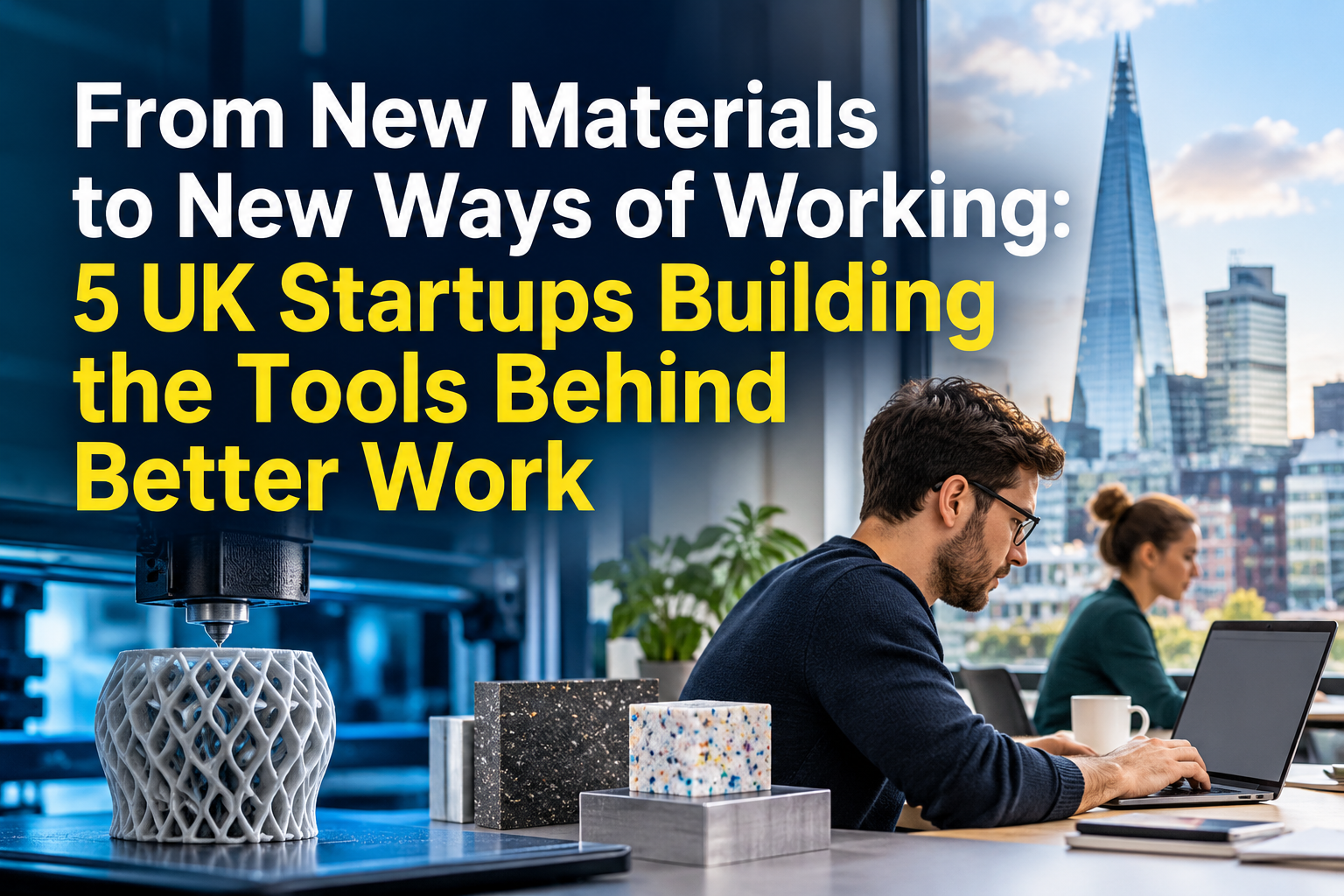
Some of the most important technology never reaches the headlines because it works behind the scenes: the materials inside a battery, the checks on a factory line, the software that lays out a house, the tools that run a team, the marketplace that connects a business to the right freelancer. Five UK startups are each improving one of these hidden layers.
Using AI to discover materials faster
Almost every industry depends on materials, from chips and batteries to carbon capture and construction, yet finding a new one has traditionally taken years of trial and error. CuspAI, founded in Cambridge in 2024 by Dr Chad Edwards and Professor Max Welling, uses AI to speed up that search. Its platform, MIRA, handles the discovery cycle from generating candidate materials through simulation and synthesis planning to experimental validation.
The investor interest has been striking. After a $100m Series A in 2025, CuspAI raised a $450m Series B in July 2026 at a reported $2.6bn valuation, led by Kleiner Perkins and NEA with Bezos Expeditions taking part. It also launched the AI Materials Foundry, a network of more than 45 industrial companies, laboratories and data and compute providers. Analysts have noted that the harder test is still ahead, namely turning computational discoveries into manufacturable materials at scale. That is exactly what the new funding and the foundry partners are meant to address.
Helping factory workers get it right first time
On a production line, a small error such as a wrong part, a missed step or a mislabelled kit can cost far more by the time someone spots it. KIT-AR was founded in 2018 as a spinout from University College London and the Norwegian research institute SINTEF, and builds an augmented quality assurance platform for manufacturers. It combines augmented reality and AI to guide workers through tasks and to catch and anticipate errors before they become defects.
The idea is to support people rather than replace them. The platform gives frontline staff clear visual instructions and checks, with applications in sectors such as automotive, aerospace and electronics. The company has raised seed funding from European backers including Armilar Venture Partners and Caixa Capital Risc, and has been developing focused products for specific shopfloor jobs, starting with preventing errors during packing and kit creation. For manufacturers under pressure to cut waste and rework, catching mistakes at the source is where the savings are.
Making 3D home design simple
Designing a room or a house in 3D has long meant expensive software and a steep learning curve. arcadium 3d tackles that with a browser-based tool that is free to use and needs no installation. Users can draw floor plans, switch between 2D and 3D views, drop in furniture from a model library, and share their project through a link for feedback.
The platform also adds AI features, including rendered visualisations of a finished space and AI-generated furniture, so a layout can go from blank room to polished image in a single session. Interior designers, architects, home builders and ordinary homeowners can all use the same tool, and the free, browser-based approach lowers the barrier for people who just want to see an idea before they commit to it. It is a good example of how AI can make a once-specialist skill available to far more people.
Looking after the people side of small teams
Small businesses often run on spreadsheets, group chats and good intentions, until growth makes that approach crack. Twikkie, a London-based company, offers cloud-based people management and workspace software designed for startups and small firms. It aims to help teams perform better and feel better by bringing the everyday work of managing people and workflows into one place, with a mobile app so it travels with the team.
The pitch is practical: instead of stitching together half a dozen separate tools, a growing company gets a single platform for the basics of managing staff and workspace. That matters most in the early stages, when founders have little time for admin and every extra system adds friction. Better people management does not make headlines, but it often decides whether a young company holds together as it grows.
Connecting businesses with freelancers more fairly
Finally, Zinn Hub works on how businesses find outside talent. Founded in London in 2025 by Neil Lock and Natalie Lock, it is a global marketplace for digital services where verified freelancers, called “Zinners”, offer their skills across thousands of categories. It positions itself as a fairer alternative to the big incumbents, with low fees and a focus on safer hiring through a projects board and a freelancer directory.
Its international ambitions are clear. The platform supports 46 languages with live translation, so that a buyer and freelancer on opposite sides of the world can work together without a language barrier. It has also been recognised as UK Freelance Marketplace of the Year 2026 by 365 Awards. As remote and project-based work keeps growing, marketplaces that treat freelancers and buyers more evenly could play a bigger part in how work gets done.
The common thread
These five companies work in very different fields, but each takes something complicated, slow or expensive and makes it more accessible. CuspAI compresses years of materials research. KIT-AR puts guidance in the hands of the people doing the work. arcadium 3d opens up 3D design to everyone. Twikkie simplifies how small teams are managed. Zinn Hub widens the pool of talent a business can reach.
None of them is flashy in the way consumer apps can be, and that is part of the point. The tools that quietly improve how things are made, designed and staffed tend to have the longest-lasting effect.

 Arabic
 French
 Spanish
 Portuguese
 Deutsch
 Turkish
 Dutch
 Italiano
 Russian
 Romaian
 Portuguese (Brazil)
 Greek
