

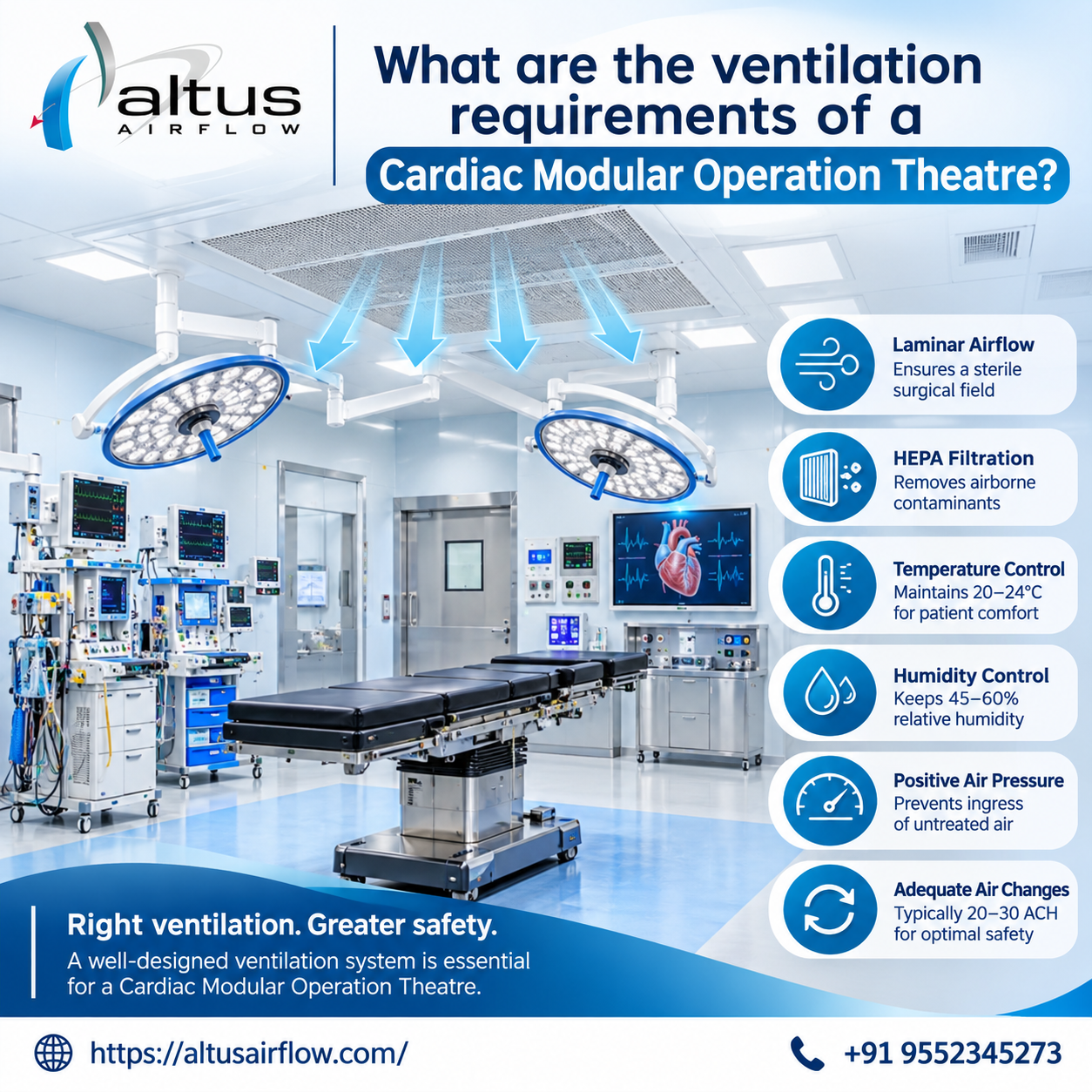
What are the ventilation requirements of a Cardiac Modular Operation Theatre?
Introduction
Altus Airflow specialises in developing advanced healthcare infrastructure that supports safe and efficient surgical environments. A Cardiac Modular Operation Theatre requires carefully planned ventilation systems to maintain controlled air quality, regulate temperature and humidity, and minimise airborne contamination during complex cardiac procedures. Proper HVAC design, HEPA filtration, positive air pressure, and adequate air changes are essential components of this specialised environment. Integrating these systems with modular construction helps hospitals establish hygienic, functional, and technically compliant operating theatres that support surgical teams and patient safety.
Ventilation planning is particularly important in cardiac surgery because these procedures require reliable environmental control, specialised equipment, and consistent operating conditions. A properly designed ventilation system helps create a controlled surgical environment while supporting infection prevention practices.
1. Understanding the Importance of OT Ventilation
Ventilation is one of the most important elements of a cardiac operating theatre. During surgical procedures, airborne particles, microorganisms, and contaminants can originate from people, equipment, surgical materials, and other activities.
An effective ventilation system helps dilute and remove airborne contaminants while maintaining suitable environmental conditions.
The main objectives of operating theatre ventilation include:
-
Maintaining appropriate indoor air quality.
-
Reducing airborne particulate contamination.
-
Supporting controlled temperature and humidity.
-
Maintaining positive pressure.
-
Providing adequate filtered fresh air.
-
Supporting specialised surgical requirements.
Cardiac operating theatres require particular attention because surgical procedures can be lengthy and involve specialised medical equipment. Ventilation systems must therefore be designed around the room's intended use, equipment heat loads, and applicable healthcare engineering standards.
2. Maintaining the Recommended Air Changes Per Hour
Air Changes Per Hour (ACH) refers to how many times the equivalent volume of air in a room is supplied or replaced within one hour. It is an important parameter when designing operating theatre ventilation systems.
The NABH Revised Guidelines for Air Conditioning in Operation Theatres (2018) classify cardiothoracic surgery theatres under Type A operating theatres.
For Type A theatres, the guidelines specify:
-
Minimum total air changes: 20 ACH.
-
Minimum fresh air component: 4 ACH.
-
Remaining air may include appropriately filtered recirculated air, subject to system design and applicable requirements.
The required air changes should be calculated according to the actual room volume and ventilation design.
For example, a theatre with a volume of 150 cubic metres and a total ventilation rate of 20 ACH requires an airflow volume of 3,000 cubic metres per hour.
Adequate air changes help dilute airborne contaminants and maintain the intended environmental conditions.
However, simply achieving the required ACH does not guarantee infection control. Air distribution, filtration, pressure relationships, and maintenance are equally important.
3. Installing High-Efficiency HEPA Filtration Systems
Air filtration is essential for controlling airborne particles in cardiac operating theatres. High-Efficiency Particulate Air (HEPA) filters are designed to remove very small particles from the supplied air.
The filtration arrangement should be selected according to the applicable operating theatre standard and project requirements.
Important filtration considerations include:
Pre-filtration: Initial filtration stages capture larger airborne particles and protect downstream filters.
Fine filtration: Additional filtration improves the cleanliness of the supplied air.
HEPA filtration: High-efficiency filters remove a significant proportion of fine particles, including particles that may carry microorganisms.
Filter integrity testing: Periodic testing helps identify leaks, damage, or installation problems.
Maintenance planning: Filters should be inspected and replaced according to their condition and manufacturer recommendations.
NABH's 2018 Type A OT guidelines recommend HEPA filtration as part of the operating theatre air-conditioning arrangement. Hospitals should ensure that filter selection, installation, and testing meet the applicable technical specifications.
4. Maintaining Positive Air Pressure
Positive air pressure is an important requirement for cardiac operating theatres. It helps prevent less-clean air from entering the surgical environment through doors, openings, and other leakage points.
The pressure inside the operating theatre should remain higher than the pressure in adjoining less-clean areas.
The NABH 2018 guidelines specify a minimum positive pressure differential of 2.5 Pascal for operating theatres.
Important considerations include:
-
Maintaining positive pressure during operating and non-operating hours.
-
Installing differential pressure monitoring devices.
-
Properly sealing wall and ceiling penetrations.
-
Using suitable door arrangements.
-
Maintaining appropriate airflow between adjoining zones.
-
Regularly checking pressure readings.
A well-designed pressure cascade allows air to move from cleaner areas towards less-clean areas.
Maintaining this pressure relationship helps reduce the possibility of contaminated air entering the operating theatre.
5. Providing Unidirectional Airflow Over the Surgical Area
Airflow distribution is especially important in cardiac operating theatres. The ventilation system should provide an appropriate airflow pattern over the operating table and surgical team.
The NABH 2018 Type A guidelines recommend unidirectional downward airflow through a non-aspirating diffuser or ceiling array.
The recommended air face velocity is 25–35 feet per minute (FPM).
The purpose of this arrangement is to deliver filtered air towards the critical surgical area and help move airborne contaminants away from that zone.
Important design considerations include:
-
Appropriate ceiling-mounted supply diffusers.
-
Suitable diffuser dimensions.
-
Uniform air distribution.
-
Correct positioning above the operating table.
-
Properly located return air outlets.
-
Avoidance of unnecessary airflow obstructions.
The arrangement of surgical lights, pendants, booms, and other ceiling-mounted equipment should be coordinated with the ventilation design.
This helps reduce airflow disturbances and supports the intended performance of the system.
6. Maintaining Suitable Temperature and Humidity
Temperature and humidity control are important for patient comfort, surgical team performance, and equipment operation.
The NABH 2018 guidelines specify a temperature range of 21°C ± 3°C and relative humidity of 20–60% for the relevant operating theatre requirements.
The precise operating set points should be determined according to patient needs, surgical procedures, equipment specifications, and applicable standards.
Important features include:
Digital temperature controllers: These allow authorised personnel to monitor and adjust room temperature.
Humidity sensors: They provide information about relative humidity levels.
Automated controls: Integrated HVAC controls help maintain the selected environmental conditions.
Monitoring displays: Digital displays allow staff to review important environmental parameters.
Alarm systems: Notifications can alert technical personnel when conditions move outside approved limits.
Proper temperature and humidity control helps create a stable surgical environment and supports the performance of sensitive medical equipment.
7. Designing an Appropriate HVAC System
The Heating, Ventilation, and Air Conditioning system is the central component of operating theatre ventilation.
A properly designed HVAC system must account for room dimensions, surgical equipment, lighting loads, occupancy, ventilation requirements, and environmental conditions.
Important HVAC components include:
-
Air Handling Units (AHUs).
-
Fresh air intake arrangements.
-
Pre-filters and fine filters.
-
HEPA filtration systems.
-
Cooling and heating coils.
-
Supply air ducting.
-
Return and exhaust air arrangements.
-
Digital control panels.
For specialised cardiac operating theatres, dedicated AHU arrangements should be considered according to applicable standards and project requirements.
The system should also provide suitable access for filter replacement, equipment inspection, and routine maintenance.
Correct HVAC planning supports consistent air delivery and helps the hospital maintain the required environmental conditions.
8. Proper Placement of Air Supply and Return Outlets
The location of air supply and return outlets directly affects ventilation performance.
Filtered air should be supplied through appropriately designed ceiling diffusers. Return air outlets should be positioned to support the intended airflow pattern and minimise stagnant areas.
Important placement considerations include:
Ceiling supply arrangement: Supply diffusers should be positioned to provide suitable air distribution over the surgical area.
Return air outlets: Their location should support effective removal of room air without disturbing the intended clean airflow pattern.
Equipment coordination: Medical pendants, surgical lights, and other ceiling-mounted equipment should not obstruct the supply airflow.
Duct design: Duct dimensions and routing should accommodate the required airflow volume.
Air balancing: The completed system should be adjusted to achieve the specified airflow distribution.
Poor outlet placement can create unwanted turbulence and reduce the effectiveness of the ventilation arrangement.
Therefore, outlet positioning should be considered during the initial architectural and HVAC design stages.
9. Integrating Digital Ventilation Monitoring Systems
Modern operating theatres can incorporate digital monitoring technologies to improve visibility into ventilation performance.
These systems allow authorised personnel to monitor important environmental and HVAC parameters through electronic displays.
Common monitoring features include:
-
Temperature monitoring.
-
Relative humidity monitoring.
-
Differential pressure readings.
-
Air changes information.
-
HEPA filter status.
-
HVAC operating status.
-
Automated deviation alerts.
A centralised Building Management System (BMS) can integrate selected building services and provide a convenient monitoring interface.
Digital systems also help maintain historical records that can support maintenance reviews and quality management activities.
However, monitoring devices should be calibrated, tested, and maintained regularly to ensure reliable readings.
10. Importance of Ventilation Testing and Validation
Installing an HVAC system does not automatically mean that the operating theatre meets its ventilation requirements.
Testing and validation are necessary to confirm that the installed system performs according to its design specifications.
Important testing activities include:
Air change verification: Confirms whether the required airflow volume is being delivered.
Air velocity testing: Evaluates the airflow velocity at designated locations.
Pressure differential testing: Checks positive pressure relationships between the theatre and adjoining areas.
HEPA integrity testing: Identifies filter leaks or installation defects.
Temperature and humidity testing: Confirms that the environmental controls maintain the required conditions.
Airflow visualisation: Helps assess airflow direction and identify potential disturbances.
Microbiological monitoring: Where required, supports evaluation of airborne microbial conditions.
Testing should be performed by qualified professionals using suitable calibrated instruments.
Results should be documented, reviewed, and compared with the applicable project specifications and healthcare standards.
11. Maintaining Ventilation Systems for Long-Term Performance
Regular maintenance is essential to ensure that operating theatre ventilation systems continue to function correctly.
Without proper maintenance, filters can become clogged, sensors may provide inaccurate readings, and HVAC components may lose performance.
A structured maintenance programme should include:
-
Regular filter inspections.
-
HEPA integrity testing at specified intervals.
-
AHU cleaning and servicing.
-
Ductwork inspection where required.
-
Sensor calibration.
-
Airflow and pressure verification.
-
Temperature and humidity monitoring.
-
Maintenance documentation.
Hospitals should maintain a maintenance schedule based on manufacturer recommendations, risk assessments, and applicable healthcare guidelines.
A properly maintained ventilation system helps preserve environmental control and supports consistent operating theatre performance.
12. How Modular OT Design Supports Ventilation Efficiency?
Modular construction allows hospitals to coordinate wall panels, ceiling systems, HVAC infrastructure, electrical services, and medical equipment within a planned operating theatre environment.
A Cardiac Modular Operation Theatre can incorporate specialised ventilation arrangements through careful coordination of modular components and engineering services.
Some important design advantages include:
Integrated ceiling systems: Ceiling arrangements can accommodate HEPA filter modules, diffusers, lighting, and medical pendants.
Sealed wall panels: Suitable modular wall systems help minimise unwanted air leakage.
Accessible service areas: Planned access points simplify maintenance and inspection.
Coordinated equipment placement: Surgical lights, pendants, and ventilation outlets can be arranged to reduce interference.
Flexible infrastructure planning: Modular systems can support project-specific layouts and future modifications.
The success of modular construction depends on proper engineering design, installation quality, testing, and commissioning.
It should always be supported by a ventilation design that meets the requirements of the intended surgical activities.
Conclusion
Ventilation is a critical part of cardiac operating theatre infrastructure because it helps maintain controlled air quality, temperature, humidity, and positive pressure. Proper HVAC design, HEPA filtration, adequate air changes, and unidirectional airflow contribute to creating a suitable surgical environment.
A well-planned Cardiac Modular Operation Theatre should combine advanced ventilation technology with suitable modular panels, ceiling systems, digital monitoring, and regular maintenance. Altus Airflow focuses on delivering specialised modular healthcare infrastructure that addresses hospital engineering and operational requirements. With appropriate planning and technical coordination, Altus Airflow supports the development of modern cardiac operating theatres designed for reliable ventilation performance and patient safety.
Frequently Asked Questions
1. What are the ventilation requirements of a Cardiac Modular Operation Theatre?
A Cardiac Modular Operation Theatre requires adequate air changes, HEPA filtration, positive air pressure, controlled temperature and humidity, and properly designed airflow distribution.
2. How many air changes per hour are required in a cardiac OT?
The NABH 2018 Type A operating theatre guidelines specify a minimum of 20 total air changes per hour, including at least 4 fresh air changes.
3. Why is HEPA filtration important in cardiac operating theatres?
HEPA filtration helps remove airborne particles and supports cleaner air conditions in the surgical environment.
4. What is the recommended positive pressure for a cardiac OT?
The NABH 2018 guidelines specify a minimum positive pressure differential of 2.5 Pascal compared with adjoining areas.
5. What temperature should be maintained in a cardiac operating theatre?
The NABH 2018 guidelines specify 21°C ± 3°C, with relative humidity between 20% and 60%.
Read Our Previous Blog --------------->What are the installation requirements for a Modular Cardiac Operation Theatre?

 English
 Arabic
 Spanish
 Portuguese
 Deutsch
 Turkish
 Dutch
 Italiano
 Russian
 Romaian
 Portuguese (Brazil)
 Greek
