

How are HVAC and electrical systems tested in Modular Gynaec OT Setup Services?
Introduction
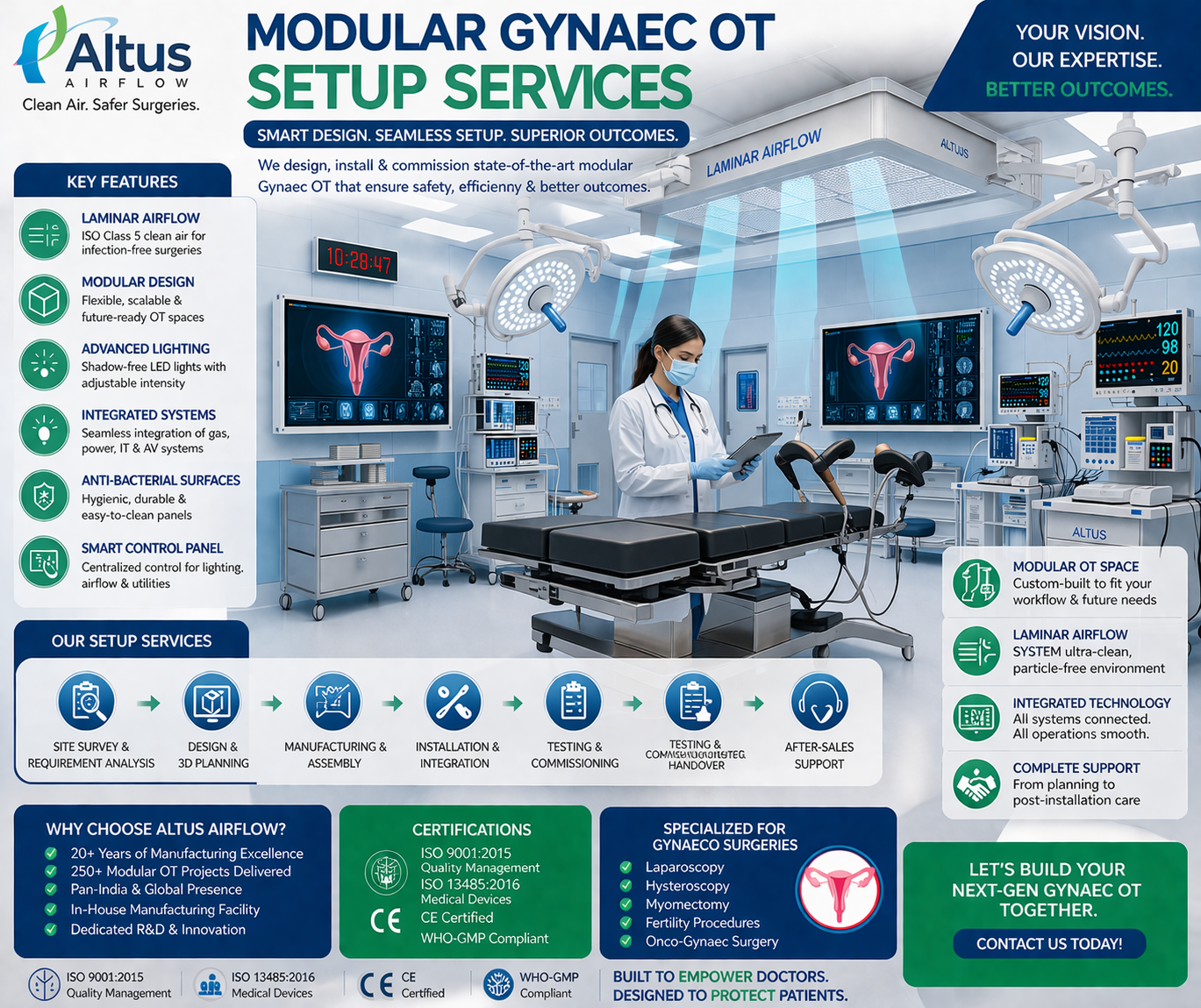
A gynaecology operation theatre requires properly coordinated ventilation, electrical infrastructure, medical equipment, and environmental controls to support safe and efficient surgical procedures. HVAC and electrical systems must be inspected and tested after installation to confirm that they operate according to the approved project design. Modular Gynaec OT Setup Services include these important verification activities to help hospitals identify installation issues before the operation theatre becomes operational.
HVAC testing focuses on ventilation performance, airflow distribution, filtration, temperature, humidity, and room pressure. Electrical testing verifies wiring, earthing, lighting, power outlets, protective devices, and backup power arrangements. Both systems must be assessed individually and together because their performance directly affects the functionality of the completed OT.
A structured testing process also creates a documented record of installation quality, making future maintenance and troubleshooting easier for hospital engineering teams.
Why Are HVAC and Electrical System Tests Important?
An operation theatre contains several interconnected systems that must function reliably during surgical procedures. Ventilation helps maintain the environmental conditions specified for the room, while electrical infrastructure supplies power to surgical lights, equipment, monitors, control panels, and other essential devices.
If HVAC performance is inadequate, the room may not maintain its intended airflow pattern or pressure relationship. Similarly, electrical installation defects can lead to equipment interruptions, unsafe connections, or unreliable power distribution.
Testing helps verify that the installed systems match the approved drawings and technical specifications. It also identifies defects such as incorrect wiring, poorly sealed duct connections, inaccurate sensors, airflow imbalance, and malfunctioning control devices.
These checks should be planned before installation begins, carried out during the project, and completed through final commissioning before hospital handover.
1. HVAC Installation Inspection Before Testing
The first stage involves checking whether HVAC components have been installed correctly. The inspection should cover air-handling units, ductwork, filters, dampers, supply air terminals, return air grilles, sensors, and control panels.
Inspectors should compare the installation with approved mechanical drawings and equipment specifications. They should examine duct supports, insulation, connections, access panels, and sealing arrangements. Poorly sealed ductwork or incorrectly positioned air terminals can affect system performance.
The team should also verify that ventilation components do not interfere with surgical lights, ceiling-mounted equipment, medical pendants, or other services. Access should remain available for filter replacement, inspection, and routine maintenance.
Any installation differences should be documented and resolved before performance testing begins.
2. Supply and Return Airflow Measurement
Airflow measurement helps determine whether the ventilation system delivers and removes air according to the approved design. Testing may involve measuring the volume of air supplied through ceiling terminals and extracted or returned through designated grilles.
Qualified technicians use calibrated instruments suitable for the measurement points and system arrangement. Readings are recorded and compared with the design values.
If airflow is uneven or outside the specified tolerance, the team may need to adjust dampers, fan settings, or balancing devices. Measurements should then be repeated to confirm that the required performance has been achieved.
For a gynaecology OT, airflow distribution should be assessed in relation to the surgical area, equipment arrangement, and room layout. The objective is to verify that the ventilation system performs as designed rather than relying only on equipment capacity or manufacturer specifications.
3. Air Pressure and Air Change Performance Testing
Room pressure testing verifies the intended pressure relationship between the operation theatre and adjoining spaces. Where positive pressure is specified, measurements help confirm that the room maintains the required relationship when the ventilation system is operating under defined conditions.
Pressure differential instruments are used to measure the difference between the OT and connected areas. Door conditions, room sealing, supply airflow, and return-air arrangements can influence the readings.
Air-change performance is assessed using measured airflow and the room's internal volume. The result is compared with the approved project criteria and applicable healthcare guidance. Requirements should not be assumed to be identical for every facility because they depend on the room design, intended use, and relevant technical requirements.
Pressure and airflow readings should be recorded in the commissioning report. If results do not meet the specified limits, adjustments and repeat testing are necessary.
4. Temperature, Humidity, and Filtration Checks
Temperature and humidity testing confirms whether the HVAC system can maintain the environmental conditions specified for the operation theatre. Calibrated measuring instruments or monitoring devices are used to record readings under defined operating conditions.
The control system should also be checked to verify that sensors provide reliable readings and that the HVAC equipment responds correctly when adjustments are made.
Where HEPA filtration is included in the approved design, inspectors should verify the filter model, installation position, frame sealing, and compatibility with the filtration housing. Integrity testing should be conducted using an appropriate method to identify possible leakage through the filter media or installation arrangement.
Particle-count testing may also be required where specified by the room classification or project validation plan. Airflow visualisation can help assess air movement and identify unexpected turbulence when included in the testing scope.
These checks help verify environmental control, but they do not replace cleaning, sterilisation, hand hygiene, or other infection-prevention procedures.
5. HVAC Control Panel and Alarm Testing
Modern operation theatres may use control panels or building management systems to monitor and regulate ventilation performance. These controls should be tested to confirm that sensors, displays, alarms, and operating functions respond correctly.
The inspection may include checking temperature displays, humidity readings, pressure indicators, filter-related alarms, fan status, and ventilation operating modes where provided.
The team should simulate relevant operating conditions to verify whether the control system responds as intended. For example, if a monitored parameter moves outside its approved operating range, the corresponding alarm or indication should function according to the system design.
Control-system testing should also verify that the displayed operating status matches the actual equipment condition. Any communication fault, incorrect sensor reading, or alarm malfunction should be corrected before commissioning is approved.
6. Electrical Wiring and Distribution Panel Inspection
Electrical testing begins with a visual inspection of the installation. The team should examine distribution boards, circuit breakers, wiring routes, cable connections, socket outlets, protective devices, and circuit identification.
The installation should be compared with the approved electrical layout to confirm that outlets and connections are positioned according to the planned equipment arrangement.
Inspectors should check that cables are properly supported and protected, connections are secure, and electrical panels are accessible for authorised maintenance personnel. Circuit labels should be clear and consistent with the approved drawings.
Testing may include insulation resistance, earth continuity, polarity, and protective-device verification, depending on the applicable electrical design and requirements. These checks should be performed by qualified electrical personnel using appropriate calibrated instruments.
Any loose connection, damaged cable, incorrect circuit identification, or failed test result must be addressed before the electrical system is accepted.
7. Earthing, Electrical Protection, and Backup Power Testing
Electrical safety depends on correct earthing, bonding, and protective arrangements. The inspection should verify that these systems have been installed according to the approved design and applicable electrical requirements.
Testing may include earth continuity measurements and verification of protective devices. The purpose is to confirm that the electrical installation provides the intended protection under relevant fault conditions.
Backup power arrangements should also be checked where provided. The team should verify the changeover sequence, supported circuits, and operation of essential equipment supplies according to the hospital's approved power strategy.
Emergency lighting and other designated safety-related electrical functions should be tested as part of the project commissioning scope. Results should be documented so the hospital can review the condition of the installation before handover.
8. Surgical Lighting, Equipment Outlets, and Electrical Function Tests
Electrical testing should extend beyond the distribution board to the equipment connected to the system. Surgical lights, examination lights, control panels, monitors, and other installed devices should undergo functional checks.
The team should verify that surgical lights move correctly, maintain their intended positions, and respond to control adjustments. Electrical outlets should be checked for correct identification and operation.
Equipment positioning should also be reviewed to ensure that cables do not obstruct staff movement or interfere with surgical workflows. Ceiling-mounted equipment should be tested through its intended movement range to identify any conflict with lights, ducts, or other installations.
Equipment manufacturers' instructions should be followed during installation and testing. Where devices depend on building services, integrated checks should confirm that the relevant electrical and control connections operate correctly.
9. Integrated HVAC and Electrical Commissioning
Individual system tests provide important information, but final commissioning must also examine how HVAC and electrical systems work together. Modular Gynaec OT Setup Services should include an integrated review of ventilation equipment, electrical supplies, control panels, sensors, alarms, and backup arrangements.
The commissioning team should verify that HVAC equipment receives the correct electrical supply and that control systems display accurate operating conditions. Relevant alarms and monitoring functions should be tested under defined scenarios.
The team should also review the effect of normal operating modes and backup power arrangements on critical systems. Any unexpected interruption, control failure, or abnormal operating condition should be investigated and resolved.
A final inspection should compare actual installation details with approved drawings and specifications. Outstanding defects should be recorded, assigned for correction, and retested before handover.
10. Testing Reports and Handover Documentation
Proper documentation is an essential part of installation quality assurance. Hospitals should receive records showing what was inspected, which tests were performed, and whether the results met the specified acceptance criteria.
The handover package may include HVAC airflow and balancing reports, pressure measurement records, temperature and humidity readings, HEPA filter integrity reports where applicable, electrical test certificates, equipment commissioning records, control-system test results, and approved as-built drawings.
Operation and maintenance manuals should also be provided for installed equipment. These documents help hospital engineering teams understand system operation, maintenance requirements, and recommended inspection schedules.
Training may be provided to relevant hospital personnel so they understand the operation of HVAC controls, electrical distribution arrangements, alarms, and maintenance access points.
How Does Regular Testing Support Long-Term OT Performance?
Initial commissioning establishes the baseline performance of the operation theatre. However, HVAC and electrical systems require ongoing maintenance and periodic verification to remain reliable.
Filters may gradually become loaded, sensors may require recalibration, airflow can change after building modifications, and electrical components may deteriorate with use. Planned inspections help identify these issues before they affect normal operations.
Hospitals should follow manufacturer recommendations, approved maintenance procedures, and applicable healthcare requirements. Any major change to ventilation equipment, room layout, electrical distribution, or installed medical equipment should be reviewed to determine whether additional testing is necessary.
Maintaining accurate records makes it easier to compare current system performance with the original commissioning results.
Conclusion
HVAC and electrical testing are essential steps in verifying the installation quality of a gynaecology operation theatre. HVAC checks assess airflow, pressure, filtration, temperature, humidity, and control functions, while electrical inspections verify wiring, earthing, protective devices, lighting, outlets, and backup power systems.
A coordinated commissioning process confirms that these systems meet the approved design requirements and operate together as intended. Altus Airflow focuses on modular OT planning and installation coordination to help hospitals develop functional operation theatre environments supported by systematic technical checks.
Frequently Asked Questions
1. Why are HVAC tests important in Modular Gynaec OT Setup Services?
HVAC tests verify that ventilation equipment maintains the airflow, pressure relationships, filtration, temperature, and humidity conditions specified in the approved design. They help identify installation and performance issues before the operation theatre is handed over to the hospital.
2. Which instruments are used to test OT HVAC performance?
Depending on the test, technicians may use airflow meters, balometers, differential pressure meters, temperature and humidity instruments, and suitable filter-integrity testing equipment. Instruments should be appropriate for the measurement and properly calibrated.
3. What electrical safety tests are performed in a gynaecology OT?
Electrical testing may include insulation resistance, earth continuity, polarity, protective-device checks, distribution panel inspection, and verification of backup power arrangements. The required tests depend on the approved electrical design and applicable requirements.
4. How are HVAC control panels and alarms verified?
Technicians check sensor readings, display accuracy, fan status, pressure indicators, operating modes, and alarm responses. Relevant operating conditions are simulated to confirm that the controls respond according to the approved system design.
5. What reports are required after HVAC and electrical commissioning?
The hospital may receive HVAC balancing reports, airflow and pressure records, environmental measurement results, HEPA integrity reports where applicable, electrical test records, equipment commissioning documents, as-built drawings, and operation and maintenance manuals.
Read Our Previous Blog------>Which Inspection Procedures Verify Modular Major Orthopedic OT Installation Quality?

 English
 Arabic
 French
 Portuguese
 Deutsch
 Turkish
 Dutch
 Italiano
 Russian
 Romaian
 Portuguese (Brazil)
 Greek
