

Length Requirements for Insulation Pipe Manufacturing Machines
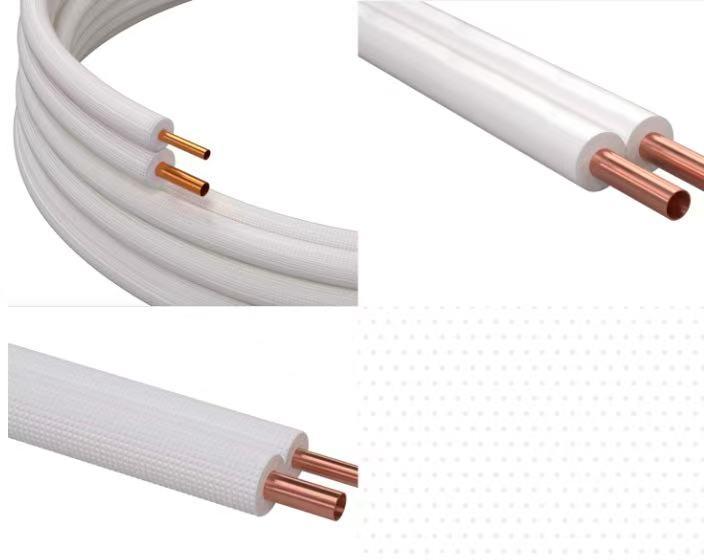
Length control is one of the core technical indicators for insulation pipe manufacturing machines, directly affecting product quality, production stability, transportation and on-site installation efficiency. Every insulation pipe production line has clear limits on the allowable pipe length, and these requirements come from mechanical structure, process characteristics and practical project demands.
First, the machine frame, supporting rollers, traction and cutting systems set the basic length boundary. Common standard production lengths are 6 meters and 12 meters for pre-insulated PU foam pipes used in district heating and HVAC systems. Longer pipes require extended machine beds, stronger support frames and synchronous traction to avoid pipe sagging, deflection or misalignment during feeding. If the raw inner pipe exceeds the designed maximum length, centering will fail, and the foam layer will show uneven density or local voids. For some semi-automatic tube threading machines, there is also an upper technical limit; excessively long pipes become difficult to feed smoothly.
Second, the foaming and forming process imposes strict length constraints. In batch foaming lines, the cavity length of the foaming platform decides the maximum pipe length. Too long a cavity makes it hard to maintain consistent material filling, temperature and curing conditions from one end to the other. Continuous extrusion or spray-winding lines can deliver longer products, yet they still rely on matched cooling sections. Insufficient cooling distance causes deformation before the insulation shell solidifies, which ruins straightness and dimensional accuracy. The cutting unit must also keep length tolerance stable, usually within a few millimeters for engineering-grade pipes.
Logistics and application standards further define practical length requirements. Standard lengths simplify truck loading, lifting and on-site welding. Custom longer lengths can reduce joint counts and lower heat loss at connections, but they demand customized machine layouts and special transport permits. Shorter pipes, meanwhile, are easier to handle for small HVAC and plumbing jobs, though they raise overall connection costs.
Manufacturers must balance machine capacity, process stability and customer specifications when selecting or configuring insulation pipe equipment. Ignoring the designed length range leads to high scrap rates and hidden risks in pipeline operation. Therefore, clear length parameters should be confirmed at the early stage of equipment selection to match the final project needs.

 English
 Arabic
 French
 Spanish
 Portuguese
 Deutsch
 Turkish
 Dutch
 Italiano
 Russian
 Romaian
 Greek
