

Pharmaceutical Logistics Market Growth Across North America: Technology and Cold Chain Developments
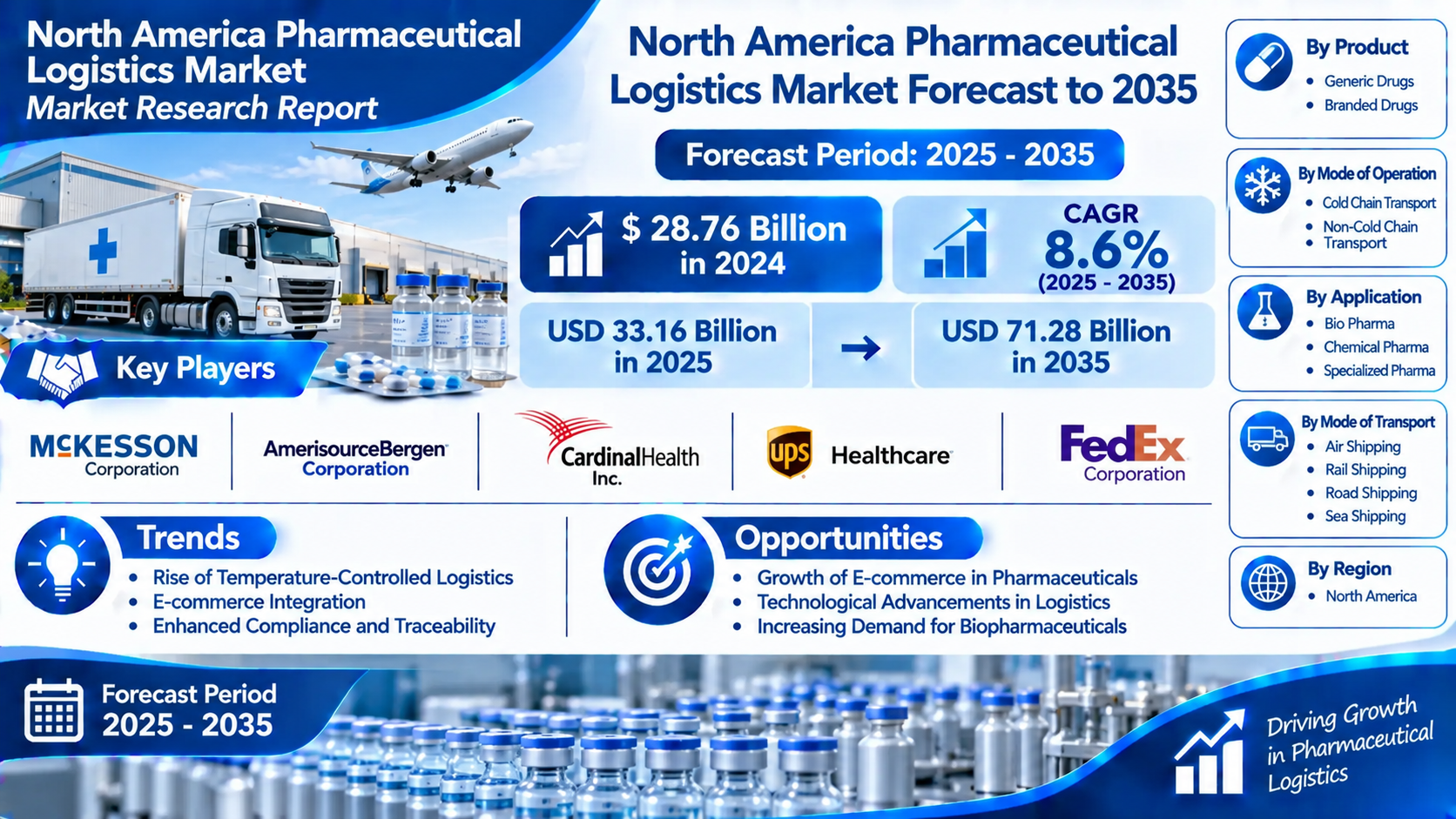
According to Market Research Future® (MRFR), the North America Pharmaceutical Logistics Market is projected to increase from USD 33.16 billion in 2025 to USD 71.28 billion by 2035, registering a compound annual growth rate (CAGR) of 8.6% during the forecast period from 2025 to 2035. The market was valued at USD 28.76 billion in 2024. Its expansion reflects the importance of reliable pharmaceutical distribution across North America, where temperature-controlled logistics, e-commerce integration, and enhanced compliance and traceability are shaping supply chain requirements. Demand for biopharmaceuticals and advances in logistics technology are also creating opportunities for market participants.
Market Overview and Growth Outlook
Pharmaceutical logistics encompasses the transportation and distribution activities required to move pharmaceutical products through supply chains. The North American market serves different product categories and pharmaceutical applications, with logistics providers supporting the movement of generic drugs, branded drugs, and specialized pharmaceutical products. The range of products handled makes transport conditions, operational planning, and regulatory compliance important considerations for companies serving this market.
The market's financial outlook indicates a period of substantial growth. Its valuation rose from USD 28.76 billion in 2024 to a projected USD 33.16 billion in 2025. By 2035, the market is expected to reach USD 71.28 billion. The forecast CAGR of 8.6% points to sustained expansion throughout the 2025–2035 period. This outlook is supported by developments in pharmaceutical distribution, growing demand for temperature-sensitive handling, and the increasing integration of technology into logistics operations.
Product Segmentation: Generic and Branded Drugs
The product-based segmentation covers generic drugs and branded drugs. Both categories contribute to pharmaceutical logistics demand, requiring distribution networks that can manage product movement from suppliers to their intended destinations.
Generic drugs form one part of the market's product mix. Their distribution requires logistics operations capable of supporting consistent product availability across supply channels. Branded drugs represent the other specified category and add to the range of products handled by logistics providers. Together, these segments demonstrate the breadth of pharmaceutical distribution activity across North America.
The distinction between generic and branded products is relevant to logistics planning because pharmaceutical supply chains must accommodate different products and customer requirements. Providers need operational capabilities that support reliable delivery while maintaining appropriate handling and traceability practices.
Mode of Operation: Cold Chain and Non-Cold Chain Transport
The market is divided by mode of operation into cold chain transport and non-cold chain transport. Cold chain logistics is a central area of industry development because certain pharmaceutical products require temperature-controlled conditions during transportation and distribution.
The rise of temperature-controlled logistics is identified as a key market trend. Maintaining appropriate conditions throughout the supply chain is important for products that are sensitive to temperature variation. This makes cold chain capabilities a significant consideration for logistics companies serving pharmaceutical manufacturers and distributors.
Non-cold chain transport represents the other major operational category. It supports the movement of pharmaceutical products that do not require the same temperature-controlled logistics arrangements. The coexistence of these two modes gives the market a varied operating structure, with providers required to manage different handling and transportation needs.
Pharmaceutical Applications and Specialized Requirements
The application segmentation includes Bio Pharma, Chemical Pharma, and Specialized Pharma. These categories reflect the different pharmaceutical activities served by logistics providers.
Bio Pharma is particularly relevant to the opportunity associated with increasing demand for biopharmaceuticals. As this category becomes an important focus for pharmaceutical supply chains, logistics providers face the need to support distribution requirements appropriate to the products being transported. Temperature-controlled logistics can be especially significant where products require specific handling conditions.
Chemical Pharma and Specialized Pharma complete the application segmentation. Their inclusion highlights the range of pharmaceutical products and activities represented in the North American market. Logistics operations must be structured to accommodate the requirements of these different application categories while maintaining reliable movement and supply chain visibility.
Modes of Transport and Distribution Networks
The market's transport segmentation includes air shipping, rail shipping, road shipping, and sea shipping. These modes provide different options for moving pharmaceutical products through regional and broader distribution networks.
Air shipping is one of the identified transport categories, while rail shipping and road shipping provide additional transportation options. Sea shipping completes the segmentation. The availability of multiple transport modes gives logistics providers a range of methods for organizing pharmaceutical movement according to operational requirements.
Choosing suitable transportation arrangements involves considerations such as delivery schedules, product handling, and the logistics network involved. For pharmaceutical supply chains, these decisions are connected with the need to maintain product integrity and ensure that shipments can be monitored throughout their journey.
Key Trends Shaping the Market
Three major trends are identified in the North American pharmaceutical logistics market. The first is the rise of temperature-controlled logistics. As pharmaceutical distribution increasingly includes products requiring controlled handling conditions, cold chain capabilities remain an important area of focus for logistics providers.
E-commerce integration is another trend influencing the market. Digital commerce is changing how pharmaceutical products are ordered and distributed, creating demand for logistics arrangements that can support evolving purchasing and delivery channels. The integration of e-commerce into pharmaceutical distribution also makes coordination and visibility important considerations.
Enhanced compliance and traceability form the third key trend. Pharmaceutical logistics providers operate in an environment where product handling and movement need to be appropriately monitored. Improved traceability can support supply chain visibility, while compliance remains essential to pharmaceutical distribution activities.
Market Opportunities and Competitive Landscape
The market offers opportunities through the growth of e-commerce in pharmaceuticals, technological advancements in logistics, and increasing demand for biopharmaceuticals. E-commerce growth can create additional requirements for distribution networks as digital purchasing channels become more integrated into pharmaceutical commerce.
Technological advancements provide another avenue for market development. Logistics technology can support operational coordination, shipment monitoring, and traceability. These capabilities are relevant to providers seeking to respond to the industry's emphasis on compliance and reliable product movement.
Increasing demand for biopharmaceuticals represents a further opportunity, particularly for logistics providers with capabilities suited to specialized pharmaceutical handling. The key companies identified in the market are McKesson Corporation, AmerisourceBergen Corporation, Cardinal Health Inc., UPS Healthcare, and FedEx Corporation. These participants operate within a competitive environment shaped by service capabilities, transportation networks, and the ability to address changing pharmaceutical distribution requirements.
Future Outlook
The North America pharmaceutical logistics market is projected to reach USD 71.28 billion by 2035, advancing at a CAGR of 8.6% from 2025 to 2035. Its development will be influenced by the distribution of generic and branded drugs, the requirements of Bio Pharma, Chemical Pharma, and Specialized Pharma applications, and the use of different transport modes.
Temperature-controlled logistics, e-commerce integration, and enhanced compliance and traceability are expected to remain important areas of industry attention. Alongside technological advancements and increasing demand for biopharmaceuticals, these developments provide a foundation for the market's anticipated expansion over the forecast period.

 English
 Arabic
 French
 Spanish
 Portuguese
 Deutsch
 Turkish
 Dutch
 Italiano
 Russian
 Romaian
 Portuguese (Brazil)
