

Europe Cloud Computing Market Growth: Public Cloud, Sovereignty, and AI
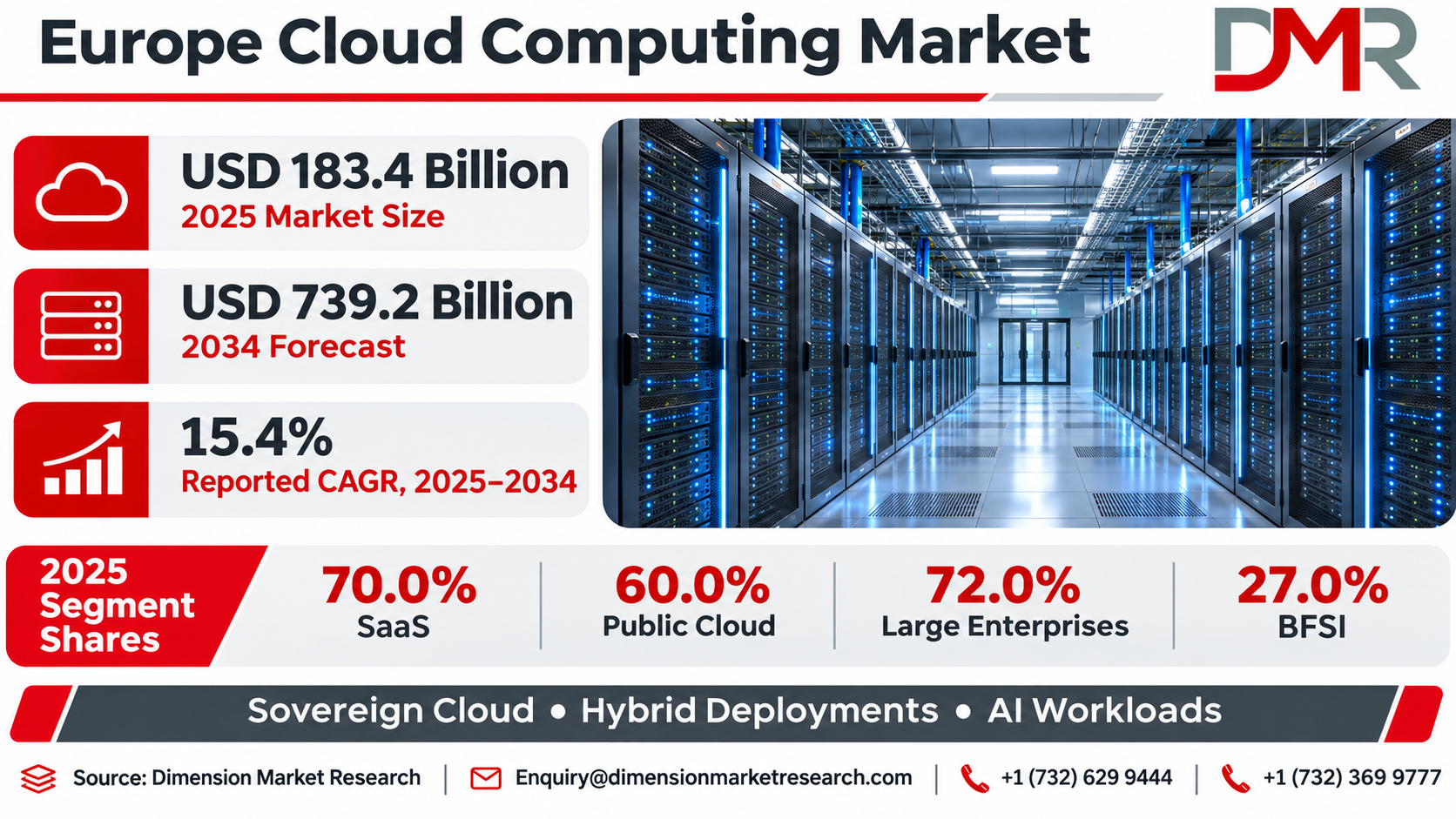
The Europe Cloud Computing Market Growth outlook reflects rising investment in digital infrastructure. According to Dimension Market Research, the market was estimated at USD 183.4 billion in 2025 and is projected to reach USD 739.2 billion by 2034, at a compound annual growth rate of 15.4% from 2025 to 2034. Enterprise modernization, hybrid cloud adoption, and the integration of AI into business applications are supporting demand.
For European businesses, a cloud purchase often starts with a decision about where a particular application should run. A customer-facing service may benefit from the ability to scale quickly, while an application that processes sensitive data may require closer control over where that data is stored and who can access it. Those decisions help explain why public cloud can lead by deployment model while hybrid and sovereign cloud offerings attract investment.
What Does the Europe Cloud Computing Market Cover?
The market covers computing resources, application development platforms, and software delivered through cloud environments. Infrastructure as a Service provides resources such as computing and storage. Platform as a Service gives teams an environment for developing and deploying applications. Software as a Service gives users access to applications managed by a provider. DMR also segments demand by deployment model, organization size, and industry.
The service and deployment decisions address different questions. The service model determines how much of the technology stack the customer manages. The deployment model determines where workloads run and how cloud resources are shared or connected. A large enterprise can use several service models while combining public and private environments.
Get a Free Customized Sample of This or Any Other Market Research Report
https://dimensionmarketresearch.com/request-sample/europe-cloud-computing-market/
Public Cloud Adoption and Financial Services Lead Key Segments
Three of DMR’s 2025 estimates show where demand was concentrated.
● Public cloud led by deployment model with an estimated 60.0% share. Its ability to scale capacity and make infrastructure accessible supports adoption across organization sizes.
● Large enterprises led by organization size with an estimated 72.0% share. DMR attributes their position to greater investment capacity and extensive IT estates that can support large deployments.
● Banking, financial services, and insurance (BFSI) led by industry with an estimated 27.0% share. Demand comes from legacy modernization, digital banking, and analytics for applications such as fraud detection.
Financial services illustrates how cloud adoption can vary within a single organization. A bank may prioritize scalability for a customer-facing application while migrating other workloads in stages because they depend on older systems or process sensitive information. For providers, the ability to support that transition can matter as much as the range of infrastructure available.
Hybrid Cloud and Data Sovereignty Shape Workload Placement
DMR identifies hybrid and multi-cloud deployments as ways organizations pursue greater flexibility and reduce dependence on a single provider. Demand for sovereign cloud also reflects buyer interest in data location, governance, and operational control. The report cites SAP’s September 2025 introduction of an On-Site model that allows customers to deploy SAP-managed cloud infrastructure on their own premises.
Migration and integration costs remain barriers. An application can depend on databases, services, and workflows that are harder to move than the application itself. For IT leaders, this makes the order of migration important. Moving a workload in stages can give teams time to test how it interacts with systems that remain in place. Concerns about security and sensitive data can also affect the pace of adoption.
AI Cloud Services and Edge Computing Create New Demand
The report identifies predictive analytics and automation as opportunities for AI-enabled cloud services. These services can help enterprises apply AI to existing workflows without building the entire computing environment internally. DMR cites NexGen Cloud’s April 2025 funding round to expand sovereign AI infrastructure in Europe, including on-demand access to graphics processing units.
Edge computing addresses a different need. In manufacturing, connected vehicles, and other environments where a fast response matters, processing some data closer to the device can reduce delays. For suppliers, this creates an opportunity to combine local processing with cloud services for applications where both response time and access to scalable infrastructure matter.
European Cloud Providers Compete on Infrastructure and Control
DMR covers Amazon Web Services (AWS), Microsoft Azure, Google Cloud, OVHcloud, and Deutsche Telekom, among others. The report identifies local data center capacity, partnerships, and energy efficiency as areas of competition. For buyers comparing providers, the commercial question is how well a service fits the workload’s requirements for integration, operating cost, and control over data.
Frequently Asked Questions
What is the size of the Europe Cloud Computing Market?
DMR estimated the market at USD 183.4 billion in 2025 and forecasts USD 739.2 billion by 2034.
What is the projected Europe Cloud Computing Market growth rate?
DMR projects a CAGR of 15.4% from 2025 to 2034.
Which cloud deployment model led in Europe in 2025?
Public cloud led the deployment segment with an estimated 60.0% share in 2025.
Which industry held the largest share of the Europe Cloud Computing Market?
Banking, financial services, and insurance led by industry with an estimated 27.0% share in 2025.
What factors are driving cloud computing demand in Europe?
Enterprise IT modernization, demand for scalable infrastructure, hybrid cloud adoption, and AI integration are supporting demand.
Conclusion
Through 2034, enterprise modernization and AI adoption are expected to support demand for cloud infrastructure in Europe. Public cloud’s scale makes it relevant across industries, while hybrid and sovereign offerings address more specific needs around workload placement and control. AI infrastructure and edge services give providers room to grow where customers need scalable computing alongside local processing or data governance.

 English
 Arabic
 French
 Spanish
 Portuguese
 Deutsch
 Dutch
 Italiano
 Russian
 Romaian
 Portuguese (Brazil)
 Greek
