

Nanoceramic Powder Market Forecast 2025–2035: Key Opportunities and Developments
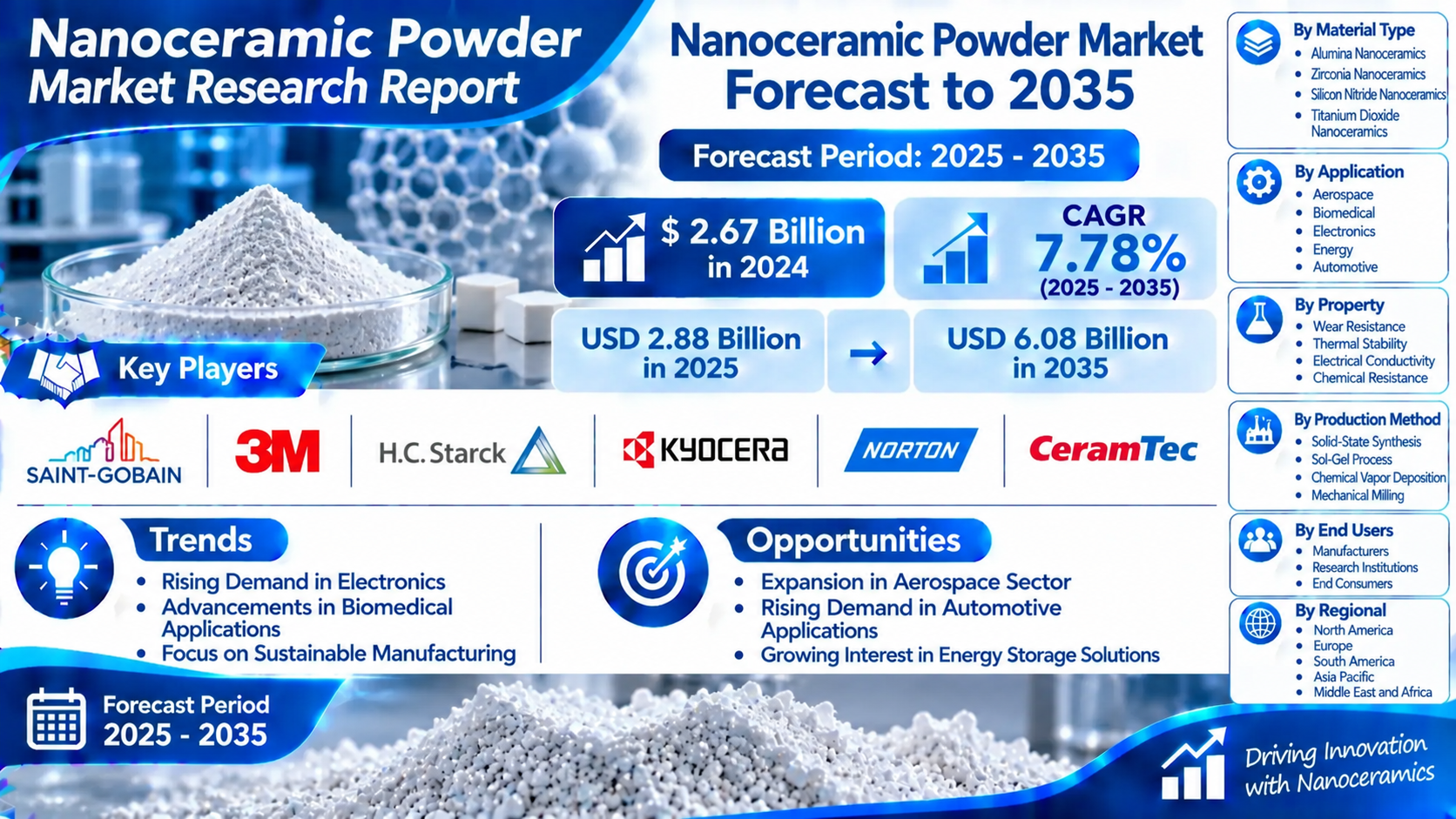
According to Market Research Future® (MRFR), the Nanoceramic Powder Market is projected to grow from USD 2.88 billion in 2025 to USD 6.08 billion by 2035, registering a compound annual growth rate (CAGR) of 7.78% during the forecast period of 2025–2035. The market was valued at USD 2.67 billion in 2024. Its expansion is associated with rising demand in electronics, advancements in biomedical applications, and a growing focus on sustainable manufacturing. Opportunities across aerospace, automotive, and energy storage applications are also contributing to the industry's growth outlook.
Market Overview and Growth Potential
Nanoceramic powders are relevant to industries that require advanced ceramic materials with specific performance properties. Their applications span several sectors, including aerospace, biomedical, electronics, energy, and automotive. As manufacturers and research institutions explore advanced materials for specialized requirements, nanoceramic powders are gaining attention across a broad industrial landscape.
The market's projected increase from USD 2.88 billion in 2025 to USD 6.08 billion by 2035 reflects the anticipated expansion of these applications. The 7.78% CAGR indicates sustained growth over the forecast period. Demand will be influenced by the development of end-use industries, improvements in production methods, and the ability of manufacturers to deliver powders suited to different material and performance requirements.
Material Types and Their Industrial Relevance
The market is segmented into Alumina Nanoceramics, Zirconia Nanoceramics, Silicon Nitride Nanoceramics, and Titanium Dioxide Nanoceramics. Each material category contributes to the overall product landscape and provides manufacturers with different options when selecting materials for particular applications.
The diversity of material types is important because industrial users do not have a single set of requirements. Applications across electronics, aerospace, biomedical products, energy, and automotive manufacturing may call for different combinations of material properties. The availability of multiple nanoceramic categories therefore supports a varied market structure.
Manufacturers' ability to produce and supply these material types consistently will remain important as demand develops. Research activity and advances in material processing can also influence how these categories are adopted in commercial and specialized applications.
Applications Across High-Value Industries
Aerospace, Biomedical, Electronics, Energy, and Automotive are the five application segments identified in the report. These industries provide different sources of demand for nanoceramic powders.
Electronics is a notable area of market interest, with Rising Demand in Electronics identified as a key trend. The continued development of electronic products and components creates opportunities for advanced materials that meet specialized performance requirements. The market's growth will depend partly on how nanoceramic powders are incorporated into evolving manufacturing processes.
Biomedical applications are another important area. Advancements in Biomedical Applications are identified as a major trend, reflecting the growing relevance of nanoceramic materials in this field. Research and product development can contribute to new uses, although commercial adoption will depend on application requirements and the ability to meet relevant standards.
Aerospace and automotive applications offer further growth opportunities. Expansion in the Aerospace Sector and Rising Demand in Automotive Applications are specifically identified as opportunities for the market. Energy applications also provide a potential growth area, particularly as interest in energy storage solutions increases.
Performance Properties and Product Requirements
The market is categorized by Wear Resistance, Thermal Stability, Electrical Conductivity, and Chemical Resistance. These properties provide a framework for understanding the requirements that influence the selection of nanoceramic powders.
Different industries prioritize different performance characteristics. Wear resistance and chemical resistance may be relevant to demanding operating environments, while thermal stability and electrical conductivity are important considerations in applications with specific thermal or electrical requirements. The relevance of each property depends on the intended product and operating conditions.
This property-based segmentation demonstrates the importance of matching material characteristics with end-user needs. Producers that can respond to varied technical requirements may be better positioned to serve a diverse customer base.
Production Methods and Manufacturing Development
The production methods covered in the report include Solid-State Synthesis, Sol-Gel Process, Chemical Vapor Deposition, and Mechanical Milling. These approaches form an important part of the market's manufacturing landscape.
Production methods influence how nanoceramic powders are developed and supplied. Manufacturers must consider process requirements, consistency, and suitability for the intended material type and application. Improvements in production techniques can support the industry's ability to meet changing customer requirements.
A focus on Sustainable Manufacturing is also identified as a key market trend. This emphasis places attention on production practices and the broader environmental considerations associated with manufacturing. As sustainability becomes more prominent in industrial decision-making, producers may face increasing pressure to evaluate resource use and manufacturing processes.
End Users and Regional Development
The end-user segmentation includes Manufacturers, Research Institutions, and End Consumers. Manufacturers represent an important customer group because nanoceramic powders are used as inputs in industrial production. Research institutions contribute through material investigation and application development, while end consumers form the third category identified in the report.
The regional market covers North America, Europe, South America, Asia Pacific, and the Middle East and Africa. Conditions across these regions may vary according to industrial activity, research capabilities, manufacturing infrastructure, and demand from key application sectors. Regional differences will influence market development and the pace at which nanoceramic powder applications expand.
Competitive Landscape
The key players identified in the market are Saint-Gobain, 3M, H.C. Starck, Kyocera Corporation, Norton Abrasives, and CeramTec. These companies form part of the competitive environment for advanced ceramic materials.
Competition is shaped by product development, manufacturing capabilities, material expertise, and the ability to serve multiple end-use industries. As applications develop across electronics, biomedical, aerospace, automotive, and energy sectors, companies will need to align their offerings with changing performance requirements and production needs.
Market Outlook Through 2035
The Nanoceramic Powder Market is forecast to reach USD 6.08 billion by 2035, supported by a CAGR of 7.78% between 2025 and 2035. Rising demand in electronics, advancements in biomedical applications, and sustainable manufacturing priorities are important trends. Expansion in aerospace, automotive applications, and energy storage solutions provides further opportunities. The industry's future growth will depend on material innovation, production development, and adoption across its diverse end-user sectors.

 English
 Arabic
 French
 Spanish
 Deutsch
 Turkish
 Dutch
 Italiano
 Russian
 Romaian
 Portuguese (Brazil)
 Greek
