

Is Sirsasana Really the King of Yoga Poses, or Have We Overestimated Its Benefits?
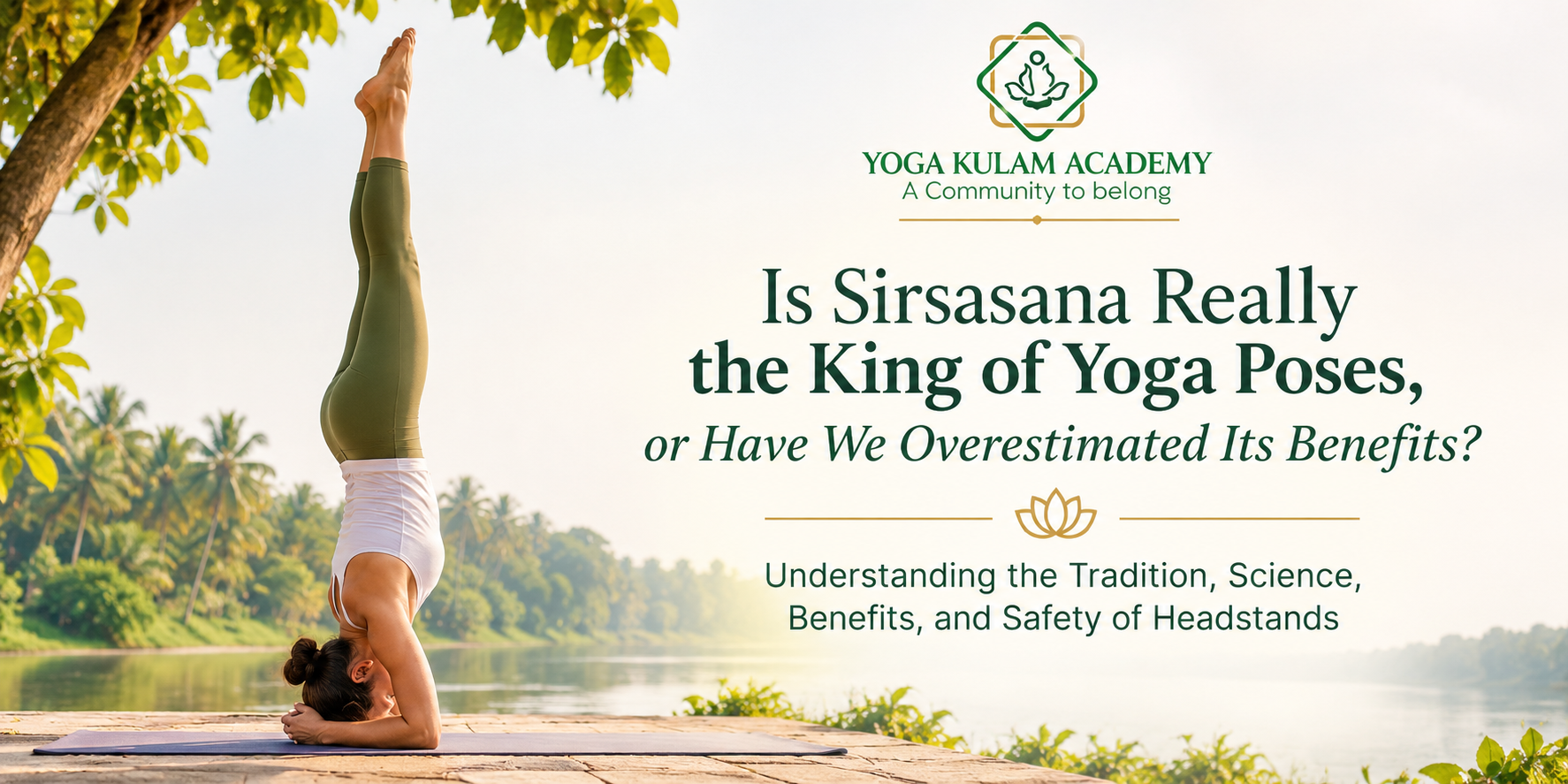
Understanding the Traditional Significance, Scientific Evidence, and Safety Considerations of Headstands
Walk into a yoga studio, and you may notice something interesting. While some students are practising simple standing postures, others are attempting to balance upside down on their heads. The headstand often attracts attention because it looks challenging, requires concentration, and is associated with advanced yoga practice. But does mastering Sirsasana actually make someone a better yogi? It is a question worth considering whether you practise independently or are exploring 200 hour yoga teacher training kerala.
Sirsasana, commonly known as Headstand, has long been celebrated in several modern yoga traditions as the King of Asanas.
Supporters describe it as a posture that develops balance, concentration, and physical control. Some even claim it improves memory, increases blood circulation to the brain, and supports hormonal health.
But how much of this is supported by evidence?
And more importantly, does everyone need to practise Sirsasana to experience meaningful progress in yoga?
Why Is Sirsasana Called the King of Asanas?
The title King of Asanas is particularly associated with influential modern yoga traditions, including the teachings of B.K.S. Iyengar.
In these traditions, Sirsasana holds a respected place because it requires considerable coordination, stability, and attention.
Unlike ordinary standing postures, a headstand changes the body's relationship with gravity.
Practitioners must maintain balance while supporting their body in an unfamiliar position.
This demands preparation and control.
However, calling Sirsasana the king of yoga poses is a traditional description, not a scientific ranking.
It does not mean the posture is universally superior to every other asana.
Yoga includes a wide range of practices, and different postures serve different purposes.
What Actually Happens When You Perform a Headstand?
During Sirsasana, the body is inverted, with the head below the heart and the legs extending upward.
Maintaining this position requires muscular coordination involving the shoulders, arms, trunk, and other supporting muscles.
The neck also experiences loading, depending on the technique used.
Balance becomes more demanding because the body's usual points of support have changed.
For experienced practitioners, these challenges may provide an opportunity to develop movement control.
However, successfully maintaining a headstand does not automatically indicate superior fitness, concentration, or overall health.
A person who cannot perform Sirsasana may still have excellent strength, balance, and body awareness.
Does Sirsasana Increase Blood Flow to the Brain?
One of the most repeated claims about headstands is that turning upside down sends more blood to the brain.
This sounds reasonable at first.
After all, gravity influences the movement of fluids throughout the body.
But the human circulatory system is more complicated.
The brain has mechanisms that help regulate its blood supply despite changes in body position.
A small study examining blood flow through the internal carotid artery during Sirsasana found that headstands did not increase blood flow in the way commonly claimed.
The findings challenge the idea that inversion automatically provides the brain with additional nourishment or oxygen.
More research is needed to understand all the physiological effects of headstands.
However, claims that Sirsasana improves memory or intelligence by increasing cerebral blood flow should not be presented as established facts.
Can Headstands Improve Strength and Balance?
Sirsasana requires muscular control and balance.
Experienced practitioners may develop skills through the process of preparing for and maintaining the posture.
However, strength and balance can also improve through many other exercises.
Plank Pose, Dolphin Pose, standing balances, and appropriately challenging movement sequences can develop similar underlying abilities without requiring full inversion.
Students interested in hatha yoga certification kerala should understand that yoga education involves learning the purpose of different movements rather than ranking postures according to difficulty.
A challenging posture is not automatically the most effective one.
The appropriate exercise depends on the student's goals, experience, and physical condition.
What About Concentration and Mental Clarity?
Some practitioners describe feeling highly focused during Sirsasana.
This is understandable.
Balancing upside down requires attention to physical position and movement.
However, the experience of concentration is not unique to headstands.
A simple standing balance can require considerable focus.
Meditation, pranayama, and mindful movement also provide opportunities to develop attention.
There is currently insufficient high-quality evidence to conclude that Sirsasana produces greater mental clarity than other appropriate yoga practices.
Personal experiences may be meaningful, but they should not be treated as proof of universal benefits.
The Risks That Are Often Overlooked
Because Sirsasana is frequently celebrated, its risks sometimes receive less attention.
The posture places demands on the neck, shoulders, and supporting structures.
Poor technique, inadequate preparation, or loss of balance may increase the risk of injury.
Research has also shown that headstands can temporarily increase pressure inside the eyes.
This is particularly relevant for people with glaucoma or certain other eye conditions.
Individuals with neck problems, relevant cardiovascular or blood-pressure concerns, or other medical conditions should obtain appropriate professional advice before attempting headstands.
Pregnant practitioners also need individual medical and qualified instructional guidance because balance and other physical circumstances may change.
Students seeking the Best yoga teacher training kerala should look for programs that explain these precautions rather than presenting advanced inversions as compulsory achievements.
Should Beginners Practise Sirsasana?
Beginners generally do not need to include full headstands in their yoga practice.
Sirsasana requires preparation, strength, coordination, and appropriate supervision.
Attempting it simply because it appears impressive on social media can create unnecessary risks.
A more sensible approach involves developing foundational movement skills.
Students can work on appropriate shoulder stability, trunk control, and balance through suitable exercises.
A qualified instructor can assess whether further progression is appropriate.
However, not everyone needs to progress toward a full headstand.
There is nothing incomplete about a yoga practice that never includes Sirsasana.
Can You Experience Yoga's Benefits Without Headstands?
Absolutely.
Yoga is much broader than performing advanced physical postures.
A meaningful practice may include standing asanas, seated movements, pranayama, meditation, relaxation, and philosophical reflection.
These activities provide different opportunities for physical and mental engagement.
Someone attending a 100 hour yoga teacher training kerala program may spend considerable time developing foundational knowledge.
Students might explore basic alignment, breathing techniques, and traditional yoga philosophy.
These subjects can provide a valuable educational foundation without requiring advanced inversions.
The quality of learning matters more than the number of difficult postures performed.
Why Yoga Teachers Should Avoid Treating Headstands as a Requirement
Yoga teachers influence how students interpret progress.
When an instructor describes Sirsasana as the ultimate achievement, beginners may feel pressured to attempt it before they are ready.
A more responsible approach explains that advanced postures are optional and require individual assessment.
Teachers should understand movement principles, appropriate modifications, and professional boundaries.
A comprehensive yoga teacher training kerala india program should encourage students to recognise physical differences rather than expect everyone to perform identical postures.
Some students may eventually practise Sirsasana under suitable supervision.
Others may choose alternative exercises.
Both decisions can be appropriate.
Does Advanced Yoga Training Mean More Advanced Poses?
Not necessarily.
The word advanced is often misunderstood in yoga.
Many people associate advanced practice with difficult inversions, deep backbends, or complex balances.
But advanced education should also involve deeper understanding.
Students pursuing a 300 hour yoga teacher training kerala course may study anatomy, philosophy, pranayama, sequencing, and teaching methodology in greater detail.
These subjects can strengthen professional judgment.
An experienced yoga instructor may recognise when a simpler variation provides a better learning experience.
They may also know when a particular movement should be avoided.
Such decisions demonstrate teaching knowledge that cannot be measured through a photograph of an advanced posture.
What Should You Look for in a Yoga School?
When choosing a yoga school, consider how it approaches challenging postures.
Does the curriculum include anatomy and movement principles?
Are students taught appropriate modifications?
Do instructors explain the potential risks of inversions?
Is practical teaching experience included?
Can students ask questions without feeling pressured?
These details reveal how seriously a school approaches responsible instruction.
When comparing the top yoga schools in kerala, look beyond photographs of students performing difficult asanas.
A supportive learning environment should develop understanding, confidence, and sound judgment.
The Real Meaning of Progress in Yoga
Imagine two yoga practitioners.
One can hold a headstand for several minutes.
The other cannot perform Sirsasana but practises regularly, understands personal limitations, and maintains a thoughtful routine.
Who is more advanced?
There is no reliable way to determine that from a single posture.
Physical ability represents only one dimension of yoga practice.
Traditional yoga also explores concentration, discipline, self-study, ethical conduct, and philosophical understanding.
A person may develop these qualities without ever turning upside down.
This is why yoga should not be reduced to a competition between physical achievements.
Final Thoughts
Sirsasana has an important place in several yoga traditions, and experienced practitioners may find it physically challenging and personally meaningful.
However, calling it the King of Asanas does not make it scientifically superior to every other yoga posture.
Claims about dramatically increasing brain circulation, improving intelligence, or producing exceptional health benefits remain unsupported or insufficiently established.
Headstands also carry risks that deserve careful consideration.
For yoga students, the most important lesson is not whether they can master Sirsasana.
It is whether they understand their practice and make informed decisions about their bodies.
A headstand may demonstrate balance and control, but meaningful yoga practice is not measured by how long you can remain upside down.

 English
 Arabic
 French
 Spanish
 Portuguese
 Deutsch
 Turkish
 Dutch
 Italiano
 Russian
 Portuguese (Brazil)
 Greek
