

Lathe Chuck Limitations
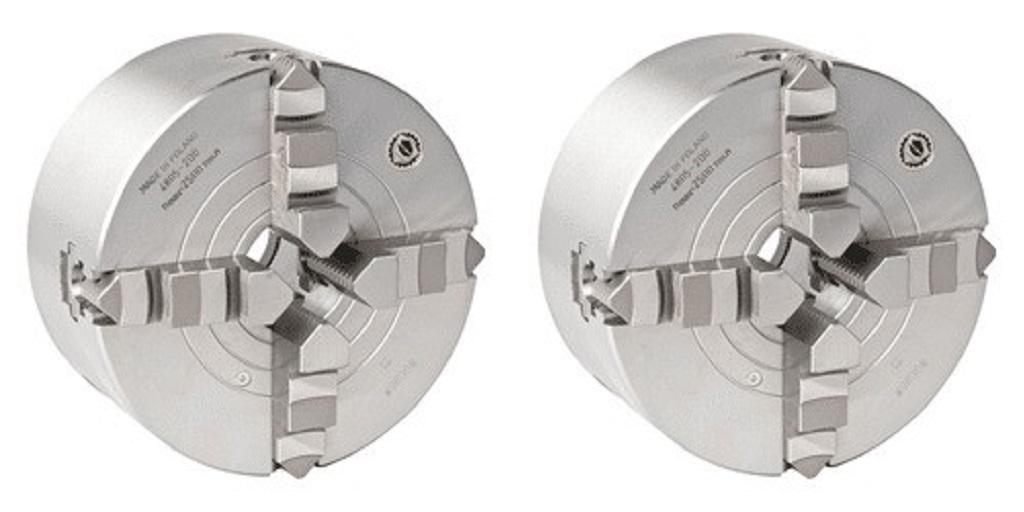
There are many different types of lathe chucks, some of which are self-centering and which offer easy tightening from a single point of contact that engages all jaws simultaneously. Others offer independent jaw tightening that offers better control over asymmetrical, eccentric workpieces.
That said, there are limitations to what lathe chucks can do, of which machinists must be aware in order to protect the quality of the finished workpiece, as well as to prevent rework as a result of damage or low quality control. Here are a few things to know.
Speed
Manufacturer recommendations for operating speed are one thing; it is equally important to recognize that at high speeds, outward, centrifugal forces naturally cause the jaws of the lathe chuck to lose grip pressure on the workpiece. As speed increases, grip pressure can drop dramatically, resulting in loss of control over the workpiece which can cause vibration, chatter and a lower quality finish.
Limited Points of Contact
Lathe chucks have jaws, unlike full-wrap collets. Because of this, pressure is unevenly distributed around the workpiece at each point of contact, which can result in deformation of the workpiece if it is a fragile material, a hollow material, or if the lathe chuck’s jaws are overtightened. This becomes especially concerning if the jaws are overtightened to compensate for higher operating speeds. At some point, operating speed and jaw pressure have to be balanced with the requirements of the workpiece.
Overtightening (“Three Jaw Triangle Effect”)
The “three jaw triangle effect” is a phenomenon that primarily occurs when a cylindrical workpiece is clamped into a three-jaw lathe chuck. When too much pressure is applied in order to properly secure the workpiece, it can deform the cross-section of the workpiece from a concentric cylinder to a triangle, ruining it in the process.
Workpiece Support
Longer, heavier workpieces that are only supported on one end by a lathe chuck can experience harmonic irregularities at high speeds, which can cause them to wobble or vibrate, which in turn causes chatter. The longer a workpiece is, the more force is exerted on the lathe chuck from the disparity of mass at the other end. In some cases, larger workpieces may require a tailstock or the additional support of a steady rest.
Independent Lathe Chucks Offer Greater Flexibility for Eccentric Workpieces
While self-centering chucks are convenient and easy to use, they are not the best for eccentric workpieces since each jaw cannot be adjusted independently. Though it increases labor and involvement, lathe chucks with independent jaws are often a much better option for eccentric workpieces that need more specialized support than symmetrical workpieces that can be easily supported (and relatively well) by chucks with self-centering jaws.
Shop Lathe Chucks and Other Machine Tool Accessories at TMT Toolbox
Hopefully you found this article informative, even though it only covers some of the limitations of lathe chucks from a very high level. If you landed here because you need a reliable supplier of high-quality machine tools and accessories, visit TMT Toolbox. They carry a wide range of hand and machine tools along with accessories, all at competitive prices. Visit their website and get in touch with them if you need more information.
For more information about Milling Inserts and Dormer end mills Please visit: TMT Toolbox.

 English
 Arabic
 French
 Spanish
 Portuguese
 Deutsch
 Turkish
 Dutch
 Italiano
 Romaian
 Portuguese (Brazil)
 Greek
