

How edForce Designs Training Around Real Work, Not Just Theory
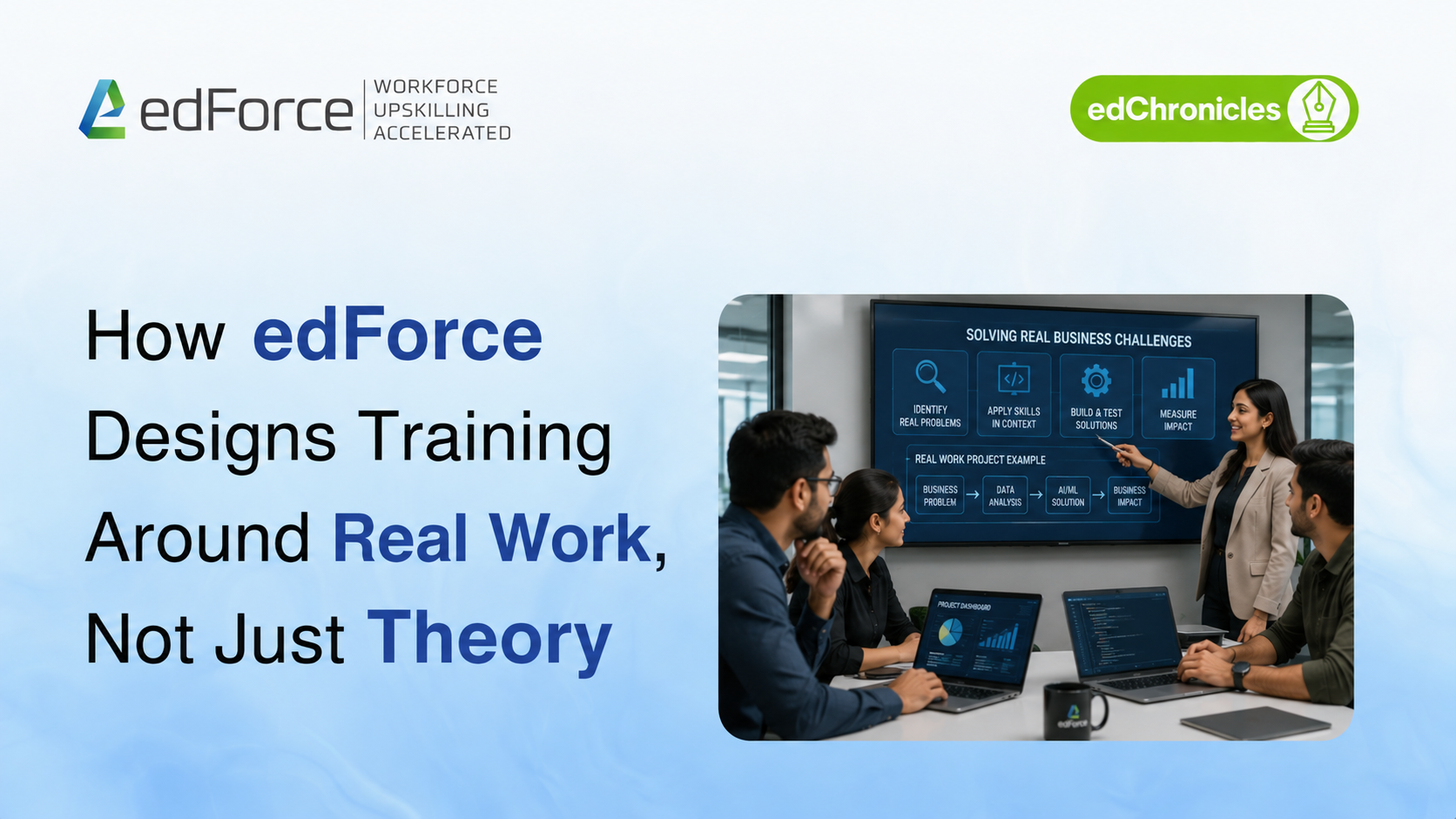
A developer is not struggling with AI simply because they can't remember what a Transformer Model is.
When an AI-generated suggestion of code breaks a workflow, they are frustrated.
Finance professionals do not need to be told again that AI can analyze documents. They must know how to apply it to a real report, without exposing sensitive data or relying on an incorrect result.
Corporate training can often miss the point. The technology may be taught to employees, but the actual work it is meant to improve will not always be covered.
This distinction becomes more important as businesses invest in AI, cloud computing, data, cybersecurity and other rapidly changing technical skills. According to the Future of Jobs Report for 2025 by the World Economic Forum, 63% of employers view skills gaps as major barriers to business transformation. AI and big data were also cited as two of the fastest-growing skills areas.
The challenge for organisations is not just finding the right training.
The training must be designed so that employees can use it.
The training should start with the job, not the technology
Traditional Agentic AI training begins with a topic.
Let's teach generative AI.
Let's train our employees about cloud computing.
Let's introduce cyber security.
The work-focused approach begins elsewhere.
What is the employee's task?
This question can change the learning design.
A software engineer's AI program might be focused on code generation and debugging. It could also include testing, documentation and model integration. The same technology can be used by a business analyst to conduct research, interpret data, create reports, and validate results.
The technology is identical.
It is not the work.
Gartner's latest guidance on AI-ready workplace development also makes the same point: Training is more effective if it's aligned to what employees do, the risks they face in making decisions, and the judgment required for those roles.
This is the basis of a model for learning that is aligned with your job.
Real problems make for better training exercises
During practice, the difference between theory and practical application is evident.
Imagine teaching cloud computing using a series of slides. Employees might understand terms like containers, orchestration and scalability.
Give them a scenario that is realistic.
Unpredictable traffic is experienced by a business application. Infrastructure costs are increasing. A deployment failed. The team must identify the problem, and then improve the environment while avoiding creating new security risks.
The way we learn suddenly changes.
Employees are required to apply knowledge, solve problems, troubleshoot and explain their decisions.
This is more like the pressure that they will experience at work.
This method also reveals gaps that can be missed by traditional assessments. A person may pass a test of knowledge but struggle to combine concepts in order to solve a workplace problem.
The best learning paths follow a skill journey
It is rare that a person develops real capability in a single session.
Employees typically move through different stages.
They need to first understand the concept. They need to be guided through practice. Then, they must solve increasingly real problems with less help.
The following is a good starting point for a strong learning pathway:
Understanding - Practice - Apply - Assess and Improve
It is important to assess the skill.
The test should not just ask if the employee can recall the material. It should test whether the employee can apply their skill in a situation similar to that of their job.
This could include writing code and reviewing it, configuring infrastructure, analysing data or building an AI workflow. It might also involve responding to security incidents, explaining technical recommendations to business stakeholders, or resolving a security issue.
It is not just about completing the course.
This is workplace readiness.
Role-Based learning prevents the "One course for everyone" problem
One of the most common mistakes made in enterprise training is to assume that everyone requires the same curriculum.
They don't.
A cloud architect, developer and IT manager may work with the exact same technology, but require very different levels of expertise.
Gartner’s research for 2026 recommends that AI skill development be scaled using persona-based and role-based training, as different employees will have different learning needs.
It is also easier to justify training investments.
Organisations can build their learning around the specific skills needed for each job role, rather than asking all employees to complete the same program.
This means less training just for the sake of training and more development based on business capabilities.
The Learning Must Continue After the Course Has Ended
The Monday morning effect is a common problem in corporate training.
The employees attend a training course. They gain useful knowledge. They are back to their full workload. A few weeks later, the majority of what was learned is lost because it wasn't put into practice.
Real-Work Training addresses this issue by integrating learning with ongoing tasks.
Employees can practice with familiar tools, solve real problems, receive feedback and return to their skills when a new challenge arises.
AI is a special case.
The tools and models change too fast for employees to rely solely on instructions that they have memorised. Knowing how to solve a problem, assess an AI output and verify information is a more durable skill.
The World Economic Forum has also identified analytical thinking, creativity, adaptability and technological literacy as important skills for the future.
Training should connect skills to business outcomes
When leaders are able to answer a single question, a training programme is more valuable.
What can employees do to improve their performance?
One team may find that the solution is faster development.
Another example could be fewer cloud incidents, improved data analysis, strengthened security practices or a more effective use of AI.
This is a good way to create a link between business performance and learning.
Organisations can measure success by looking at the capability of employees, rather than just attendance or completion rates. Can employees complete the task? Can they come up with a different version of the issue? Can they see a difference in the work being done by their employees?
This is a stronger definition of success in training.
The real advantage is building a capability that can adapt
While technology is constantly changing, it is impossible to fix the training for technology.
A program designed around a single tool can become obsolete. Programmes that are designed to address problem-solving and technical foundations as well as workflows and decision-making have a greater chance of staying relevant.
This is a particularly important moment.
AI changes the tasks within existing jobs, rather than creating a new category of "AI Work." Organisations need employees with a combination of technology skills, domain knowledge and sound judgment.
The future of corporate training will focus less on completing courses, and more on building capabilities around the actual work.
The best team training is not a technology course that requires employees to leave their job to learn.
This brings technology back to the workplace.
The real test of learning isn't what someone can say after training. What they can do when they return to their jobs is the true measure of learning.

 English
 Arabic
 French
 Spanish
 Portuguese
 Turkish
 Dutch
Dutch
 Italiano
 Russian
 Romaian
 Portuguese (Brazil)
 Greek
Greek
