

CBSE Board Exam 2027: How to Balance School, Coaching, and Self-Study
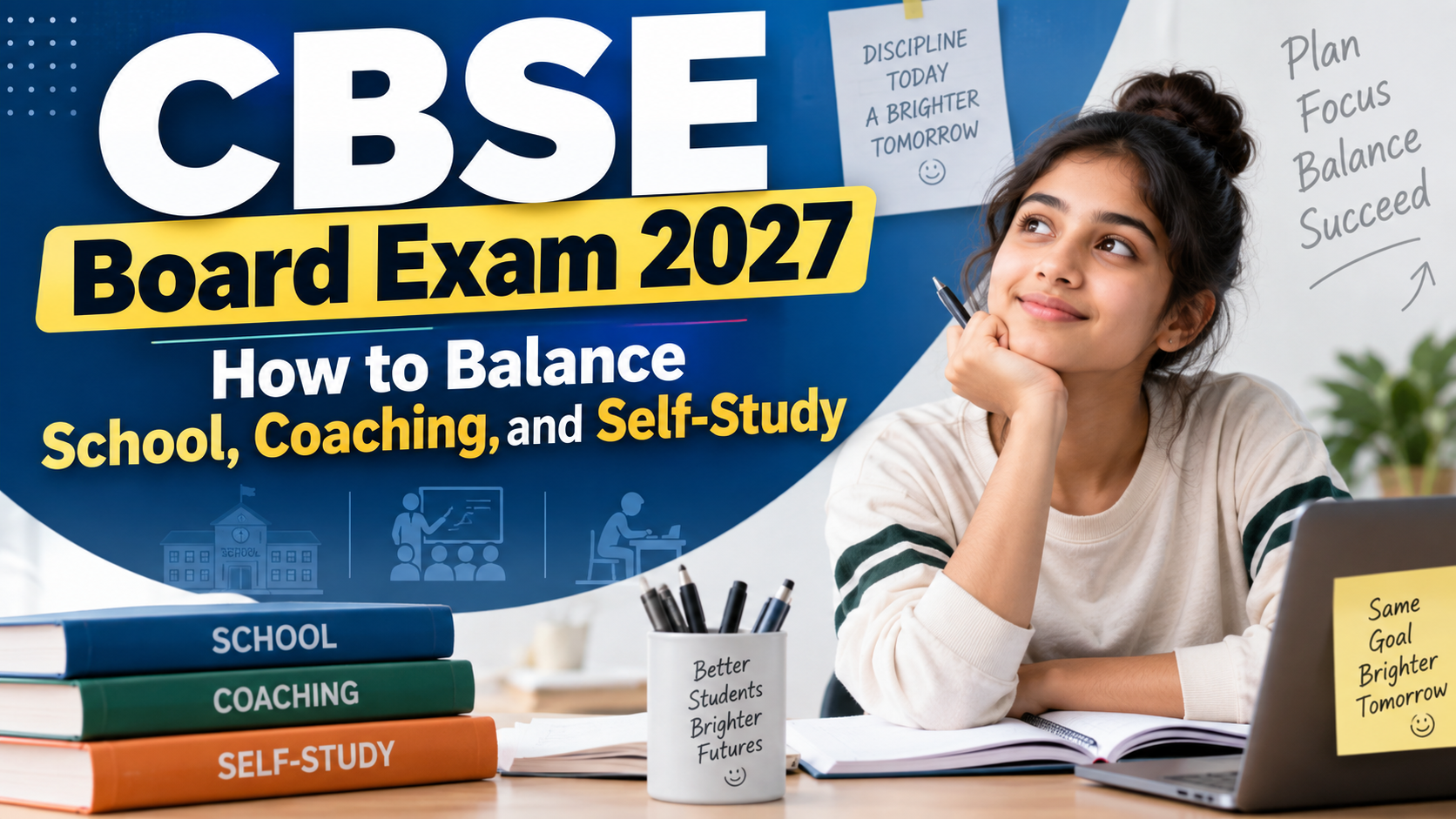
Every year, as winter turns to spring, a familiar restlessness settles over Class 10 and Class 12 households across the country. Timetables get taped to bedroom walls, phone screens dim earlier, and dinner conversations start revolving around one question: "Is the syllabus done yet?" For students appearing in the CBSE Board Exam 2027, that season is closer than it feels, and the pressure of juggling three very different demands regular school, coaching classes, and independent study can turn preparation into a source of anxiety rather than confidence.
The good news is that this juggling act is entirely manageable once you understand how the three pieces are meant to work together rather than compete with each other. Parents evaluating options often start by researching the Best CBSE School in Sikar to build a strong academic foundation, but even the finest institution can't do the work of balance for a student. That has to be built deliberately, through habits and choices made day after day.
This article breaks down a realistic, sustainable approach to managing school, coaching, and self-study for the 2027 board exams, without sacrificing sleep, sanity, or the subjects that don't get as much attention as Physics and Math.
Why This Balance Feels So Hard in the First Place
Before jumping into solutions, it helps to understand why students genuinely struggle here. School consumes six to seven hours of the day and demands attention across five or six subjects at once. Coaching, layered on top, often focuses narrowly on two or three subjects with an intensity that assumes students have nothing else going on. Self-study, meanwhile, is the piece most likely to get squeezed out entirely, because unlike school and coaching, no one is enforcing it with a bell or a fee receipt.
The result is a schedule where a student might spend eight or nine hours a day physically present in a classroom of some kind, yet still feel unprepared, because passive listening was never the same thing as actual learning. Understanding this distinction is the first step toward fixing it.
Start With an Honest Time Audit
Most students underestimate how much time actually exists in a day and overestimate how productively they're using it. Before building any new schedule, spend three or four days simply logging how your current time is spent, in thirty-minute blocks if possible.
You'll likely notice a few patterns:
-
Commute time to and from coaching that could be used for quick revision or audio recall
-
Long gaps between school ending and coaching beginning that dissolve into scrolling
-
Weekend mornings that feel "free" but rarely get used with intention
-
Late-night cramming sessions that produce diminishing returns after a certain point
This audit isn't about guilt. It's diagnostic information that tells you where the real time is hiding.
Treat School, Coaching, and Self-Study as Three Different Jobs
One of the biggest mistakes students make is treating all study time as interchangeable, as though an hour in a coaching class equals an hour of self-study. It doesn't, because each setting serves a different purpose.
School builds your conceptual foundation and, crucially, prepares you for the exact format and marking scheme of the CBSE board paper. Internal assessments, practicals, and project work also happen here, and these contribute meaningfully to your final scores.
Coaching typically accelerates problem-solving speed and exposes you to a broader range of question types, particularly for competitive exam-oriented subjects. It's valuable, but it's supplementary by design, not a replacement for classroom learning.
Self-study is where actual retention happens. This is the time when you revisit what you've absorbed, identify gaps, attempt problems independently, and consolidate everything into memory that survives exam-day pressure. Skipping or shortchanging this stage is the single most common reason bright students underperform relative to their effort.
Recognizing these as separate functions, rather than three overlapping versions of the same thing, changes how you allocate energy across them.
Build a Weekly Structure, Not Just a Daily One
Daily to-do lists feel productive but often fail because they don't account for how energy and attention fluctuate across a week. A better approach is to plan at the weekly level first, then break it into days.
A workable structure for most CBSE students preparing for 2027 boards might look like this:
-
Weekday mornings before school: Light revision of the previous day's coaching or school content, roughly 30-40 minutes
-
After-school and pre-coaching gap: A short break followed by homework or NCERT-based practice
-
Post-coaching evenings: Focused self-study on subjects not covered that day in coaching, since these otherwise get neglected
-
Weekends: Longer blocks for mock tests, weak-topic revision, and catching up on subjects like languages or social science, which frequently lose out to Science and Math during the week
The specific hours matter less than the principle: give every subject a home in your week, and don't let coaching subjects silently crowd out the rest.
Don't Let Coaching Subjects Eclipse the Others
This is worth calling out separately because it happens so consistently. Students enrolled in coaching for Physics, Chemistry, and Math often find that these three subjects absorb almost all their self-study time too, simply because coaching homework is due and feels urgent. Meanwhile, English, Hindi, and Social Science, which together can carry substantial weight in the final percentage, get pushed to "later."
Later rarely comes. A practical fix is to ring-fence a fixed, non-negotiable slot each week, even just three or four hours, exclusively for non-coaching subjects. Treat this slot with the same seriousness as a coaching class you can't skip.
Make Self-Study Active, Not Passive
Sitting with a textbook open for two hours doesn't guarantee two hours of learning. Active self-study techniques consistently outperform passive rereading, and they don't require extra time, just a shift in method.
-
Recall practice: Close the book and write down everything you remember about a topic before checking what you missed
-
Teach-back method: Explain a concept out loud, or to a sibling or friend, as though they know nothing about it
-
Spaced repetition: Revisit topics at increasing intervals rather than cramming them once and moving on
-
Solve before you check: Attempt problems fully before looking at solutions, even if it means sitting with confusion for a few extra minutes
-
Sample papers under timed conditions: Simulate the actual exam environment at least once every two weeks as the exam approaches
These methods take the same hour but produce noticeably better retention than passive review.
Protect Sleep and Downtime Like They're Part of the Syllabus
It's tempting, especially in the final months before the CBSE Board Exam 2027, to treat sleep as an expendable resource. This backfires more often than not. Memory consolidation happens largely during sleep, and chronic sleep deprivation measurably impairs concentration, problem-solving speed, and mood regulation, all of which directly affect exam performance.
Aim for seven to eight hours of sleep as a baseline, not an aspiration. Similarly, build in short breaks between study blocks, ideally involving movement rather than screens, since a five-minute walk restores focus far better than five minutes of reels.
Communicate With Parents and Teachers
Balance isn't a problem students should have to solve entirely alone. If a coaching schedule is genuinely leaving no room for self-study or rest, that's worth a direct conversation, whether with parents about adjusting coaching hours, or with school teachers about which topics need extra clarification versus which are already solid from coaching.
Teachers, in particular, can offer insight into what the board exam actually rewards, since they're familiar with CBSE's marking patterns and frequently asked question types in a way that generic coaching material sometimes isn't.
A Sample Framework to Adapt
No single schedule fits every student, but here's a framework worth adapting to your own subjects and energy patterns:
-
Monday to Friday: School hours, followed by coaching, followed by one to two hours of active self-study focused on same-day content
-
One weekday evening reserved entirely for non-coaching subjects
-
Saturday: Full-length mock test or extended problem-solving session in a weak subject
-
Sunday: Lighter day, covering revision, doubt-clearing, and genuine rest
Adjust the proportions based on how close you are to the exam. Six months out, the balance can lean more toward concept-building. Six weeks out, it should shift heavily toward revision and timed practice.
Conclusion
Balancing school, coaching, and self-study for the CBSE Board Exam 2027 isn't about finding more hours in the day. It's about making sure the hours you already have are doing distinct, purposeful work instead of overlapping and undercutting each other. Start with an honest look at how your time is currently spent, give every subject a fair share of attention, make your self-study sessions active rather than passive, and don't sacrifice sleep in the name of extra revision. Done consistently, this kind of structured balance turns exam preparation from a source of dread into something far more manageable, and often, into genuine mastery of the material.
FAQs
Q1. How many hours should a CBSE student study daily outside school and coaching?
Two to three focused hours of self-study daily is generally sufficient, provided the time is spent actively rather than passively rereading notes or textbooks.
Q2. Is coaching necessary for CBSE board exams, or is self-study enough?
Coaching isn't mandatory; many students clear boards well through self-study and school support alone. It helps with structure but isn't a substitute for consistent effort.
Q3. How do I balance non-coaching subjects like English and Social Science?
Reserve a fixed weekly slot exclusively for these subjects so coaching-heavy subjects don't consume all your available self-study time by default.
Q4. When should I start intensive board exam preparation?
Ideally six to eight months before the exam, starting with concept clarity, then shifting toward revision and timed mock tests in the final two months.
Q5. How much sleep do board exam students actually need?
Seven to eight hours nightly is recommended. Sleep deprivation reduces memory retention and concentration, ultimately hurting performance more than it helps.
Q6. What's the best way to revise multiple subjects without forgetting earlier topics?
Use spaced repetition, revisiting topics at increasing intervals, combined with weekly mixed-subject mock tests to keep older material active in memory.

 English
 Arabic
 French
 Spanish
 Portuguese
 Deutsch
 Turkish
 Italiano
 Russian
 Romaian
 Portuguese (Brazil)
 Greek
Greek