

Offshore Company Formation in Dubai: Requirements, Documents, Costs, and Process Explained
Introduction
Dubai has become a major destination for international investors and businesses looking to establish corporate structures for cross-border investments, asset holding, international business interests, and wealth planning. An offshore company can be one option for investors who do not require a conventional UAE operating company but need a suitable corporate structure for specific international purposes.
However, offshore company formation Dubai involves several requirements that investors should understand before beginning the application. These can include choosing an appropriate jurisdiction, appointing a registered agent, preparing corporate and personal documents, completing due diligence, paying registration and professional fees, and maintaining ongoing compliance.
The process can also differ depending on whether the investor chooses a Jebel Ali offshore structure, a RAK ICC company, or another appropriate UAE structure.
This guide explains the major requirements, documents, costs, and steps investors should consider before establishing an offshore company in Dubai.
What Is an Offshore Company in Dubai?
An offshore company is a corporate structure established under a specific offshore regulatory framework. Depending on the jurisdiction and structure, it may be used for holding investments, shares, certain assets, intellectual property, or international business arrangements.
JAFZA states that its offshore companies can be used for international trade, holding companies, real estate ownership, copyrights and patents, and international consulting, subject to the applicable rules.
RAK ICC also offers different corporate structures, including Company Limited by Shares, Company Limited by Guarantee, Restricted Purposes Company, Segregated Portfolio Company, and Unlimited Company.
An offshore company should not, however, be confused with a conventional Dubai mainland or free zone operating company. The rights, permitted activities, licensing arrangements, and restrictions can differ significantly.
Why Consider Offshore Company Formation in Dubai?
Investors may consider an offshore structure for several different reasons.
International Investment Holding
An offshore company may be used to hold shares or interests in companies located in different jurisdictions.
Asset Holding
Depending on the relevant regulations, an offshore structure may be suitable for holding certain assets, including eligible real estate or intellectual property.
Corporate Structuring
International groups can use holding or special-purpose structures to organize ownership between different entities.
Wealth Planning
Families and high-net-worth investors may consider corporate structures as part of broader wealth and succession planning.
International Business Interests
Some businesses may require a UAE-based corporate vehicle to organize international activities without establishing a conventional operating company in Dubai.
The suitability of an offshore structure depends on the investor's objectives, tax position, assets, residence, business activities, and the laws applicable in other jurisdictions.
Offshore Company Formation Dubai: Main Requirements
Before beginning the application, investors should understand the core requirements involved.
1. Define the Company's Purpose
The first requirement is to establish what the company will actually be used for.
Potential purposes can include:
- Holding shares
- Investment holding
- Property holding
- Intellectual property ownership
- International business structuring
- Special-purpose arrangements
- Wealth and succession planning
The purpose can influence which jurisdiction and corporate structure are appropriate.
2. Choose the Appropriate Jurisdiction
The UAE offers different corporate structuring options, so investors should not assume that every offshore company works in the same way.
JAFZA is one established option for offshore structures in Dubai. RAK ICC provides another UAE corporate structuring framework in Ras Al Khaimah.
The choice should be based on:
- Intended purpose
- Ownership structure
- Type of assets
- Business activities
- Banking requirements
- Compliance obligations
- Long-term objectives
Choosing the structure first and determining its purpose later can create unnecessary complications.
3. Appoint a Registered Agent
Registered-agent involvement is an important requirement for offshore incorporation.
JAFZA states that offshore company registration must be processed through JAFZA registered agents, and that interactions with its Offshore Section and document submissions must be conducted through registered agents.
RAK ICC likewise states that companies are incorporated through registered agents.
The agent typically assists with documentation, application submission, due diligence, registry communication, and corporate administration.
Documents Required for Offshore Company Formation
The exact documentation depends on the jurisdiction, ownership structure, and applicant.
For a JAFZA offshore company, the official requirements include:
- Offshore application
- Memorandum and Articles of Association
- Letter appointing the registered agent
- Passport copies of directors and secretary
Individual applicants may also need:
- Founder's details or CV
- Specimen signature
- Passport copy
Corporate applicants may need additional documentation, including:
- Certificate of registration or formation
- Certificate of good standing
- Incumbency certificate
- Memorandum and Articles of Association
- Board resolution
- Power of Attorney
- Passport and specimen signature of the relevant POA holder
JAFZA notes that documents for non-individual applicants may need notarisation and attestation through the UAE Embassy, and that the Registrar can request additional documents when necessary.
Understanding KYC and Beneficial Ownership Requirements
Documentation is not limited to incorporation papers.
Investors should also be prepared for KYC and beneficial ownership checks. These requirements help identify the individuals who ultimately own or control the company.
This becomes particularly important when a proposed offshore company has:
- Multiple shareholders
- Corporate shareholders
- Holding companies
- Trusts or foundations
- Cross-border ownership
- Complex investment structures
A clear ownership chart can make the structure easier to understand and may help the registered agent conduct its due diligence efficiently.
Investors should ensure that passports, corporate certificates, ownership information, and other supporting documents are accurate and current.
How Much Does Offshore Company Formation in Dubai Cost?
Cost is one of the most important considerations when establishing an offshore company.
However, there is no single total price applicable to every offshore company. Costs can include:
- Government registration fees
- Registered-agent fees
- Document certification
- Notarisation and attestation
- Courier charges
- Corporate administration
- Banking support
- Annual renewal
- Additional certificates or amendments
JAFZA Offshore Registration Fees
JAFZA currently lists an offshore company registration fee of AED 10,000. It also lists an AED 50 fee for each specimen signature and courier charges of AED 10 within the Free Zone or AED 20 outside it.
JAFZA's published offshore regulations separately list a AED 2,500 renewal fee after 12 months from registration.
These are registry fees and should not automatically be treated as the complete cost of establishing and maintaining an offshore company.
RAK ICC Fees
RAK ICC's 2026 fee schedule lists International Business Company incorporation at:
- AED 3,250 for 1 year
- AED 6,700 for 2 years
- AED 9,600 for 3 years
Its listed renewal fees are AED 3,950 for one year, AED 7,250 for two years, and AED 10,650 for three years.
Additional fees can apply depending on the corporate structure and services required.
Therefore, investors comparing offshore company costs should compare the complete formation and ongoing cost, rather than looking only at the headline registration fee.
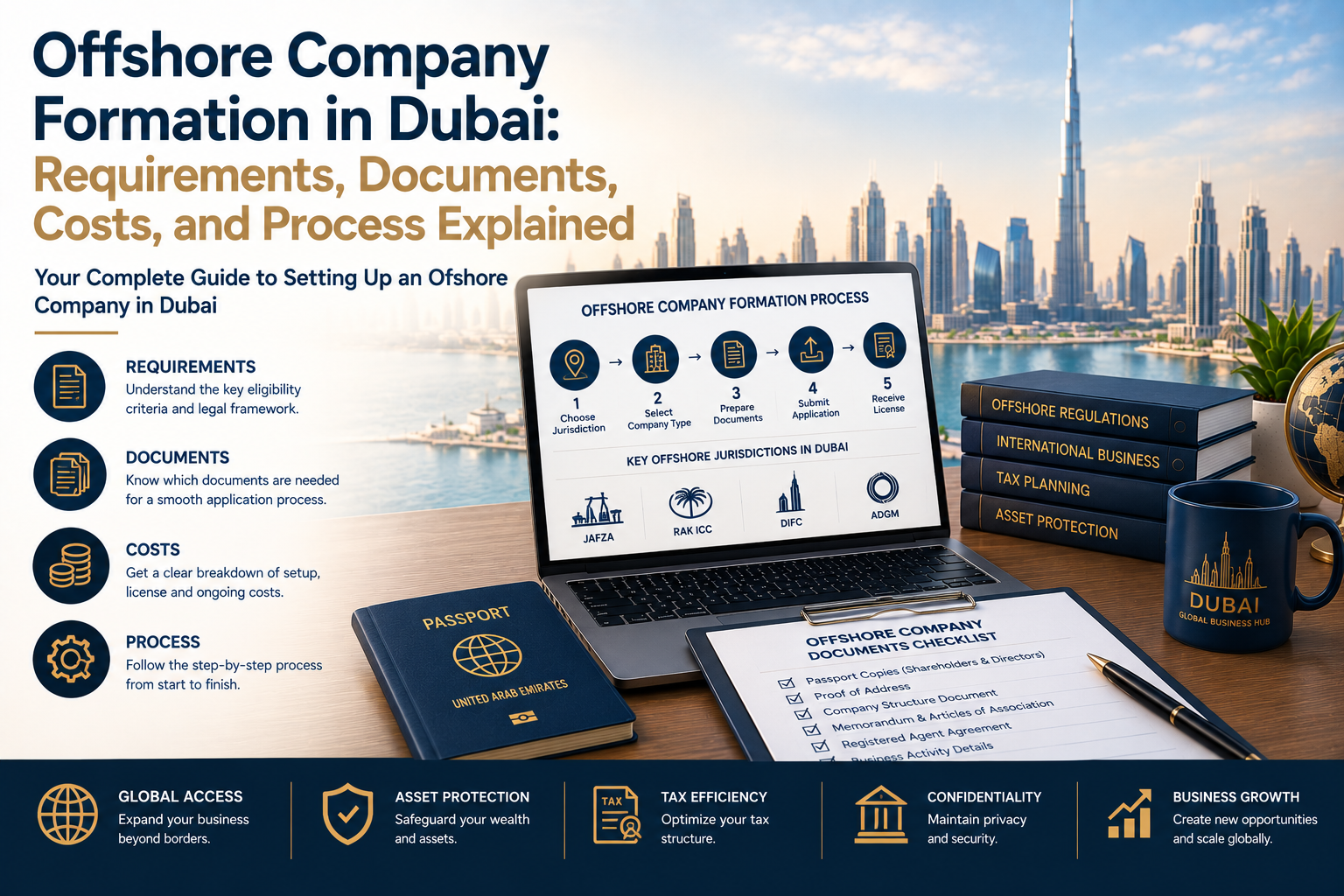
Step-by-Step Offshore Company Formation Process
Once the requirements and costs are understood, the formation process generally follows a series of stages.
Step 1: Determine Your Business Objective
Start by identifying why you need an offshore company.
This could involve holding investments, owning eligible assets, structuring international companies, or supporting a broader wealth strategy.
Step 2: Select the Structure
Compare the available UAE offshore structures according to your intended purpose.
Consider ownership, permitted activities, asset type, banking requirements, and ongoing compliance.
Step 3: Choose a Registered Agent
Select an agent authorized to handle the relevant offshore registration process.
Step 4: Prepare the Documents
Collect identification documents, corporate records, constitutional documents, ownership information, and any required certifications.
Step 5: Complete KYC and Due Diligence
The registered agent will review the ownership structure and supporting documentation.
Additional information may be requested depending on the circumstances.
Step 6: Submit the Application
Once the documents have been reviewed and finalized, the application is submitted through the applicable registration process.
For JAFZA, the application and supporting documents are submitted through the appointed registered agent.
Step 7: Pay Registration Fees
The applicable government and professional fees are paid according to the selected structure and services.
Step 8: Receive Incorporation Documents
Once approved, the investor receives the relevant incorporation documents and can proceed with the next steps required for the company's intended purpose.
How Long Does Offshore Company Formation Take?
The timeline depends on the jurisdiction, document preparation, due diligence, and complexity of the ownership structure.
JAFZA currently lists a processing time of 5–7 working days for a new offshore company application.
However, this does not necessarily represent the entire period from the first consultation to completed incorporation.
Additional time may be required for:
- Document certification
- Notarisation
- Embassy attestation
- KYC checks
- Corporate document preparation
- Additional information requests
- Registered-agent onboarding
Investors who prepare their documents in advance can often reduce avoidable delays.
Can an Offshore Company Conduct Business in Dubai?
This is an important distinction for anyone considering an offshore structure.
An offshore company should not automatically be assumed to have the same operating rights as a Dubai mainland or free zone company.
JAFZA's offshore framework is designed for specific purposes and has restrictions concerning conducting commercial activity with persons within the UAE. Investors who need to actively trade, employ staff, lease operational premises, or conduct locally licensed activities should investigate an appropriate operating-company structure instead.
This is why defining the company's purpose before incorporation is so important.
Offshore Company Banking
Banking is another major consideration during the formation process.
An offshore company may require a corporate bank account for managing its permitted financial activities, receiving investment income, paying expenses, or holding funds.
However, incorporation does not automatically guarantee bank-account approval.
Financial institutions may assess:
- Company structure
- Shareholders
- Ultimate beneficial owners
- Business activity
- Source of funds
- Expected transaction volumes
- Countries involved in transactions
- Supporting financial documentation
Investors should therefore treat banking as a separate approval process and prepare the necessary KYC information accordingly.
Offshore Company Property Ownership
Property investors may also consider offshore structures for eligible real estate arrangements.
JAFZA provides an offshore NOC service for property ownership and lists a specific Arabic NOC to own property among its available offshore company letters.
However, property ownership remains subject to applicable UAE property laws and the rules governing the specific property and ownership arrangement.
Investors should therefore verify eligibility before purchasing property through an offshore company.
Ongoing Compliance After Formation
Incorporation is not the final stage.
An offshore company may have continuing obligations involving:
- Annual renewal
- Corporate records
- Beneficial ownership information
- KYC updates
- Registered-agent arrangements
- Shareholder changes
- Director changes
- Required certificates
- Applicable tax obligations
JAFZA also provides post-incorporation services such as good-standing certificates, incumbency letters, property-related NOCs, and other company documentation.
Maintaining accurate records is therefore important throughout the life of the company.
Common Mistakes to Avoid
Choosing an Offshore Company Without Understanding Its Purpose
An offshore company is not automatically the right solution for every business.
Comparing Only Registration Fees
The total cost can include professional, documentation, renewal, banking, and compliance expenses.
Submitting Incomplete Documents
Missing or outdated documents can delay the application.
Ignoring Ownership Transparency
Investors should accurately identify the ultimate beneficial owners and provide the required information.
Assuming Offshore Means Tax-Free
An offshore designation does not automatically determine a company's tax position. Tax treatment depends on applicable UAE rules, the company's circumstances, activities, and potentially the laws of other jurisdictions.
Treating Formation as the End
Ongoing renewal, compliance, corporate administration, and KYC requirements should be considered before establishing the structure.
Who Should Consider an Offshore Company in Dubai?
An offshore company may be relevant to:
- International investors
- Holding companies
- Family-owned businesses
- Cross-border entrepreneurs
- Property investors
- Intellectual property owners
- Investment structures
- Businesses with international subsidiaries
- Investors seeking specific wealth-planning structures
It may be less appropriate for businesses that require unrestricted day-to-day commercial operations within Dubai.
The right choice depends on the investor's objectives and the activities the company needs to perform.
Final Thoughts
Offshore company formation in Dubai can provide international investors with a structured option for holding investments, organizing corporate ownership, managing eligible assets, and supporting cross-border business arrangements.
However, successful formation requires more than paying a registration fee. Investors need to understand the applicable requirements, prepare the correct documents, complete KYC and beneficial ownership checks, select an appropriate structure, and account for both initial and ongoing costs.
For anyone researching offshore company formation Dubai, comparing the structure, jurisdiction, costs, documentation, and long-term compliance obligations before incorporating can help avoid costly mistakes.
Because offshore structures can involve corporate, banking, property, and cross-border tax considerations, professional guidance can be valuable. UAE business advisors such as Dubai Business and Tax Advisors (DBTA) can help investors assess their objectives, compare suitable offshore structures, and navigate the company formation process

 English
 French
 Spanish
 Portuguese
 Deutsch
 Turkish
 Dutch
Dutch
 Italiano
 Russian
 Romaian
 Portuguese (Brazil)
 Greek
Greek