

NEC Face Recognition: How AI Is Redefining Digital Identity
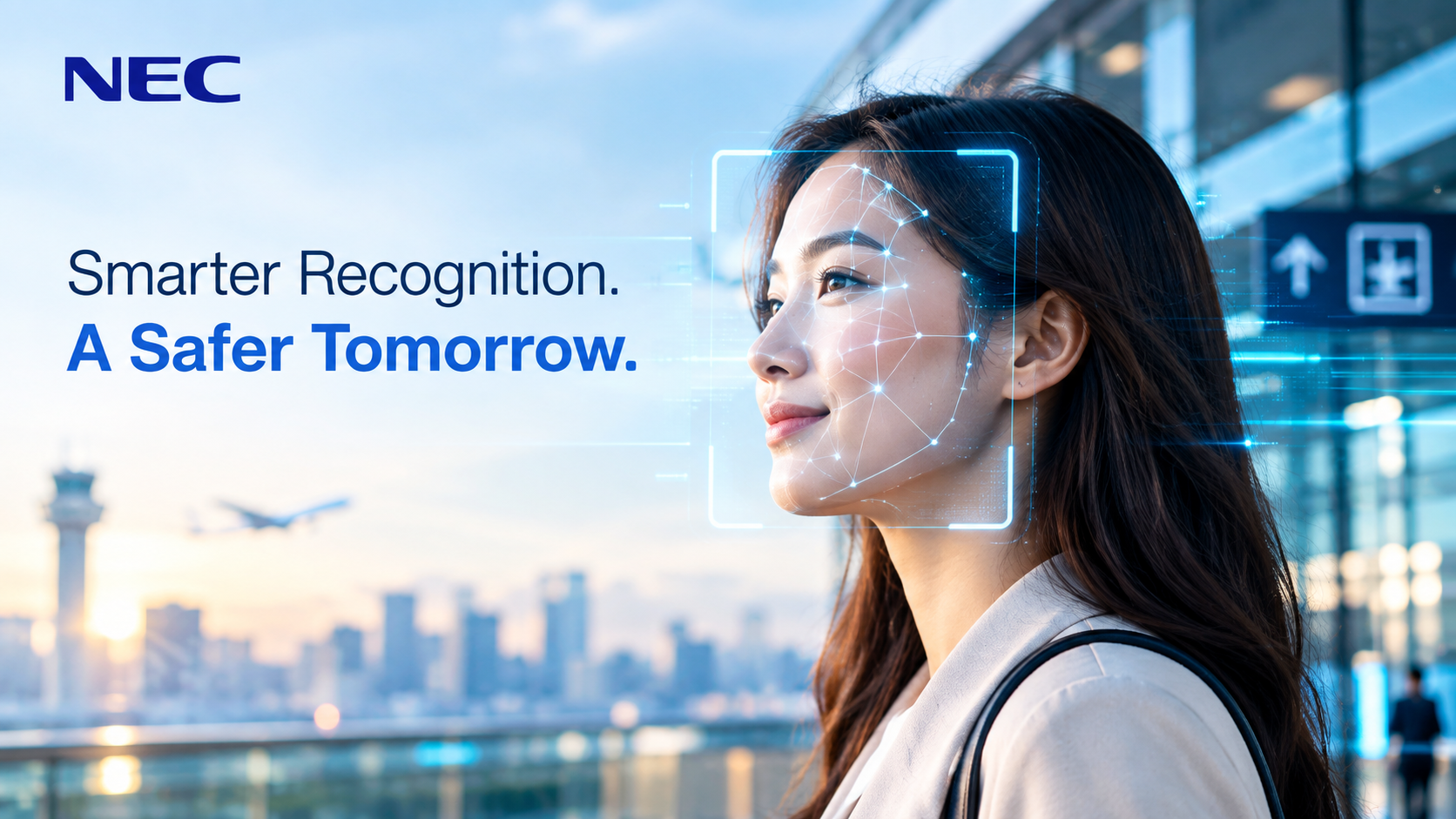
What happens when a face becomes more than an image—and becomes a secure digital key?
That question sits at the heart of modern biometric authentication. NEC face recognition technology offers an interesting example of how artificial intelligence, large-scale data processing and digital identity are moving from research laboratories into everyday environments.
The technology has also attracted attention through repeated independent benchmark evaluations by the U.S. National Institute of Standards and Technology (NIST), providing a measurable way to understand its development over time.
The Interesting Fact: 12 Million Faces in One Test
One of the most striking facts behind NEC's recent recognition milestones is the scale of the NIST evaluation.
In the 2025 Face Recognition Technology Evaluation (FRTE) 1 Identification benchmark, NEC reported an authentication error rate of 0.07% in a test involving still images of 12 million people. NEC also ranked first in two aging tests involving images taken more than 10 and 12 years apart, and was placed in the top two across all eight major FRTE 1 Identification categories listed by NIST at the time.
Put simply, under that particular test condition, a 0.07% error rate corresponds to about 7 errors per 10,000 comparisons. It is important, however, to understand what the number represents: NEC's 2025 release describes it as the false-negative rate when the false-positive rate was fixed at 0.3%, rather than a universal accuracy percentage for every real-world situation.
That distinction matters when evaluating biometric technology.
From Benchmark to Real-World Identity
A laboratory benchmark is only one part of the story. The more interesting question is how biometric technology performs as part of real services.
According to NEC, its face recognition technology has been deployed across approximately 80 airports worldwide and in more than 50 countries and regions. Applications include immigration, boarding procedures, customer service, transportation, offices, factories, hotels, hospitals, financial institutions and local government services.
Consider an airport.
Instead of repeatedly presenting physical documents at different stages of a journey, biometric authentication can help connect identity verification with processes such as admission, immigration or boarding. The objective is not simply to “recognise a face”; it is to make identity verification work as part of a larger digital journey.
This is where the engineering challenge becomes much more significant.
Why Aging Tests Matter
Faces change.
A photograph taken ten or twelve years ago may look noticeably different from a person's appearance today. Hair, age, facial structure and other visual characteristics can change over time.
That makes aging tests particularly relevant to identity systems that may need to compare historical records with current images.
NEC's 2025 NIST results included first-place rankings in aging-related tests, including comparisons involving images separated by more than a decade.
The broader lesson is that biometric innovation is not only about improving recognition under ideal conditions. It is also about making algorithms more resilient to changes that occur naturally in people's lives.
The Next Step: From Face Recognition to Digital Identity
Perhaps the more significant development is what happens after recognition.
NEC has been working on combining biometric authentication with decentralized identity (DID) and verifiable credentials (VC). The concept allows individuals to have greater control over how their verified identity information is shared digitally.
NEC describes its DID/VC approach as enabling a form of “self-sovereign identity,” where people can manage and selectively disclose identity information rather than relying entirely on centralized service providers.
Imagine a traveller entering a digital service.
The system does not simply ask, “Does this face match?”
Instead, the broader question becomes:
Can this person prove who they are, verify the required credential and decide what information to share?
That represents a shift from traditional authentication toward user-controlled digital identity.
NEC Face Recognition: A Technology Story That Keeps Moving
NEC's NIST journey also shows how quickly biometric technology continues to evolve.
In its March 2026 update, NEC reported another first-place result in the latest NIST FRTE 1 Identification benchmark, with an authentication error rate of 0.06% using still images of 12 million individuals. NEC also reported the top position in four of the eight major categories covered in that evaluation.
This makes the 2025 result an important milestone rather than the endpoint.
The company has also continued to expand its biometric portfolio beyond facial recognition. In March 2026, NEC reported first-place performance in a NIST fingerprint identification evaluation involving a 1.6-million-person database, illustrating its broader focus on biometric identity technologies.
The Bigger Picture
The real story behind NEC face recognition is therefore not simply about a leaderboard position.
It is about the evolution of identity—from physical documents and passwords toward biometric authentication, digital credentials and increasingly user-controlled digital identities.
For businesses, airports, governments and service providers, the challenge is to make identity verification secure without making digital experiences unnecessarily complicated. For individuals, the equally important question is how personal information is handled, protected and shared.
NEC says its biometric and AI initiatives follow its AI and Human Rights Principles, with privacy and respect for human rights identified as priorities in the use of AI and biometric data.
As biometric systems become more capable, that balance between accuracy, convenience, security, privacy and user control will remain central to the future of digital identity.
And that may be the most interesting fact of all: the future of face recognition is increasingly not just about recognising who you are, but about enabling you to decide how your digital identity is used.
About NEC Corporation
NEC Corporation integrates IT and network technologies to address social and business challenges, with areas including AI, biometrics, digital identity, security and digital transformation. Its face recognition technology has repeatedly appeared at the top of NIST benchmark evaluations.

 English
 Arabic
 French
 Portuguese
 Deutsch
 Turkish
 Dutch
Dutch
 Italiano
 Russian
 Romaian
 Portuguese (Brazil)
 Greek
Greek
