

Why Internal Tools Development Often Fails
Most companies have at least one internal tool that nobody uses, or worse, one that everyone complains about but nobody has time to fix. Internal tools development has a surprisingly high failure rate compared to customer facing product development, not because the engineering is harder, but because the surrounding process is often treated as an afterthought. This guide covers the most common failure patterns and how to avoid them.
Failure Pattern One: Building From Assumptions, Not Observation
The most frequent cause of failure in internal tools development is building based on how a manager or team lead assumes a process works, rather than how the people who actually perform the task work day to day. A request written from a distance often misses small but critical steps: an exception case that happens weekly, a workaround someone already built in a spreadsheet, or a dependency on a system nobody mentioned.
Tools built this way often technically function but fail to match the real workflow closely enough, so users quietly return to their old spreadsheet or manual process within weeks, and the new tool becomes shelfware.
Failure Pattern Two: No Clear Owner After Launch
Internal tools development projects are frequently staffed as a short term sprint: a developer builds the tool, ships it, and moves on to the next priority. Without a named owner responsible for the tool afterward, small issues accumulate unaddressed. A broken integration, an outdated dependency, or a minor bug that blocks one specific workflow step can sit unresolved for months, since no one has been assigned to notice or fix it.
Over time, this erodes trust in the tool. Users learn that reporting a bug leads nowhere, so they stop reporting, and eventually stop trusting the tool enough to rely on it for anything important.
Failure Pattern Three: Scope Creep During the Build
A request that starts as a simple internal tool often grows during development as stakeholders see progress and suggest "just one more feature." Individually, each addition might seem reasonable, but collectively they can double or triple the original scope, delaying launch and increasing the surface area for bugs.
Internal tools development teams that succeed consistently tend to enforce a firm initial scope, launch a working version quickly, and treat additional requests as a genuine second phase rather than an extension of the original sprint.
Failure Pattern Four: Underestimating Adoption Effort
Even a well built tool fails if the team never properly adopts it. Simply announcing that a new tool exists rarely changes behaviour, especially if the old process, however painful, is familiar. Successful internal tools development includes a real adoption plan: training sessions, a migration period where both old and new processes are supported, and visible leadership buy in showing the tool is a genuine priority rather than an optional experiment.
Failure Pattern Five: No Feedback Loop After Launch
Many internal tools development teams treat launch as the finish line rather than the starting point. Without actively soliciting feedback afterward, small frustrations that could be fixed quickly instead accumulate silently until users abandon the tool entirely rather than reporting problems that seem unlikely to be addressed.
Setting up even an informal feedback channel, and genuinely acting on what comes through it in the weeks after launch, dramatically improves long term adoption compared to a silent launch followed by silence from the team.
Failure Pattern Six: Choosing the Wrong Build Approach
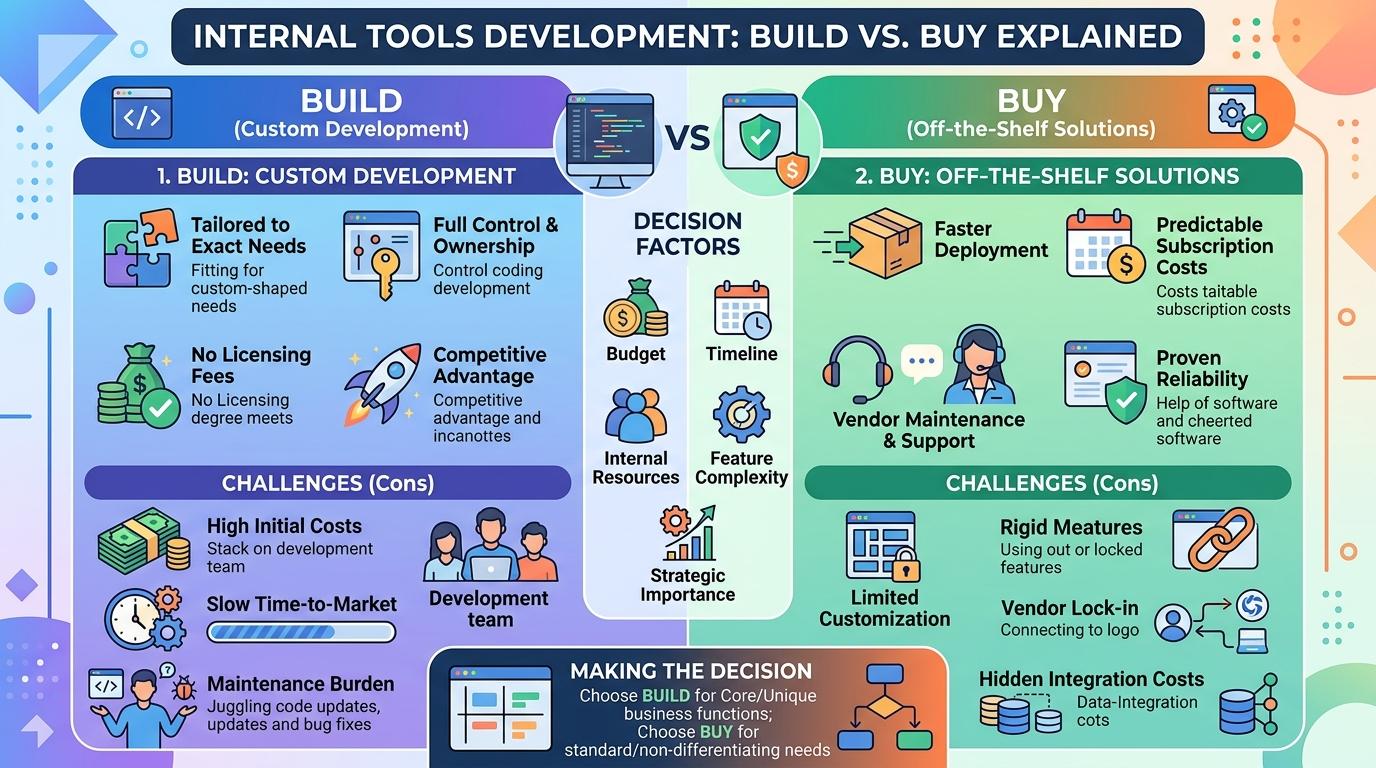
Sometimes failure stems from a mismatched build decision rather than execution quality. A team might spend months custom building a tool that an existing low code platform could have delivered in days, or conversely, might force a genuinely complex, company specific workflow into an inflexible off the shelf tool that fights the actual process at every step. Revisiting the build versus buy decision honestly, rather than defaulting to whatever approach the team is most comfortable with, avoids this mismatch.
How to Reduce Failure Risk
Several practices consistently reduce failure risk in internal tools development. Spending real time observing the current process before writing any code catches requirements a written brief would miss. Assigning a named, permanent owner before development even begins ensures maintenance happens after launch. Launching a minimal working version quickly, then iterating based on real usage, avoids both scope creep and the risk of building the wrong thing at scale. Building in a lightweight feedback mechanism from day one keeps small problems from becoming reasons to abandon the tool.
Final Thought
Internal tools development rarely fails because of poor engineering skill. It fails because of process gaps: assumptions instead of observation, missing ownership, uncontrolled scope, weak adoption planning, and silence after launch. Teams that address these gaps deliberately, even with modest engineering resources, consistently produce internal tools that actually stick, while teams that ignore them often produce technically competent tools that nobody ends up using.

 Arabic
 French
 Spanish
 Portuguese
 Deutsch
 Turkish
 Dutch
Dutch
 Italiano
 Russian
 Romaian
 Portuguese (Brazil)
 Greek
Greek
