

Hair Transplant in Al Ain for Hairline Repair After Scarring
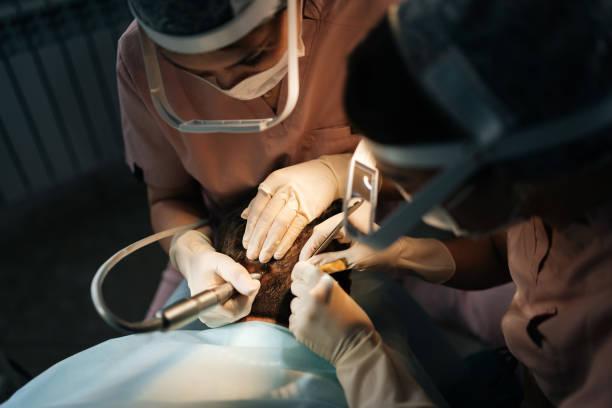
A mature scar along the hairline can remain visible even when the surrounding hair is healthy. Hair Transplant in Al Ain may provide a way to camouflage selected hairline scars by placing suitable grafts within or around the affected tissue after careful assessment of scar maturity and scalp condition.
Scarred tissue behaves differently from normal scalp. The surgeon therefore needs to evaluate the scar's width, texture, blood supply, surrounding hair, and stability before deciding whether graft placement is appropriate.
Why Hairline Scars Can Remain Noticeable
Hairline scars can interrupt the normal relationship between skin and hair follicles.
Changes in Hair Growth
Scar tissue may lack the follicular structures normally present in healthy scalp skin. Its surface can also differ in thickness, flexibility, pigmentation, or texture.
These changes can make a scar more visible when the surrounding hair is short or when the hairline is exposed.
Scar Width and Position
A narrow scar hidden within an existing hairline presents a different challenge from a scar extending directly across the frontal border.
The location matters because the surgeon must consider how newly transplanted follicles will interact with nearby native hairs.
Hair Transplant in Al Ain for Mature Hairline Scars
Transplantation into scarred tissue requires more than simply filling an empty strip.
Assessing Scar Maturity
A scar should generally be stable before elective graft placement is considered. Active changes in redness, thickness, tenderness, or texture may require further medical evaluation before transplantation.
The surgeon can assess whether the tissue appears sufficiently mature for a grafting plan.
Examining Surrounding Hair
Healthy follicles around the scar can provide important visual context. Their density, direction, and angle help determine how new grafts should be positioned.
A natural result depends on blending rather than creating a separate row of transplanted hairs.
How Grafts Can Camouflage a Hairline Scar
The objective is usually to reduce the visual contrast between the scar and surrounding scalp.
Strategic Placement
Depending on the scar, grafts may be positioned:
- Directly within suitable scar tissue
- Along the scar's border
- Between existing hairs near the hairline
- In selected areas where the scar becomes most visible
The exact pattern depends on tissue quality and available donor hair.
Matching Hair Direction
Hairline restoration requires careful attention to emergence angle. A graft growing in a noticeably different direction can draw attention to the area rather than disguising it.
The surgeon therefore considers the surrounding native hair when determining the direction of implantation.
Why Scarred Tissue Requires Careful Assessment
Scar tissue can have altered vascularity and structural characteristics. As a result, graft behavior may differ from transplantation into healthy scalp.
Graft Survival Can Vary
Hair growth within scar tissue is not guaranteed to match growth in unaffected scalp. Tissue quality, scar density, previous procedures, and individual healing characteristics can all influence the outcome.
Patients should receive realistic expectations before treatment.
Donor Hair Must Be Used Selectively
The donor supply is limited. Using grafts for scar camouflage should therefore make sense within the patient's broader restoration plan.
If progressive hair loss is expected, the surgeon may need to consider how today's scar correction fits with future native-hair changes.
Designing a Natural Hairline Around a Scar
A scar should not automatically dictate the final hairline design.
Preserving Natural Irregularity
A completely uniform hairline can look artificial. Small changes in density and direction help new grafts transition into existing hair.
The surgeon may therefore use a softer, irregular distribution rather than forming a sharply defined border.
Considering Hair Length
Some scars become much more visible when the surrounding hair is cut very short. Patients who prefer short hairstyles should discuss this during planning because it can influence camouflage expectations.
When Hair Transplantation May Not Be the First Option
Not every scar requires transplantation.
A clinician may first determine whether the scar is mature, whether it is medically stable, and whether its appearance can be improved through another appropriate approach.
Transplantation may be less suitable when:
- The scar is still changing
- The recipient tissue is unsuitable
- The available donor supply is very limited
- Expectations exceed what grafting can realistically achieve
- Another treatment would be more appropriate
The decision should follow an examination rather than the scar's appearance alone.
Recovery and Hair Growth After Scar Camouflage
Healing varies according to the technique and the individual. Temporary redness, crusting, swelling, or sensitivity can occur after graft placement.
The transplanted hairs may initially shed before new growth develops. Hair maturation is gradual, so early appearance should not be treated as the final result.
Consultation for Hairline Scar Repair
A scar along the hairline can be assessed as a separate restoration problem rather than treated like ordinary hair thinning.
Tajmeels Clinic can assess scar maturity, surrounding hair direction, donor availability, and the feasibility of targeted graft placement. For patients considering treatment, explore the Hair Transplant in Al Ain page and arrange a personalized consultation.

 English
 French
 Spanish
 Portuguese
 Deutsch
 Turkish
 Dutch
Dutch
 Italiano
 Russian
 Romaian
 Portuguese (Brazil)
 Greek
Greek