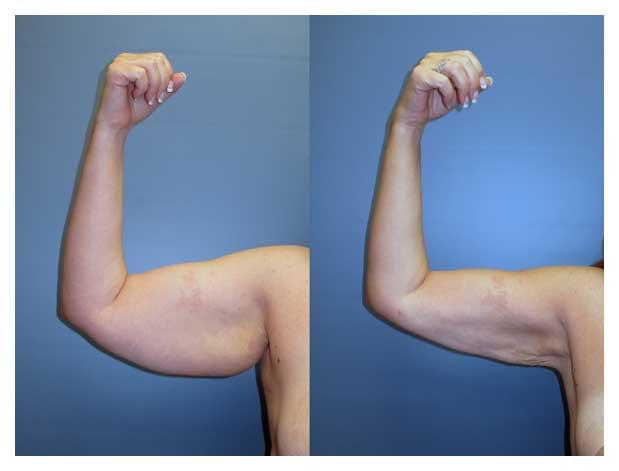
Scarring is an expected part of Arm Lift Surgery because excess skin needs to be removed through an incision. The location, length, and eventual appearance of the scar can vary depending on how much loose skin is present and the surgical approach used.
Although scars cannot always be eliminated completely, they generally change as the healing process progresses. Understanding where incisions may be placed and how scars mature can help create realistic expectations before undergoing upper-arm contouring.
Why Does Arm Lift Surgery Create Scars?
Arm Lift Surgery involves removing excess skin from the upper arm. To access and remove this tissue, an incision is necessary.
The length of the incision depends largely on the amount of skin requiring correction. A person with limited excess skin may have a shorter incision, while significant skin laxity can require a longer incision along the inner arm.
Where Are Arm Lift Scars Usually Located?
Incisions are commonly positioned along areas of the upper arm where they can be concealed as much as reasonably possible. However, the exact placement depends on the individual's anatomy and the amount of skin being removed.
The incision pattern may extend along the inner portion of the arm when substantial excess tissue needs to be addressed.
What Do Arm Lift Scars Look Like Initially?
New surgical scars can appear more noticeable during the early healing period. They may be raised, firm, red, darker, or sensitive while the skin is recovering.
These early characteristics do not necessarily represent the eventual appearance of the scar. Scar tissue continues to change as it matures.
How Do Scars Change Over Time?
Scar maturation is a gradual process. As healing continues, scars may become flatter and less prominent. Their color and texture can also change.
The rate of scar maturation varies from person to person. Some scars become relatively subtle over time, while others may remain more noticeable depending on individual healing characteristics.
Factors That Can Affect Scar Appearance
Several factors can influence how a scar develops. Skin type, genetics, incision size, wound healing, sun exposure, and postoperative care can all play a role.
The body's natural response to injury also affects scar formation, meaning two people undergoing similar procedures may develop scars with different appearances.
Can Arm Lift Scars Be Hidden?
The visibility of a scar depends on its location, length, and the type of clothing worn. Incisions are generally planned with concealment in mind where appropriate, but a scar may still be visible in certain clothing or arm positions.
It is important to understand that improving loose skin requires an incision, so completely scar-free Arm Lift Surgery should not be expected.
How Can You Support Scar Healing?
Following postoperative care instructions is an important part of scar management. Protecting healing skin and avoiding unnecessary tension around the incision can support the normal healing process.
Sun protection can also be important because newly healed scars may be more sensitive to sun exposure. Specific scar treatments should be used only according to appropriate professional guidance.
Does Exercise Affect Arm Lift Scars?
During the early recovery period, strenuous exercise can place tension on healing tissues. Activities involving heavy lifting or repetitive arm movements may therefore need to be restricted temporarily.
Once sufficient healing has occurred, physical activity can generally be increased gradually according to the recommended recovery plan.
Can Scar Appearance Be Predicted?
It is difficult to predict exactly how a scar will look after it has fully matured. Individual healing characteristics play a significant role.
The amount of excess skin removed, incision length, skin quality, genetics, and aftercare can all contribute to the eventual appearance.
Are Arm Lift Scars Permanent?
A scar is permanent tissue, but its appearance can change considerably over time. A scar that looks prominent during the early healing period may become flatter and less noticeable as it matures.
The goal of recovery is not necessarily to eliminate the scar but to allow it to heal and mature as naturally as possible.
Final Thoughts
Arm Lift Surgery does leave scars because removing excess upper-arm skin requires incisions. Their visibility depends on factors such as incision length, placement, skin characteristics, and individual healing. Understanding the scar-maturation process can help set realistic expectations before treatment. TAJMEELS CLINIC can be considered when exploring Arm Lift Surgery and learning more about incision placement, recovery, and upper-arm contouring.
For More Details, Contact Us Through:
WhatsApp: +971 56 203 8751
Phone: +971 4 373 9000
Social Media:



 English
 Arabic
 French
 Spanish
 Portuguese
 Deutsch
 Turkish
 Italiano
 Russian
 Romaian
 Portuguese (Brazil)
 Greek
Greek