Not all tattoos respond to removal treatment in the same way. Some tattoos fade relatively gradually, while others may require a longer treatment process because of their pigment, depth, density, location, or the way the ink was originally applied. Understanding these factors can help explain why laser tattoo removal is typically planned according to each individual tattoo rather than using the same approach for everyone.
Tattoo Ink Color
Ink color is one of the most important factors affecting tattoo removal. Different pigments absorb different laser wavelengths, so one wavelength may work well for one color while another pigment requires a different approach.
Dark pigments such as black may respond well to certain laser wavelengths, while colors such as green, blue, yellow, and some lighter shades can require different treatment strategies. Multicolored tattoos may therefore need customized treatment for different sections of the design.
Ink Composition
The chemical composition of tattoo ink can vary considerably. Professional tattoo inks may contain different combinations of pigments, while older tattoos may contain formulations that respond differently to modern laser treatment.
Even when two tattoos appear to have the same color, their underlying pigments may not behave identically when exposed to laser energy. This is one reason why treatment response can vary from person to person.
How Deep the Ink Was Placed
Tattoo pigment is deposited into the dermis, but the depth and distribution of ink can vary. Ink positioned more deeply within the skin may take longer to break down and clear.
The depth can depend partly on the tattooing technique and the area of the body being treated. A professional assessment can help determine how deeply the pigment appears to be distributed.
Dense or Heavily Saturated Tattoos
A tattoo containing a large concentration of pigment may require more treatment because there is simply more ink for the laser to target and the body to process.
Heavily saturated sections can gradually become lighter as pigment is fragmented and cleared. However, the process generally requires patience because the body needs time between treatments to remove the fragmented particles.
Tattoo Age
Tattoo age can influence its appearance, but an older tattoo is not automatically easier to remove. Some older tattoos naturally fade over time as the body processes small amounts of pigment.
However, remaining pigment can still be dense or deeply positioned. The composition of the ink and its distribution within the skin remain important factors regardless of the tattoo's age.
Professional Versus Amateur Tattoos
The way a tattoo was created can influence how difficult it is to remove. Professional tattoos are often applied with equipment designed to place pigment relatively consistently into the skin, while amateur tattoos may have more irregular pigment distribution.
Neither type is automatically easy or difficult to remove. The actual response depends on the characteristics of the pigment and how it is distributed.
Tattoo Location
The location of a tattoo can also affect treatment response. Blood circulation, skin characteristics, and the body's ability to process fragmented pigment can differ between areas of the body.
Tattoos located farther from the body's central circulation may sometimes respond differently from tattoos in other areas. Your practitioner can take the treatment location into account when planning treatment intervals.
Skin Type and Natural Pigmentation
Your skin tone is another consideration when planning laser tattoo removal. Melanin in the skin can interact with laser energy, meaning treatment settings may need to be carefully adjusted according to individual skin characteristics.
For people with higher levels of melanin, inappropriate laser settings may increase the risk of unwanted pigmentation changes. A customized approach helps balance effective pigment targeting with appropriate skin protection.
Previous Tattoo Removal Attempts
Tattoos that have already undergone laser removal or another treatment may behave differently during subsequent sessions. Previous treatment can change the amount and distribution of remaining pigment.
Your practitioner should know about previous removal attempts so that the tattoo and skin can be evaluated before another session. Repeated treatment should be planned according to the current condition of the area rather than simply repeating an earlier protocol.
Cover-Up Tattoos
A tattoo that has been covered with another tattoo can be particularly complex because additional pigment has been placed over or around the original design. The resulting combination of colors and pigment densities can make treatment planning more complicated.
In these situations, the goal may sometimes be substantial fading rather than complete removal, particularly when the person is preparing the area for another cover-up.
Cosmetic Tattoos Can Behave Differently
Permanent makeup and cosmetic tattoos may contain pigments that behave differently from traditional body tattoo inks. Certain cosmetic pigments can change color when exposed to laser energy.
For this reason, cosmetic tattoo removal requires careful assessment before treatment. A practitioner should identify the pigment characteristics and consider the possibility of unexpected color changes.
Why Multiple Sessions Are Often Needed
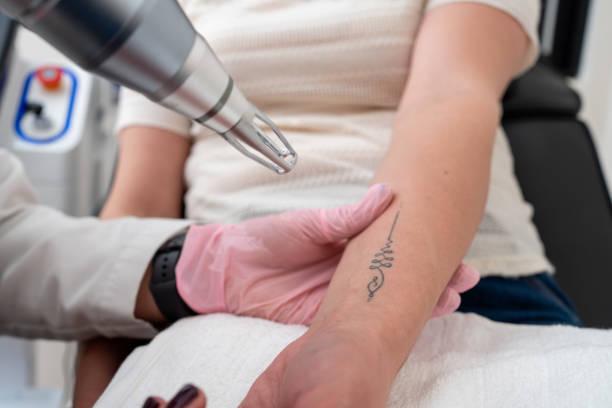
Laser Tattoo Removal in Riyadh is generally performed over multiple sessions because the laser does not simply erase tattoo ink from the skin. Instead, laser energy breaks pigment into smaller particles, and the body gradually processes them.
The skin also needs sufficient time to recover between treatments. The number of sessions varies according to the tattoo and individual response, so a precise treatment course can only be estimated after professional assessment.
Can Difficult Tattoos Still Be Treated?
Many tattoos that initially appear difficult to remove can be significantly faded with an appropriately planned treatment approach. However, complete removal cannot be guaranteed.
Factors such as pigment composition, color, depth, density, location, skin type, and previous treatment history all contribute to the final outcome. A consultation can provide a more realistic understanding of what may be achievable.
Book Your Appointment at Royal Clinic Saudia
If you have a tattoo that appears particularly dark, dense, multicolored, or resistant to previous treatment, Royal Clinic Saudia can evaluate its characteristics and your skin type during a consultation. A personalized assessment can help determine an appropriate approach for gradual tattoo fading.
FAQs:
Why are some tattoos harder to remove than others?
Ink color, composition, density, depth, tattoo location, skin type, and previous treatments can all affect how a tattoo responds.
Are dark tattoos easier to remove?
Some dark pigments can respond well to particular laser wavelengths, but the result still depends on the ink's composition, density, depth, and the individual's skin.
Can an old tattoo be difficult to remove?
Yes. Tattoo age alone does not determine how easily it can be removed. Remaining pigment may still be deep or densely distributed.
Can every tattoo be completely removed?
Complete removal cannot be guaranteed. Many tattoos can fade substantially, but the final outcome varies according to the tattoo and individual response.



 English
 Arabic
 French
 Spanish
 Portuguese
 Deutsch
 Turkish
 Dutch
Dutch
 Italiano
 Romaian
 Portuguese (Brazil)
 Greek
Greek
