

BEE Registration Online: Process, Certificate, Fees & Star Rating Guide
What Is BEE Registration?
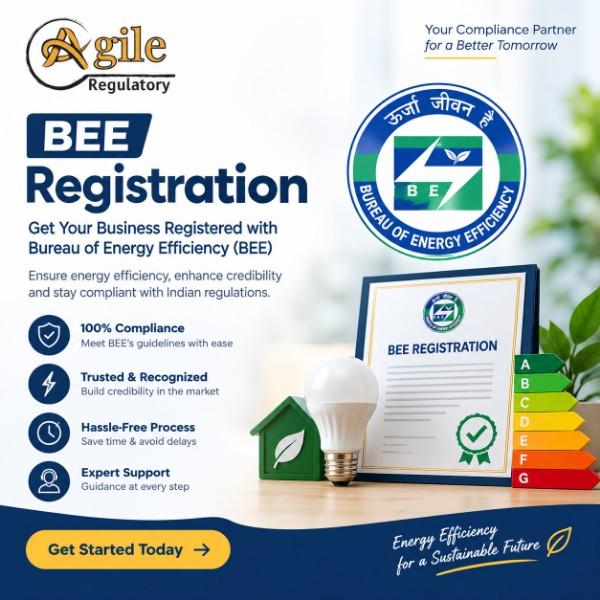
BEE registration is the process through which eligible manufacturers, brands or other permitted entities obtain approval to use the applicable energy label for products covered under the Bureau of Energy Efficiency’s Standards & Labelling programme.
The Bureau of Energy Efficiency, commonly called BEE, uses energy labels to help buyers compare the energy performance of similar products. For products covered by the star-rating system, the rating generally ranges from 1 Star to 5 Star, with the higher rating representing greater energy efficiency within the applicable product category.
For a business, BEE registration is not simply about putting a five-star logo on a product. The product must meet the requirements applicable to its particular schedule, including technical information, testing and labelling requirements.
This is why manufacturers should first identify the correct BEE product category and current requirements before starting an application.
Why Is BEE Registration Important for Manufacturers?
Energy efficiency has become an important buying factor in India. Customers increasingly compare electricity consumption before purchasing products such as air conditioners, refrigerators, lamps and other electrical equipment.
A valid BEE star label gives consumers a common way to understand energy performance.
For manufacturers, registration can also support:
-
Compliance with applicable energy-labelling requirements
-
Legal sale and marketing of covered products
-
Better product transparency
-
Consumer confidence
-
Clear energy-performance communication
-
Participation in the organised market for labelled products
BEE reports that its Standards & Labelling programme covered 38 appliance categories and more than 3,600 registered brands in 2025, showing the size of the programme.
Which Products Can Require BEE Registration?
The applicable requirement depends on the product and the current BEE schedule.
Examples of products appearing in the Standards & Labelling programme include:
-
Room air conditioners
-
Refrigerators
-
LED lamps
-
Electric water heaters
-
Televisions
-
Diesel generator sets
-
Chillers
-
Microwave ovens
-
Deep freezers
-
Air compressors
-
Certain fans and other equipment
BEE maintains product-specific schedules and regulations. Some products are under mandatory labelling, while others may be under voluntary labelling depending on the applicable category and current notification.
Therefore, a manufacturer should not assume that every electrical product needs the same registration route.
BEE Registration Process
The BEE registration process can vary according to the product. In general, a business should approach it in the following order.
1. Identify the Product Category
The first step is to check whether the product is listed under a BEE Standards & Labeling schedule.
This is important as the requirements of an air conditioner are not same as the requirements of Refrigerator or LED lamp.
2. Check the Applicable Product Schedule
The relevant schedule sets out the technical and labeling requirements for that product.
It may specify matters such as:
-
Energy-performance parameters
-
Testing requirements
-
Label details
-
Star-rating criteria
-
Model information
-
Validity or renewal requirements
-
Documentation
3. Arrange Product Testing
Where testing is required, the product information and test results must meet the applicable requirements.
Businesses should avoid submitting reports without checking whether the laboratory, test method, model details and parameters match the current product schedule.
4. Prepare the Application
The applicant then prepares the required business, manufacturer, brand and product information.
The exact documentation depends on the product category.
5. Submit the Application
The application is submitted through the applicable BEE process or portal.
BEE provides an interactive Star Label platform as part of its Standards & Labelling programme.
6. Technical Review
The application and supporting information may be reviewed against the applicable requirements.
If clarification or correction is required, the applicant needs to respond accordingly.
7. Approval and Labelling
After successful completion of the applicable process, the business can proceed according to the permission and label requirements applicable to its product.
The label should not be designed or used independently of the prescribed requirements.
Documents Required for BEE Certificate Application
The document list depends on the product. Common information may include:
-
Manufacturer details
-
Brand details
-
Product/model information
-
Factory information
-
Product specifications
-
Test reports
-
Technical documents
-
Authorisation documents
-
Application-related declarations
-
Existing registration details, where applicable
The safest approach is to prepare the documents after identifying the exact product schedule.
What Is a BEE Star Rating?
A BEE star rating communicates the energy performance of a covered product.
TThe rating system uses stars, from 1 to 5. The more stars, the better the energy efficiency of the product, within the applicable product criteria.
For example, when comparing two eligible products in the same category, a consumer can use the label to understand their relative energy performance.
However, a five-star product should not be compared directly with a five-star product from a completely different category without considering the applicable measurement method.
Is BEE Certification the Same as a BEE Licence?
The phrase “BEE licence” is commonly used in online searches, but businesses should identify the actual regulatory approval applicable to their product rather than relying on the generic term.
For many product-related cases, the relevant requirement concerns registration and permission to use the prescribed BEE label under the Standards & Labelling programme.
The correct terminology matters because different BEE programmes have different procedures.
BEE Registration Fees
BEE-related fees can depend on the product schedule, application type, number of models and other factors.
Older product schedules show examples of separate company registration, application-processing, labelling and renewal fees. However, businesses should not use an old fee figure as a current universal BEE fee. Product-specific schedules and current BEE instructions should be checked before payment.
Common Mistakes in BEE Registration
Some avoidable problems include:
-
Selecting the wrong product category.
-
Using an outdated test report.
-
Mismatch between the test report and model number.
-
Incorrect brand information.
-
Designing the star label without following the prescribed format.
-
Ignoring product-specific regulations.
-
Treating BEE registration as a one-time process for every product.
-
Assuming all products have identical requirements.
A proper document review before submission can reduce unnecessary queries and delays.
How Agile Regulatory Can Help
Agile Regulatory assists businesses with regulatory registration and certification requirements in India.
For BEE-related work, our support can include:
-
Product-category assessment
-
Document checklist
-
Application preparation
-
Testing coordination guidance
-
Application support
-
Query and correction support
-
BEE registration assistance
-
Star-label compliance guidance
The exact process depends on the product, manufacturer and applicable BEE schedule.
Frequently Asked Questions
What does BEE stand for?
BEE stands for Bureau of Energy Efficiency. It works under the Ministry of Power, Government of India.
What is BEE registration?
BEE registration generally refers to the applicable registration/approval process under BEE programmes, particularly the Standards & Labelling programme for covered products.
How do I apply for a BEE certificate online?
The route depends on the product. First identify the applicable BEE schedule, prepare the required technical and business documents, complete applicable testing and then follow the relevant BEE application process.
Is a BEE star rating mandatory?
It depends on the product category and applicable notification. BEE identifies certain products as mandatory and others as voluntary under its Standards & Labelling programme.
Can a product get a BEE 5-star rating automatically?
No. A five-star rating is linked to the applicable energy-performance criteria. The product must meet the relevant requirements.
Does every electrical product need BEE registration?
No. The requirement is product-specific. Businesses should check the current BEE schedule before applying.
Where can I check BEE information?
The official BEE website and its Star Label platform are the appropriate sources for current programme information.
Final Takeaway
BEE registration is an important compliance step for manufacturers and brands dealing with products covered under the Standards & Labelling programme. The right approach is to identify the product schedule first, verify testing and documentation requirements, submit accurate information and use the prescribed label correctly.
If you are unsure whether your product needs BEE registration or which process applies, taking professional assistance before submission can save time and reduce documentation errors.
Need help with your BEE registration? To get help with product-specific registration and compliance, contact Agile Regulatory.

 English
 Arabic
 French
 Spanish
 Portuguese
 Turkish
 Dutch
Dutch
 Italiano
 Russian
 Romaian
 Portuguese (Brazil)
 Greek
Greek