

Malaysia Driving License Test Questions: JPJ Road Signs Learners Should Recognise Quickly
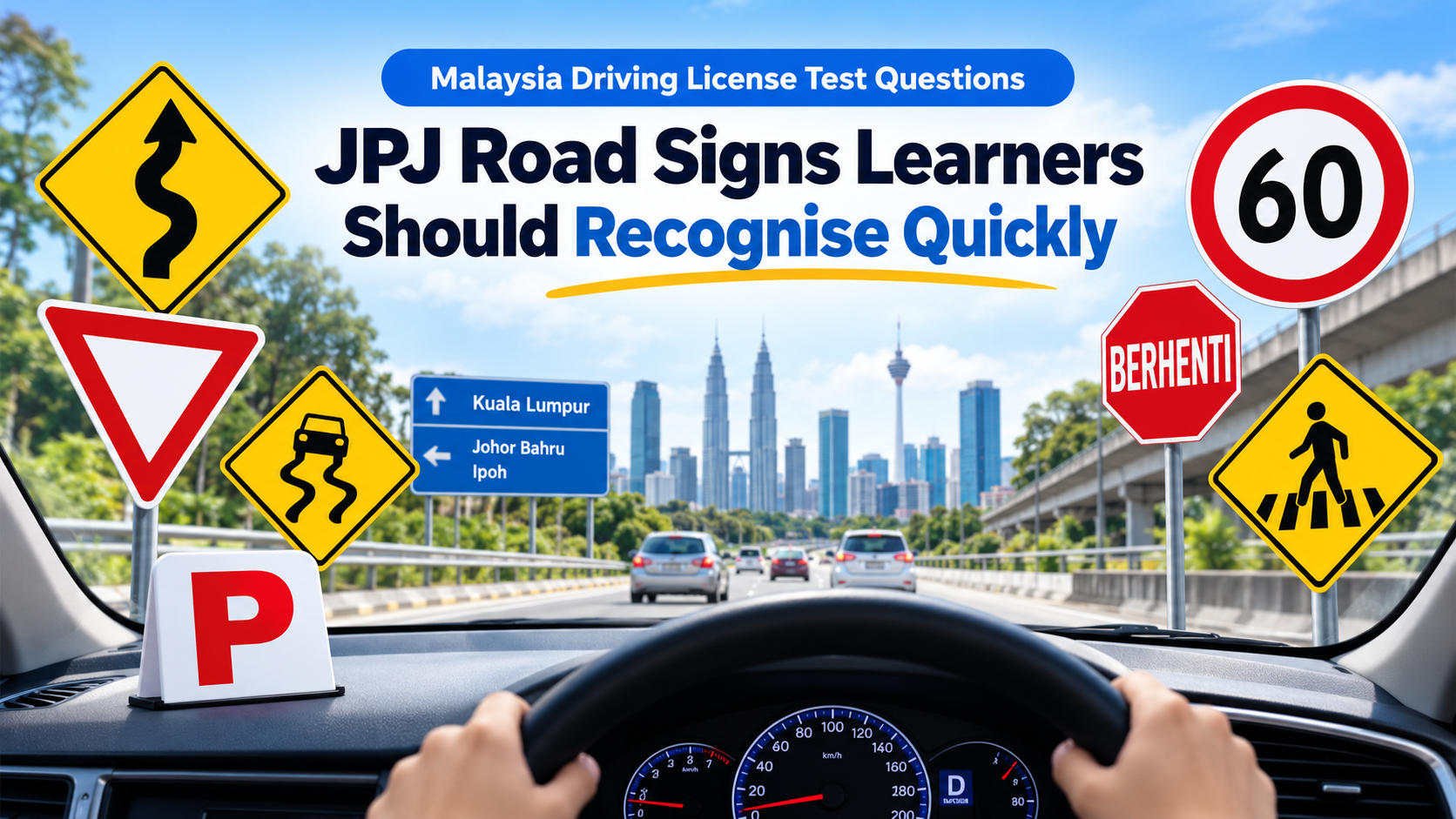
Road signs are one of the easiest topics to underestimate when preparing for a Malaysian driving theory exam. Many learners recognise a familiar shape but hesitate when two signs look similar, when a symbol appears inside a realistic traffic scene, or when the question asks what the driver should do next.
That is why malaysia driving license test questions should be used to test understanding, not just memory. A road sign is only useful if you can recognise it quickly and respond correctly while driving.
Start With the Signs That Control Your Actions
Some signs directly tell a driver what must or must not be done. These deserve extra attention because they can affect your speed, direction, lane choice, or right of way.
The most important ones to review include:
-
Stop
-
Give Way
-
No Entry
-
Speed Limit
-
No Parking
-
No Stopping
-
No U-turn
-
Mandatory direction signs
A Stop sign requires a complete stop before proceeding when the way is safe. A Give Way sign is different because the driver must yield to traffic with priority, but may not need to stop completely if the road is clear.
That distinction is simple in theory, yet it becomes harder when a practice question adds junctions, pedestrians, or several vehicles to the image.
Warning Signs Are About What Happens Next
Warning signs prepare drivers for a hazard ahead.
They may alert you to:
-
Sharp bends
-
Intersections
-
Roundabouts
-
Slippery roads
-
Pedestrian crossings
-
Roadworks
-
Narrow roads
-
School areas
-
Traffic lights
-
Uneven road surfaces
When answering malaysia driving license test questions, do not stop at naming the sign.
Ask yourself what behaviour the sign should trigger.
A slippery-road warning may mean reducing speed, increasing following distance, and avoiding sudden braking. A sharp-bend warning may require slower entry speed and better vehicle positioning.
The test may be checking your response rather than the sign name itself.
Speed-Limit Signs Need Context
Speed-limit signs are among the easiest to recognise, but the questions around them can still be tricky.
A posted speed limit sets the maximum permitted speed for that section of road. It does not mean that driving at the maximum is always safe.
Heavy rain, traffic congestion, poor visibility, school zones, or roadworks can require a lower speed.
So if a question shows a 70 km/h sign but also shows wet roads and limited visibility, the correct decision may be to drive well below the posted limit.
This is an important habit to build before the practical driving stage as well.
No Entry and One-Way Signs Are Often Confused
No Entry and One Way signs can appear in related situations but communicate different rules.
No Entry tells you that vehicles must not enter from that direction.
A One Way sign tells you which direction traffic is permitted to travel along that road.
Learners sometimes recognise both but choose the wrong answer when the question shows a side street, junction, or turning manoeuvre.
A useful study method is to imagine yourself approaching the sign in a car. Would you stop? Turn? Continue? Avoid entering?
That makes the meaning easier to remember.
Give Way, Priority and Junction Signs
Priority questions can be more difficult because road signs often work together with traffic position.
When approaching a junction, look for:
-
Stop signs
-
Give Way signs
-
Priority road signs
-
Roundabout signs
-
Traffic lights
-
Road markings
Do not answer based only on which vehicle arrived first.
The sign may change who has priority.
For malaysia driving license test questions, slow down mentally and inspect the whole diagram before choosing an answer.
Pedestrian-Crossing Signs Need More Than Recognition
Pedestrian-related signs are important because theory questions often place them inside real road situations.
You may be asked what to do when a pedestrian is waiting near a crossing, when visibility is poor, or when children are nearby.
The correct response may involve slowing down, preparing to stop, or giving way depending on the situation.
It is worth remembering that pedestrian safety is not only about the sign itself. Road markings, nearby vehicles, and visibility all matter.
Roundabout Signs and Lane Choice
Roundabout questions often combine three separate topics:
-
Road signs
-
Lane choice
-
Right of way
Learners sometimes focus only on the roundabout symbol and forget to check which lane they are in.
Before entering a roundabout, consider the direction you intend to travel, the lane markings, and the traffic already circulating.
If a question shows arrows painted on the road, those markings may be just as important as the roundabout sign.
Road Markings Can Change the Answer
Road signs and road markings usually work together.
Important markings include:
-
Stop lines
-
Broken lane lines
-
Solid lines
-
Direction arrows
-
Pedestrian crossings
-
Box markings
-
Lane separators
A Stop sign may appear with a stop line showing where the vehicle should halt. A turn sign may be combined with lane arrows telling you which lane to use.
This is why studying signs as isolated pictures is not enough.
How to Review Similar Signs Faster
One of the most effective ways to prepare is to compare confusing signs side by side.
For example:
Stop vs Give Way
No Entry vs No Parking
Warning bend vs mandatory direction
Pedestrian warning vs pedestrian crossing
Maximum speed vs minimum speed
Ask what changes in the driver’s action.
That one question often makes the difference between recognising a sign and truly understanding it.
Do Not Memorise Only the Correct Option
Repeatedly answering practice questions can create false confidence if you remember the answer position instead of the rule.
If a question appears again with different wording, you may hesitate.
A better method is to explain the answer in your own words after each question.
For example:
“This sign means I must stop completely because traffic on the other road has priority.”
That explanation is far more useful than remembering that “Option B was correct.”
Build a Short Daily Road-Sign Routine
You do not need to study every sign at once.
Try this instead:
Day 1: Regulatory signs
Day 2: Warning signs
Day 3: Priority and junction signs
Day 4: Road markings
Day 5: Mixed practice questions
Then go back to the signs you still confuse.
This keeps practice focused and prevents the study process from becoming repetitive.
Learn the Action, Not Just the Symbol
The strongest preparation for Malaysian theory testing comes from understanding what each sign requires you to do.
If you can recognise the sign, understand the rule, and apply it in a realistic traffic situation, you are much better prepared than someone who has only memorised a picture.
Use malaysia driving license test questions to identify weak areas, then return to the road rule behind each mistake. For more guidance on Malaysia’s licensing stages, KPP preparation, road signs, licence classes, and practical training, visit the Malaysia Driving Licence Guide and continue reviewing the topics that need the most attention.

 English
 Arabic
 French
 Spanish
 Portuguese
 Deutsch
 Turkish
 Dutch
Dutch
 Italiano
 Romaian
 Portuguese (Brazil)
 Greek
Greek
