

Why Operator Training Simulators Matter in Industrial Environments
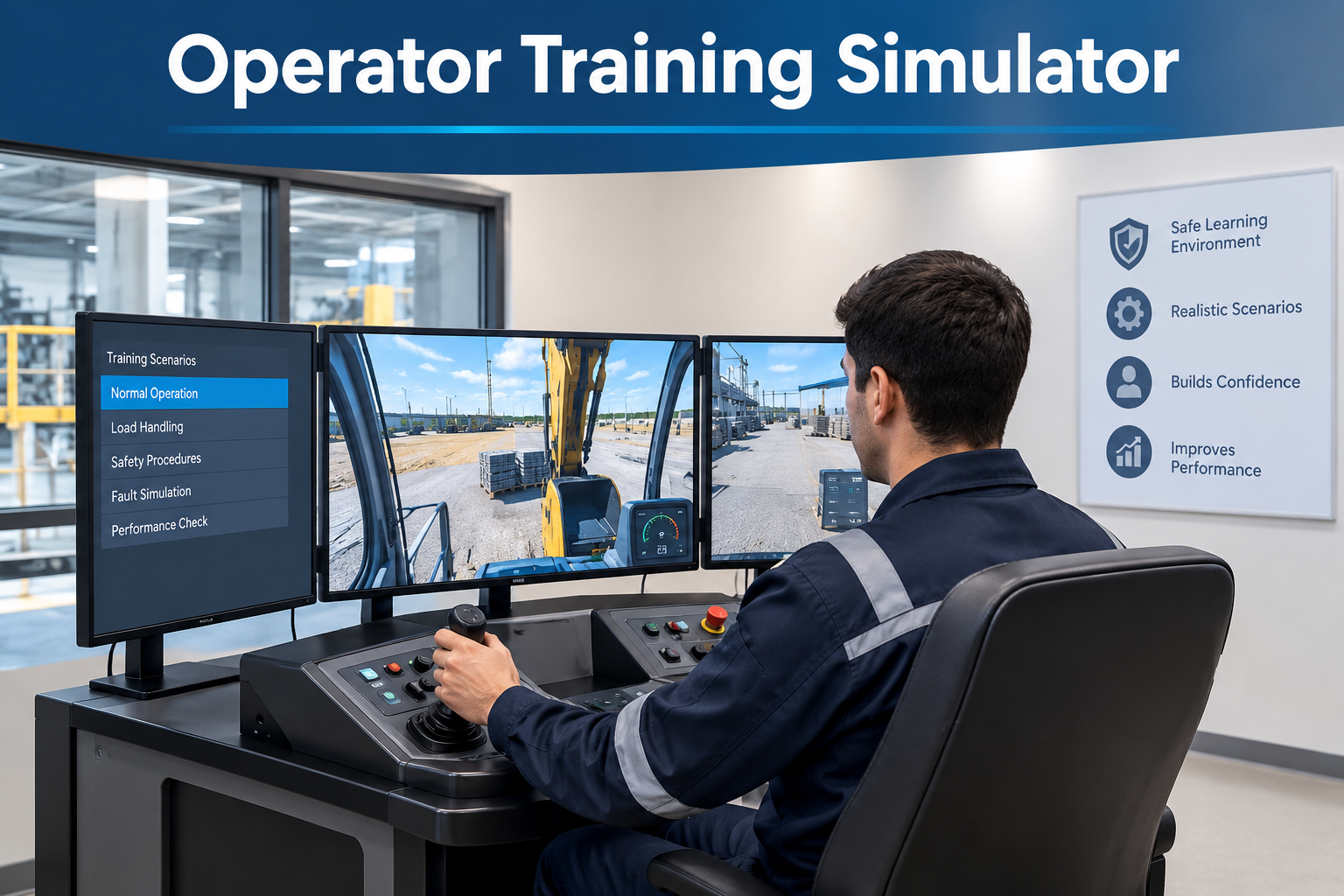
Industrial equipment often requires operators to understand complex procedures, respond to changing conditions, and follow established operating instructions. Traditional training can involve classroom sessions, demonstrations, and supervised practice. Simulation technology provides another way to help operators develop their skills.
An operator training simulator can reproduce selected equipment behaviors and operating scenarios in a controlled environment.
What Is an Operator Training Simulator?
An operator training simulator is a system designed to help people learn operating procedures without relying entirely on live equipment. Depending on its purpose, it may represent a machine interface, industrial process, control room, or equipment operating sequence.
The level of realism varies according to the system's design and training objectives.
Benefits of Simulation-Based Training
Simulation can help trainees become familiar with controls, practice routine procedures, and learn how a system responds to different inputs. It may also allow instructors to demonstrate scenarios that would be difficult, expensive, or unsuitable to recreate during normal operations.
A simulator can support repeatable practice and help instructors assess understanding before trainees work with actual equipment.
Key Features to Consider
When selecting an operator training simulator, organizations should consider:
-
Accuracy of the simulated process.
-
Relevance to actual operating procedures.
-
User interface and control representation.
-
Training scenarios and assessment options.
-
Compatibility with the intended equipment.
-
Ease of updating training materials.
The simulator should reflect the tasks operators are expected to perform.
Supporting Workforce Development
Training is most effective when simulation is combined with appropriate instruction, documented procedures, and supervised practical experience. Organizations should also review training outcomes to identify areas where additional support is needed.
Engineering expertise may be required when a simulator must represent specialized equipment or complex control behavior.
Servotech Inc. offers engineering-related services that businesses can explore when evaluating technical projects involving control systems and simulation requirements.
Conclusion
An operator training simulator can provide a useful environment for practicing procedures and understanding equipment behavior. When designed around real operational needs, simulation can complement broader industrial training programs.

 English
 Arabic
 French
 Spanish
 Portuguese
 Deutsch
 Turkish
 Italiano
 Russian
 Romaian
 Portuguese (Brazil)
 Greek
Greek