

Analytical Labs Keep Blaming Instruments for Laboratory Air Dryer Problems
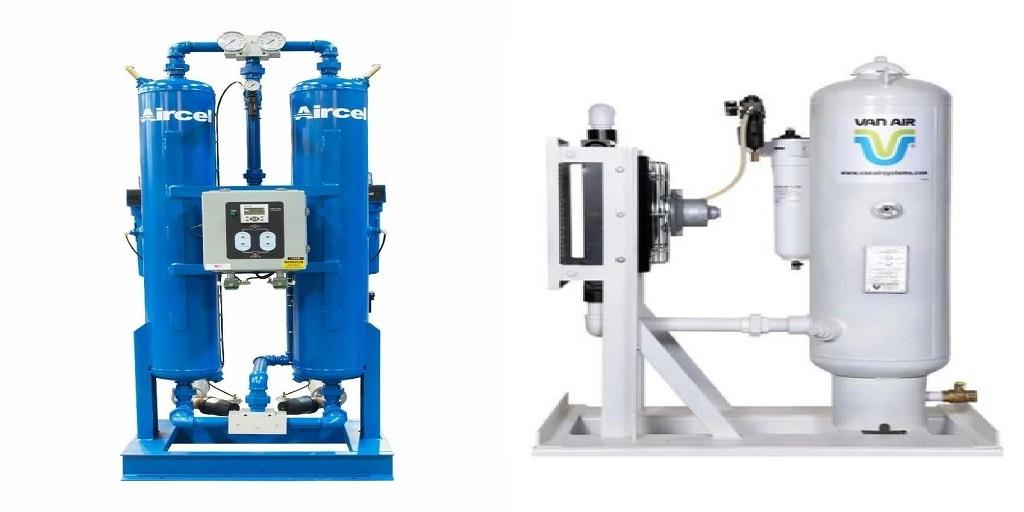
A drifting baseline sends most labs straight to the manual. Almost nobody checks the laboratory air dryer feeding it. Service engineers arrive, swap parts, run diagnostics, and leave an invoice, and a few weeks later the same noise creeps right back into every spectrum they run. Wet compressed air causes exactly these symptoms. One dew point reading can rule it out.
Check the Laboratory Air Dryer Before Calling Service
Moisture in analytical instrument air mimics hardware failure. Water vapor absorbs infrared energy strongly between roughly 3900 and 3500 cm⁻¹ and again between 1900 and 1300 cm⁻¹, so a poorly purged FTIR throws jagged noise across exactly those regions and the technician starts suspecting the source or the detector. The laboratory air dryer rarely makes that list. A failing unit passes vapor straight into the bench every cycle. Before booking service, your team should measure dew point at the instrument inlet, then run a comparison spectrum on a dry nitrogen purge and see whether the noise disappears.
Set a Laboratory Air Dryer Dew Point Target
"Dry air" means nothing without a number attached. ANSI/ISA 7.0.01 calls for instrument air with a pressure dew point at least 18°F below the lowest temperature the piping will ever see, and ISO 8573-1 Class 2 sets its limit at -40°C, which happens to equal -40°F. Refrigerated house dryers usually stop around 35°F to 39°F. A heatless regenerative laboratory air dryer closes that gap. Its standard rating is -40°F. Your lab should write its target purity class onto every instrument's utility requirements sheet so every future purchase, service quote, and facilities request has one number to meet.
Move Drying to the Point of Use
Central lab air drying systems dry the air once. After that, the air travels through decades of building pipe, where low spots collect condensate, older galvanized runs shed scale, and lines routed along exterior walls can drop below the air's dew point every winter. A point-of-use dryer treats the air last. The PureGas MDH Series accepts inlet pressures from 30 to 120 PSIG, and its smallest model stands just 7 inches tall and weighs 1.4 pounds, small enough for a cabinet shelf. Your facilities team can mount one beside each sensitive instrument.
Size the Dryer to Outlet Flow
Every scientific instrument air dryer loses air to purge. Heatless regenerative designs send part of the dried air backward through the offline desiccant tower to strip out the moisture it collected, then vent that air, so sizing to the inlet number leaves instruments short. At 100 PSIG, the MDH6 takes in 3.2 SCFM. Purge uses 0.8 of that, leaving 2.4 for the instrument. At 50 PSIG, output falls to 0.94 SCFM. Your lab should total the demand of every connected instrument, including purge boxes and pneumatic actuators, and match that figure to outlet flow at the pressure it actually runs.
Demand Test Conditions on Every Spec Sheet
A dew point without test conditions tells a buyer nothing. Pressure dew point describes air at line pressure, atmospheric dew point describes the same air after it expands to ambient, and because expansion spreads the moisture out, the atmospheric number always reads lower. The MDH Series lists a standard -40°F pressure dew point with a 100°F saturated inlet and an optional -100°F atmospheric rating, two separate specs that buyers sometimes merge into one number. Distributors such as Air & Vacuum Process, Inc. publish both conditions. Reject any quote without a stated basis.
Protect Valves With a Laboratory Air Dryer
Wet air damages hardware too. Condensate pools in small-bore tubing, corrodes solenoid valve seats, and leaves plungers sticking open or shut, which turns a data problem into a parts order that nobody budgeted for. At -40°F pressure dew point, air can't condense in a heated room. The MDH Series cycles its towers on a solid-state timer with memory, draws 6 watts or less, and vents purge through non-plugging, non-corroding mufflers inside a package small enough for an equipment cabinet. Your team should log outlet dew point at every calibration.
Plenty of repeat runs start with the air. Putting a correctly sized laboratory air dryer at the point of use, with a documented dew point target behind it, takes that variable off the list before anyone books the next service call or orders another valve.
For more information About Silent Air Compressors and Breathing Air System please vist: Air & Vacuum Process Inc.

 English
 Arabic
 French
 Spanish
 Portuguese
 Deutsch
 Turkish
 Dutch
Dutch
 Italiano
 Russian
 Portuguese (Brazil)
 Greek
Greek
