

Disadvantages of Manual Tube Benders
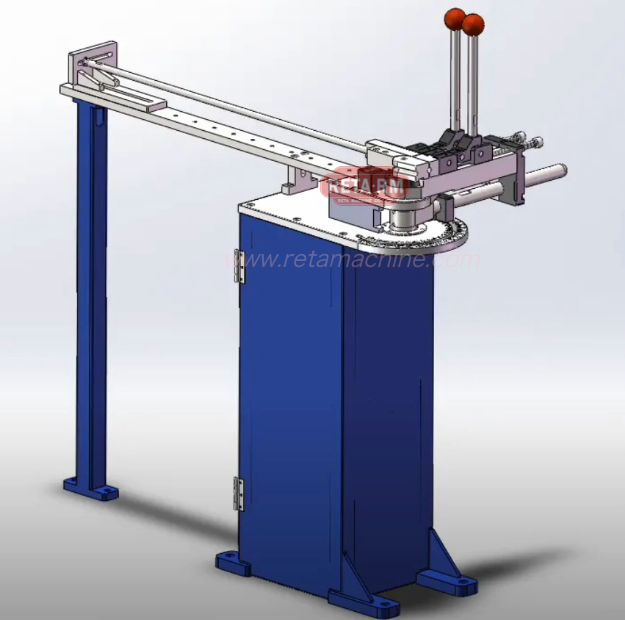
Manual tube benders are widely used in small workshops and on-site operations because of their low price and simple structure. However, they have obvious limitations compared with hydraulic, pneumatic or CNC automatic bending equipment, which restrict their application in mass production and high-precision processing.
First of all, manual tube benders rely entirely on human force to complete bending. Operators need to apply continuous and stable force during processing. When bending thick-walled tubes, hard metal pipes or large-diameter pipes, the work becomes extremely labor-intensive. Long-time operation easily causes operator fatigue. Once the force is uneven, wrinkles, flat deformation or cracks will appear on the bending arc of the tube. For stainless steel, copper and alloy tubes with strict surface requirements, such defects often make the finished parts scrapped directly.
Secondly, the bending precision of manual benders is hard to guarantee. There is no servo positioning system or digital angle feedback device. The bending angle mainly depends on the operator's experience and visual judgment. Even the same batch of pipes may have inconsistent bending angles and different arc radii. The error cannot be controlled stably. This shortcoming makes manual equipment unsuitable for heat exchangers, refrigeration pipelines and other products that require interchangeable pipe fittings. A small angle deviation may lead to assembly failure and leakage risk in later use.
Thirdly, the processing efficiency is very low. Each pipe needs manual clamping, alignment, force application and measurement. One operator can only finish a limited number of workpieces per hour. It cannot support continuous large-batch orders. Besides, manual tube benders usually have limited mould specifications. One set of moulds only fits one specific pipe outer diameter and bending radius. If customers need diversified pipe sizes or special bending radii, frequent mould replacement is required, which further wastes production time.
In addition, there are hidden safety risks. If the pipe slips during bending or the operator exerts excessive force suddenly, the workpiece may spring back and hurt people. The rebound of metal tubes is also difficult to compensate manually. Operators need to repeatedly test and adjust, which increases the rejection rate.
To sum up, manual tube benders are only suitable for low-volume, simple and non-precision bending jobs. For modern industrial manufacturing pursuing stable quality, high output and high precision, they cannot meet long-term production demands. Most professional pipe processing factories gradually upgrade to automatic bending machines to solve these problems.

 English
 Arabic
 French
 Spanish
 Portuguese
 Deutsch
 Turkish
 Dutch
Dutch
 Italiano
 Russian
 Romaian
 Greek
Greek
