

Cisco Firewalls: Types, Features, Benefits & Buying Guide
Introduction
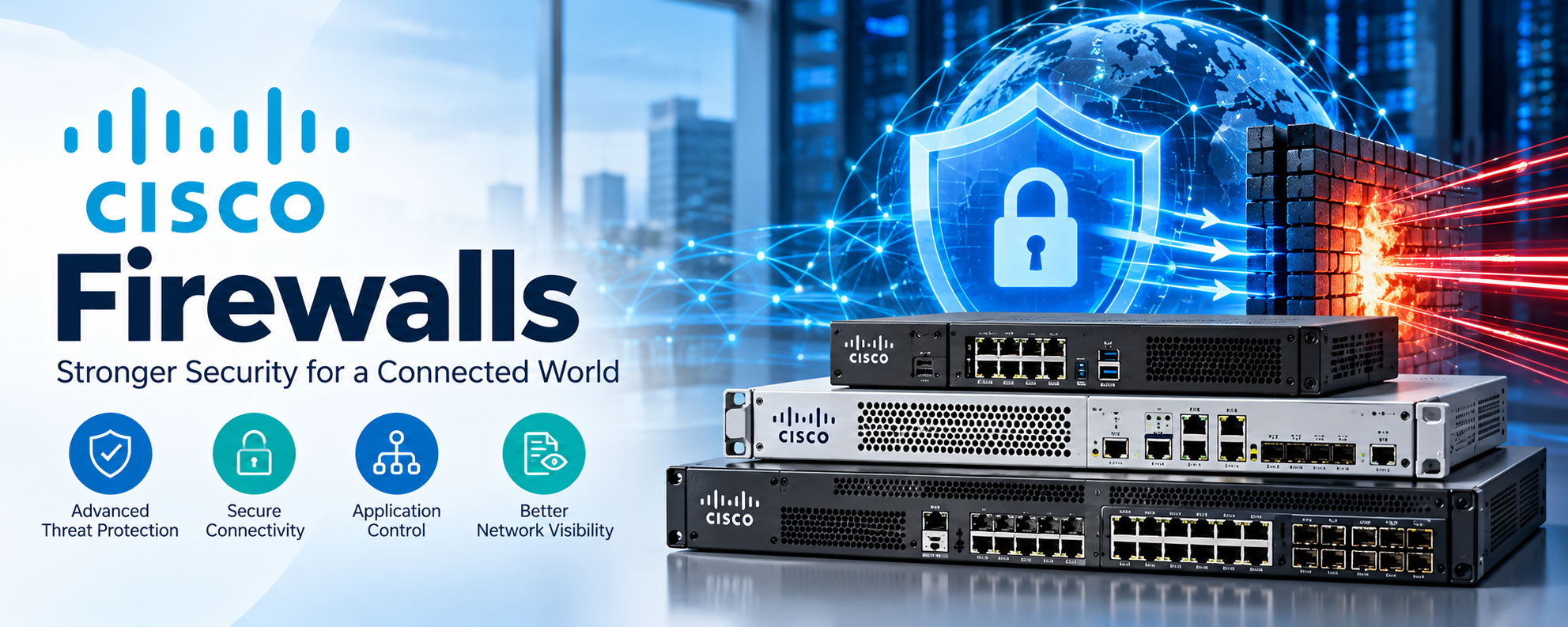
Network security has become a major concern for businesses as cyber threats continue to evolve. Organizations depend on secure networks to protect confidential information, maintain business operations, and prevent unauthorized access. Cisco Firewalls provide network security solutions designed to monitor traffic, enforce security policies, and protect IT infrastructure against various cyber threats.
From small businesses to large enterprises, Cisco Firewalls help organizations secure their networks through advanced threat detection, intrusion prevention, application control, and secure connectivity. These solutions are commonly deployed in corporate offices, data centers, branch locations, and hybrid cloud environments.
Understanding how Cisco Firewalls work, their different types, and their security capabilities can help businesses make informed decisions when upgrading their network infrastructure.
What Are Cisco Firewalls?
Cisco Firewalls are network security devices or software solutions that control incoming and outgoing network traffic according to predefined security rules.
They act as a protective barrier between trusted internal networks and external networks, including the internet. Their primary purpose is to identify potentially harmful traffic and prevent unauthorized communication.
Traditional firewalls mainly focus on IP addresses, ports, protocols, and connection states. Modern Cisco next-generation firewalls offer additional capabilities, including application visibility, intrusion prevention, URL filtering, and malware protection.
These advanced features allow security administrators to monitor network activity and apply more detailed security policies.
Cisco Firewalls are available as physical appliances and virtual solutions, making them suitable for different networking environments.
How Do Cisco Firewalls Work?
Cisco Firewalls inspect network traffic as it enters or leaves a protected environment. Every connection is evaluated according to configured security policies.
When traffic matches an approved rule, the firewall permits communication. If the connection violates a security policy, the firewall can block or reject the traffic.
Modern Cisco Firewalls also examine application behavior and traffic characteristics to identify suspicious activities that traditional packet filtering might not detect.
For example, a firewall equipped with intrusion prevention capabilities can identify certain known attack patterns and block malicious traffic before it reaches internal systems.
Cisco Secure Firewall solutions can also provide application awareness, encrypted traffic inspection capabilities, and centralized policy enforcement. The available features depend on the platform, software, and licensing configuration.
Different Types of Cisco Firewalls
Cisco offers several firewall platforms designed for different network sizes, performance requirements, and security needs.
Cisco ASA Firewalls
Cisco Adaptive Security Appliance (ASA) firewalls have been widely used in enterprise networking environments for many years.
These firewalls provide stateful traffic inspection, access control, network address translation, and VPN connectivity.
ASA solutions are commonly associated with traditional perimeter security, where organizations need to control traffic between internal networks and external connections.
Many businesses continue to operate ASA-based infrastructure because of its established security functionality.
However, organizations purchasing firewall hardware should verify the support lifecycle and software compatibility of their selected ASA models.
Cisco Firepower Firewalls
Cisco Firepower firewalls introduced advanced threat-focused capabilities into Cisco's security portfolio.
These solutions can support next-generation firewall functions such as intrusion prevention, application visibility, and advanced malware inspection when running the appropriate software and licenses.
Firepower appliances have been deployed in enterprise networks, data centers, and organizations requiring more detailed traffic inspection.
The Cisco Firepower 1000, 4100, and 9300 Series are examples of hardware families used with supported Cisco firewall software.
Organizations evaluating these platforms should consider their performance requirements, current support status, and available security features.
Cisco Secure Firewall 1200 Series
The Cisco Secure Firewall 1200 Series provides security appliances intended for smaller distributed environments and branch networking requirements.
These firewalls support modern security functions while offering deployment options suitable for organizations managing multiple locations.
Businesses can use compatible models to implement access controls, secure network connectivity, and threat protection.
The appropriate model depends on internet bandwidth, connected users, inspection requirements, and network architecture.
Cisco Secure Firewall 3100 Series
Cisco Secure Firewall 3100 Series appliances are designed for enterprise environments that require scalable security performance.
These devices support modern network protection capabilities and are suitable for organizations managing substantial traffic volumes.
They can be deployed where businesses require application visibility, intrusion prevention, and centralized security administration.
Their capabilities make them useful for enterprise perimeter protection and demanding network environments.
Cisco Secure Firewall 4200 Series
Cisco Secure Firewall 4200 Series appliances are designed for high-performance enterprise and data center security deployments.
They provide security processing capabilities for organizations requiring substantial network throughput and advanced inspection.
These firewalls are suitable for environments where network availability, secure connectivity, and performance are important operational requirements.
Cisco also offers other appliance families, including the Secure Firewall 200 and 6100 Series, for different deployment needs.
Key Features of Cisco Firewalls
Advanced Threat Protection
One of the most important features of Cisco Firewalls is their ability to detect and respond to various network threats.
Depending on the configuration, modern Cisco firewall solutions can identify suspicious traffic, enforce security restrictions, and help prevent certain malicious activities.
Threat intelligence and regular security updates contribute to maintaining protection against newly identified attack patterns.
These capabilities help businesses strengthen their overall network security.
Intrusion Prevention System
Cisco next-generation firewalls can include intrusion prevention technology that examines traffic for suspicious behavior and attack signatures.
An Intrusion Prevention System (IPS) helps detect and block certain network-based attacks before they affect protected systems.
This functionality is particularly important for organizations hosting business applications, databases, and sensitive information.
Effective intrusion prevention requires suitable policies, current detection updates, and ongoing monitoring.
Application Visibility and Control
Cisco Firewalls can identify and control supported applications communicating across the network.
Instead of relying only on IP addresses and port numbers, administrators can create policies based on application characteristics.
For example, organizations may restrict unauthorized applications while allowing business-critical services to operate normally.
This level of control helps security teams reduce unnecessary exposure and manage network resources more effectively.
VPN and Secure Remote Access
Virtual Private Network (VPN) functionality allows organizations to establish encrypted connections between supported networks or remote users and corporate resources.
Cisco Firewalls can provide site-to-site VPN connectivity and, on compatible platforms, remote-access VPN services.
This capability is valuable for businesses operating multiple offices or supporting employees who work outside traditional office environments.
VPN connectivity helps protect transmitted information when appropriately configured and maintained.
Centralized Firewall Management
Managing multiple firewalls can become complicated as an organization expands.
Cisco Secure Firewall Management Center enables administrators to manage supported firewall policies, monitor security events, and review network activity through a centralized interface.
Centralized administration can improve policy consistency and reduce repetitive management tasks across distributed networks.
Benefits of Using Cisco Firewalls for Businesses
Improved Network Security
Cisco Firewalls help organizations protect internal systems by controlling network communications and detecting potential threats.
By combining access control with supported advanced security functions, businesses can reduce exposure to unauthorized connections and malicious network activity.
A properly configured firewall also helps limit unnecessary access to important network resources.
Protection of Sensitive Business Data
Businesses store confidential information such as customer records, financial documents, and internal operational data.
Cisco Firewalls help protect network paths leading to these resources by enforcing security policies and controlling traffic.
Although firewalls cannot replace encryption, endpoint security, and access management, they remain an important component of a layered cybersecurity strategy.
Support for Business Growth
As organizations expand, their security infrastructure must accommodate additional users, devices, applications, and locations.
Cisco offers firewall solutions for smaller branch networks and large enterprise environments.
Selecting suitable hardware and management capabilities allows organizations to develop a security architecture that supports future infrastructure requirements.
Better Network Visibility
Network visibility helps administrators understand how applications and devices communicate.
Cisco next-generation firewalls can provide traffic information, application identification, security events, and monitoring capabilities.
This information helps security teams investigate suspicious activity and identify potential policy problems.
Improved visibility can also support troubleshooting and network planning.
Common Applications of Cisco Firewalls
Enterprise Network Security
Large organizations use Cisco Firewalls to protect corporate networks and control communication between trusted and untrusted environments.
Firewalls can also support network segmentation by applying security policies between different departments, applications, and infrastructure areas.
This approach helps limit unnecessary access to sensitive systems.
Data Center Protection
Data centers contain important computing, storage, and networking resources that require controlled access.
Cisco Firewalls can help protect these environments by inspecting traffic, enforcing security policies, and supporting network segmentation.
Selecting a firewall with suitable inspection performance is particularly important in high-bandwidth data center environments.
Branch Office Connectivity
Businesses with multiple branch locations require secure connections between offices and centralized infrastructure.
Cisco Firewalls can support encrypted site-to-site connectivity and consistent security policy enforcement across supported deployments.
This helps organizations manage distributed infrastructure while maintaining appropriate network access controls.
Hybrid Cloud Environments
Many businesses operate applications across on-premises infrastructure and cloud environments.
Virtual Cisco firewall solutions can provide network security controls for supported cloud and virtualized deployments.
These solutions help organizations apply security policies across different infrastructure environments.
How to Choose the Right Cisco Firewall
Evaluate Network Size and Requirements
The first step in choosing a Cisco Firewall is understanding the size and complexity of the network.
Small organizations may require a compact security appliance, while larger enterprises may need equipment capable of handling substantial traffic volumes.
The number of connected users, applications, network interfaces, and branch locations should influence the selection process.
Consider Firewall Performance
Firewall performance is an essential consideration when purchasing security equipment.
Businesses should evaluate firewall throughput, threat inspection performance, concurrent session capacity, and VPN requirements.
A firewall may deliver different throughput levels depending on which security services are enabled.
Choosing equipment based only on advertised maximum firewall throughput can lead to performance limitations when advanced inspection features are activated.
Check Security Features and Licensing
Not every Cisco Firewall includes the same security capabilities or licensing entitlements.
Organizations should identify whether they require intrusion prevention, malware protection, URL filtering, remote-access functionality, or centralized management.
Understanding software subscriptions and ongoing licensing requirements helps avoid unexpected operational expenses.
Review Hardware Compatibility and Support
Before purchasing Cisco Firewalls, organizations should verify hardware specifications, software compatibility, and available support.
This is particularly important when considering older or refurbished networking equipment.
The device should support the required security software and receive updates appropriate for the organization's risk requirements.
Cisco Firewalls vs Traditional Firewalls
Traditional firewalls primarily enforce security policies using information such as IP addresses, ports, protocols, and connection states.
Cisco next-generation firewalls extend these capabilities by offering deeper application awareness and additional threat prevention functions.
For example, an administrator using a traditional firewall might permit or deny traffic through a particular port.
A next-generation firewall can also identify supported applications using that connection and apply more specific security policies.
These capabilities make next-generation firewalls useful for organizations requiring detailed network control.
However, their effectiveness depends on proper configuration, ongoing updates, and appropriate security monitoring.
Best Practices for Maintaining Cisco Firewalls
Maintaining firewall security requires more than installing the device and enabling basic protection.
Organizations should regularly review firewall policies to remove unnecessary permissions and verify that access rules continue to meet business requirements.
Keeping supported software updated is also important because security patches address known vulnerabilities and operational issues.
Administrators should monitor firewall logs and security alerts to identify suspicious activities or unexpected network behavior.
Configuration backups, strong administrative authentication, and periodic security assessments further improve firewall reliability.
Businesses should also review network performance to ensure that security inspection does not create avoidable bottlenecks.
Future of Cisco Firewalls in Cybersecurity
Network security requirements continue to evolve as organizations adopt cloud computing, remote work, and increasingly complex digital infrastructure.
Modern firewall technologies are moving toward greater automation, centralized visibility, and improved detection capabilities.
Cisco Secure Firewall solutions combine network traffic inspection with security intelligence and management tools to help organizations respond to changing threats.
Future developments are likely to place increasing emphasis on automation, encrypted traffic visibility, and integration with broader security operations.
However, organizations will still need effective security policies, trained administrators, and continuous monitoring to maintain strong protection.
Conclusion
Cisco Firewalls are important components of modern cybersecurity infrastructure, helping businesses protect networks, control traffic, and reduce exposure to security threats.
From established Cisco ASA and Firepower platforms to modern Cisco Secure Firewall appliances, organizations can choose solutions based on their performance, connectivity, and security requirements.
Advanced features such as intrusion prevention, application control, VPN connectivity, and centralized management provide additional protection beyond traditional firewall functions.
By carefully evaluating network size, performance requirements, software support, and licensing, businesses can select appropriate Cisco Firewalls to build secure and scalable networking environments.
Frequently Asked Questions About Cisco Firewalls
What are Cisco Firewalls used for?
Cisco Firewalls are used to monitor and control network traffic, prevent unauthorized access, and protect business infrastructure from various cyber threats. Modern Cisco firewall solutions can also provide intrusion prevention, application control, and secure VPN connectivity.
What is the difference between Cisco ASA and Cisco Firepower?
Cisco ASA is primarily associated with traditional firewall functions such as stateful inspection, access control, and VPN connectivity. Cisco Firepower platforms can support next-generation security capabilities, including intrusion prevention and application-aware traffic inspection, depending on their software and licensing.
Are Cisco Firewalls suitable for small businesses?
Yes, Cisco offers firewall platforms suitable for smaller organizations and branch environments. Businesses should select a model based on their network bandwidth, connected users, security requirements, and available technical resources.
What is a Cisco next-generation firewall?
A Cisco next-generation firewall combines traditional network traffic filtering with additional security functions such as application visibility, intrusion prevention, and supported malware protection.
Do Cisco Firewalls support VPN connections?
Yes, supported Cisco Firewall platforms provide VPN functionality for encrypted communication between networks or remote users. Available VPN options depend on the firewall model, software, and licensing configuration.
Can Cisco Firewalls prevent ransomware attacks?
Cisco Firewalls can help reduce ransomware exposure by blocking certain malicious network traffic and detecting known threats. However, they cannot guarantee complete ransomware prevention. Organizations also need endpoint protection, secure backups, patch management, and employee security awareness.
How much do Cisco Firewalls cost?
Cisco Firewall pricing depends on the appliance model, hardware specifications, security subscriptions, support coverage, and deployment requirements. Organizations should evaluate both the initial purchase price and ongoing licensing costs.
Are refurbished Cisco Firewalls reliable?
Refurbished Cisco Firewalls may be suitable for some deployments when their hardware condition, software support, licensing eligibility, and remaining product lifecycle are carefully verified. Organizations should avoid unsupported devices for environments requiring current security updates.
How often should Cisco Firewalls be updated?
Cisco Firewalls should receive relevant software and security updates according to vendor guidance and organizational maintenance policies. Administrators should evaluate security advisories regularly and prioritize patches that address critical vulnerabilities.
Which Cisco Firewall is best for enterprise networks?
The best Cisco Firewall depends on enterprise network size, traffic volume, inspection requirements, availability needs, and management preferences. Cisco Secure Firewall 3100 and 4200 Series appliances are examples of platforms designed for demanding enterprise environments, but the correct model should be selected through detailed capacity and compatibility assessment.

 English
 Arabic
 French
 Spanish
 Portuguese
 Deutsch
 Turkish
 Dutch
Dutch
 Italiano
 Russian
 Romaian
 Portuguese (Brazil)
