

Product-Aligned Teams: Why Long-Term Engineering Teams Beat Project Handoffs
Take one product and follow it through two different setups.
In the first, a vendor builds version one over four months, hands over the code, and moves on. Six months later, a bug appears in a module nobody remembers. A new vendor is briefed, spends two weeks reading unfamiliar code, and fixes the bug in a way that quietly breaks something else.
In the second, the same group of engineers stays with the product. When the bug appears, someone says, "that's the discount logic we rewrote in March," and the fix takes an afternoon.
The code in both cases may be equally good. The difference is memory, and that is what this article is about.
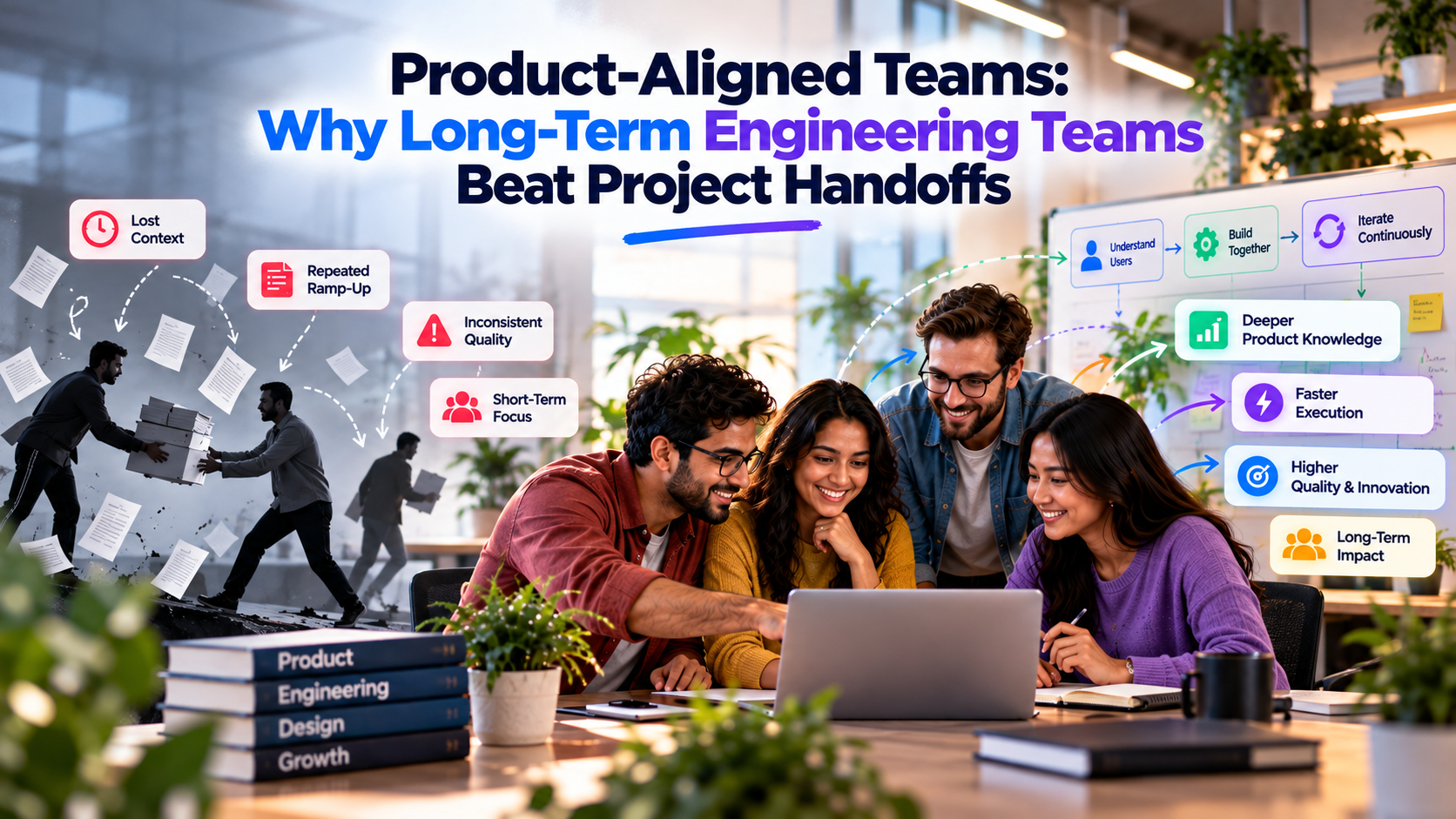
What a Project Handoff Quietly Loses
The project model is simple and familiar. Define the scope, agree on a price, build it, deliver it, and close the contract. For work with a clear end, such as a brochure site or a one-off migration, it fits well.
The trouble starts when a product is treated like a project. Products don't end at launch. They gather users, feedback, bugs, and new ideas, and the work that follows launch is often larger than the work before it.
Every handoff drops something that isn't in the documentation:
- The reasons behind decisions. Code shows what was built, not why a simpler option was rejected.
- Known weak spots. The team that built it knows which part is fragile. A new team finds out by breaking it.
- Customer context. Who complained, what they asked for, and what the roadmap quietly promised.
- Working relationships. The trust built between product owners and engineers takes months to rebuild.
None of these shows up on an invoice, but all of them cost time. Each handoff resets the learning curve, and the bill arrives as slower fixes and repeated mistakes.
What "Product-Aligned" Actually Means
A product-aligned team is organised around a product or a part of it, not around a project with an end date. The same people own the outcomes: they build, release, watch how it performs, and improve it.
Three features separate this from a loose group of contractors.
Stable membership. People stay long enough to build real knowledge. Changes happen, but deliberately and with overlap, not as a constant rotation.
Shared goals. The team is measured on things like customer adoption, reliability, and speed of improvement, not on delivering a fixed list of features by a date.
End-to-end ownership. Design, development, testing, release, and early support sit with one group, so problems are not thrown over a wall to someone else.
This explains why many product owners prefer to hire dedicated development team members who stay with the product for years instead of rotating contractors through each phase. The value isn't only in the hours bought. It is in the continuity, which turns a group of engineers into people who understand the product as well as the people who use it.
A Product's First Year With a Stable Team
Abstract benefits are easy to nod at and forget, so here is how the picture tends to develop over a year.
Month 1. The team is learning. Questions are frequent, early tasks are small, and the codebase still feels unfamiliar. Output looks no better than with any other group, which is normal.
Month 3. Patterns appear. Engineers stop asking where things live. They start suggesting simplifications and flagging risks in requirements before work begins. Reviews get faster because reviewers already know the context.
Month 6. The team now carries the product's history. When a customer reports an odd behaviour, someone recognises it. Planning shifts from "can we build this?" to "is this the right thing to build?" because the people in the room understand the users.
Month 12. Knowledge compounds. New features fit neatly with existing ones. The product has fewer surprises, and the team can take on larger changes with less fear. If a member leaves, a planned handover keeps the memory from walking out of the door.
The curve isn't magic and it depends on stability. If the team is reshuffled every quarter, the clock restarts each time.
How Planning Changes Without a Project Boundary
When work doesn't come in fixed-scope packages, planning has to change. That discomfort is often what stops companies from making the shift.
In a project model, you commit to a scope and defend it. In a product model, you commit to a team and a direction, and decide the exact work as you learn. The roadmap becomes a set of priorities, reviewed regularly, instead of a contract.
In practice, a few habits keep this from becoming chaotic:
- Quarterly goals tied to outcomes. For example, "reduce checkout abandonment" is a better goal than "build a new checkout page".
- A visible, ordered backlog. Someone decides what comes first, and everyone can see why.
- Short cycles with demos. Two-week cycles give frequent chances to adjust.
- A regular review of what was learned. Which assumptions held, and which didn't.
Budgeting also gets simpler to forecast. A stable team has a predictable monthly cost, and the question becomes how much improvement that capacity can deliver, rather than how much a fixed list would cost.
Some products need specialists beyond the core team, for example a mobile client alongside a web platform. Teams in that position often bring in mobile app development expertise as a defined part of the same group, so the knowledge stays connected to the product and does not live in a separate vendor.
Project Handoff or Product Team: A Decision Table
Neither model is better everywhere. This table helps match the approach to the work.
| Situation | Project handoff | Product-aligned team |
|---|---|---|
| Fixed deliverable with a clear end | Strong fit | Unnecessary |
| Product that will keep evolving | Weak fit | Strong fit |
| Requirements likely to change | Painful, changes become disputes | Natural, backlog adapts |
| Need to retain product knowledge | Often lost at handover | Built up over time |
| Budget certainty for one defined scope | High | Lower per feature, steady per month |
| Pace of improvement after launch | Slows or stops | Continues |
| Management effort from your side | Low after kickoff | Moderate, mostly direction |
Many companies use both. A well-scoped build can be a project, while its long-term evolution belongs to a product team. The mistake is treating a living product like a finished object.
Choosing the Right Structure for the Team
Stability isn't only about keeping people. It also depends on shaping the group so it can own outcomes.
A small product team often includes a few engineers with complementary skills, someone responsible for quality, someone who owns priorities on the business side, and access to design when needed. Fewer handoffs inside the team mean faster decisions.
The balance between internal and outside engineers matters too. Some companies keep strategy and core architecture in-house and bring outside engineers into the same product team for capacity. This overview of in-house vs outsourced development explains the trade-offs behind that choice in more detail.
Whatever the mix, treat everyone as part of one team. Outside engineers invited to planning, retrospectives, and customer discussions contribute far more than those who only receive tickets. Shared goals matter more than which payroll someone sits on.
Making the Shift Without Disruption
Moving from projects to a product mindset doesn't have to happen overnight. A staged approach works well.
- Pick one product. Start with something that will clearly keep evolving, not a one-off build.
- Name an owner. One person decides priorities and is accountable for outcomes.
- Form a small, stable team. Resist the urge to staff it by borrowing people for a few weeks at a time.
- Set two or three outcome goals for the next quarter, and write them down.
- Hold a short review every cycle. Look at what shipped, what was learned, and what to change.
- Document as you go. Decision notes and an architecture overview protect the product when people eventually move on.
- Review after a quarter. Check delivery, quality, and morale, then adjust the structure.
Keep expectations realistic. The first few weeks won't look dramatically different. The gains show up as the team's knowledge builds, in fewer repeated mistakes, faster fixes, and better suggestions.
Conclusion
Long-term, product-aligned teams beat project handoffs for work that keeps evolving, because they keep what projects lose: the reasons behind decisions, the knowledge of weak spots, and the trust between the people building and the people using the product. The model asks for steadier direction and a willingness to plan around outcomes instead of fixed scopes, but it rewards that effort with faster improvement and fewer surprises as the product grows.
EmizenTech, a mobile app development company, works with clients who want engineering teams that stay with a product beyond launch, and structures its engagements around that continuity.

 English
 Arabic
 French
 Spanish
 Portuguese
 Deutsch
 Turkish
 Dutch
Dutch
 Italiano
 Romaian
 Portuguese (Brazil)
 Greek
Greek
