

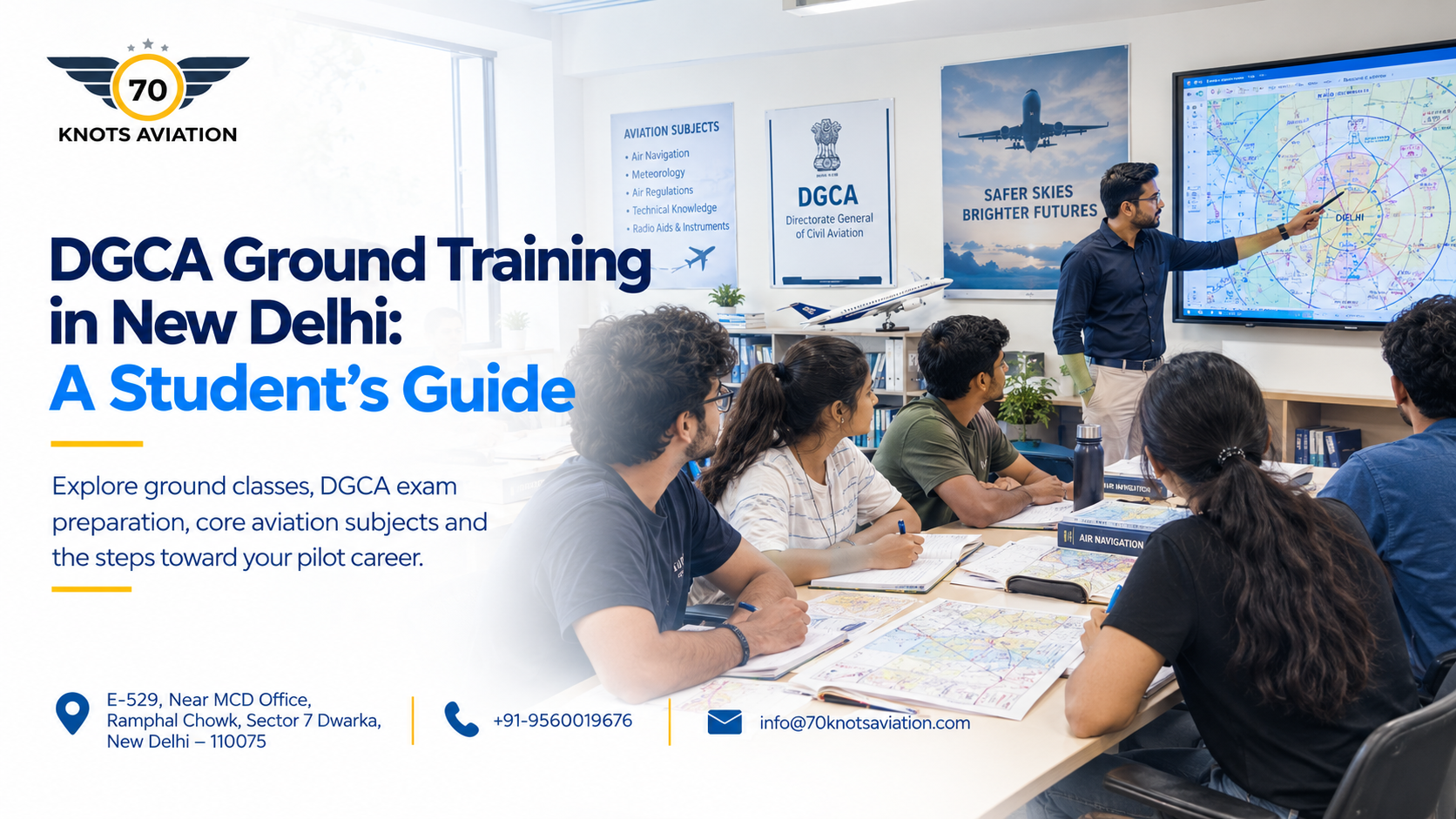
DGCA Ground Training in New Delhi: A Student’s Guide
Introduction: Starting Your Journey Towards a Pilot Career
Becoming a commercial pilot requires dedication, consistent preparation, and a clear understanding of aviation theory. For students planning to enter the aviation industry, ground training is an important step because it builds the theoretical knowledge needed for DGCA examinations and future flight training.
Before enrolling in a programme, students should understand what ground classes cover, how to prepare for examinations, and which factors matter when choosing an aviation institute. A structured learning environment can help students organise their studies, clarify difficult concepts, and develop effective revision habits.
70Knots Aviation provides DGCA ground preparation for aspiring flight crew members in Dwarka, New Delhi. Students exploring aviation training can use the opportunity to understand the syllabus, compare teaching approaches, and plan their preparation according to their individual learning needs.
Why Is DGCA Ground Training Important?
Ground training introduces students to the theoretical subjects that form an essential part of pilot training. These subjects require more than memorising definitions. Students need to understand aviation principles, apply formulas, interpret information, and learn how different systems work together.
The main areas of study generally include:
-
Air Navigation: Understanding navigation principles, charts, directions, and flight planning calculations.
-
Aviation Meteorology: Learning about weather systems, atmospheric conditions, clouds, visibility, and their effects on flight operations.
-
Air Regulations: Studying aviation rules, procedures, responsibilities, and the reasoning behind regulatory requirements.
-
Technical General: Developing knowledge of aircraft systems, engines, instruments, and relevant technical principles.
-
Technical Specific: Studying the technical characteristics of the aircraft type relevant to the applicable examination requirements.
-
RTR(A): Preparing for the applicable aeronautical radio communication requirements through the relevant examination and licensing process.
The subjects and examination requirements applicable to each student may depend on their training stage and current DGCA regulations. Therefore, candidates should verify the latest requirements before creating their preparation plan.
How Should Students Choose a Ground Training Institute?
Selecting a ground training institute is an important decision, particularly for students who are new to aviation. Rather than relying only on advertisements, students should evaluate the learning environment, faculty experience, study resources, and support available throughout the preparation process.
Students searching for the Best DGCA Ground Classes in New Delhi should consider the following factors before making a decision.
1. Subject-Wise Teaching
Each DGCA subject requires a different approach. Air Navigation involves calculations and practical problem-solving, while Air Regulations requires students to understand rules and their applications. Meteorology involves interpreting weather information and understanding atmospheric processes.
A useful training programme should explain these differences and provide opportunities to practise each type of question.
2. Experienced Faculty
Teachers who understand aviation concepts and examination expectations can help students approach difficult topics more effectively. Students should ask about the instructors' relevant experience, teaching methods, and approach to clearing doubts.
3. Regular Revision and Practice
Learning a topic once is rarely enough for a theory examination. Students benefit from regular revision, practice questions, mock tests, and feedback on their mistakes.
A well-organised study schedule can also help students balance multiple subjects without leaving all their revision until the final weeks.
4. Clear Guidance on Examination Procedures
Students should understand registration procedures, examination applications, documentation, and scheduling requirements. DGCA Pariksha is the official examination portal used for relevant examination services; it is not an examination subject itself.
Candidates should consult the official portal and current DGCA notices for the latest procedures and eligibility requirements.
What Makes Ramphal Chowk a Convenient Location for Aviation Students?
Location can influence a student's daily routine, particularly when classes require regular attendance. Students living in Dwarka and nearby areas may find institutes around Ramphal Chowk convenient because they can plan their travel and study schedules around their classes.
When researching the Best Pilot Training institute in Ramphal Chowk, students should look beyond location alone. They should assess whether the institute offers the ground subjects they need, how lessons are organised, and whether the teaching approach suits their current level of knowledge.
70Knots Aviation is located near Ramphal Chowk, Sector 7, Dwarka, New Delhi. Students can enquire about its ground preparation programmes, available subjects, teaching schedule, and admission process before deciding whether the institute fits their requirements.
It is also important to understand that ground classes focus on theoretical preparation. They do not replace practical flight training, the required medical assessments, or the other steps needed to obtain a pilot licence.
How Can Students Prepare Effectively for DGCA Examinations?
A practical study plan makes a considerable difference when students have several subjects to cover. Instead of studying without a fixed routine, candidates should divide the syllabus into manageable sections and track their progress.
Build a Realistic Timetable
Allocate specific study periods to each subject. Give additional time to topics that involve complex calculations or unfamiliar technical concepts. Include short revision sessions throughout the week.
Focus on Understanding
Avoid depending entirely on memorisation. Understanding why a navigation formula works or why a particular aviation regulation exists makes it easier to apply knowledge to unfamiliar questions.
Practise Examination-Style Questions
Solve relevant practice questions after completing each topic. Review incorrect answers carefully and identify whether the problem arose from a conceptual misunderstanding, a calculation error, or a misreading of the question.
Maintain Revision Notes
Create concise notes containing important formulas, definitions, regulatory points, and difficult concepts. These notes can make revision more efficient as examinations approach.
Monitor Official Updates
Examination procedures, eligibility conditions, and regulatory requirements can change. Students should use current official DGCA information rather than relying solely on old notes or informal online discussions.
A Conversation Between a Student and an Aviation Counsellor
Student: I want to become a commercial pilot, but I am not sure where to begin. Should I join ground classes first?
Counsellor: Start by understanding the complete pilot training pathway, including eligibility, medical requirements, theoretical examinations, and flight training. Ground classes can help you prepare for the theoretical subjects, but you should also plan the other stages of training.
Student: Which subjects should I expect to study?
Counsellor: The applicable subjects can include Air Navigation, Aviation Meteorology, Air Regulations, Technical General, and Technical Specific. You should confirm the current examination requirements that apply to your training stage.
Student: I find calculations difficult. Will that affect my preparation?
Counsellor: You may need extra practice, but difficulty with calculations does not automatically mean aviation theory is beyond your ability. Start with the basic principles, solve questions regularly, and review every mistake. Ask your instructors to explain the steps you do not understand.
Student: How should I choose an institute near Dwarka?
Counsellor: Compare the teaching approach, faculty experience, available subjects, revision support, timetable, and fees. Visit the institute or speak to its representatives so you can make an informed decision.
Student: Can ground classes guarantee that I will clear every examination?
Counsellor: No responsible institute should guarantee examination results. Classes can provide structure and guidance, but your preparation, understanding, practice, and performance also matter.
Student: What should I ask 70Knots Aviation before enrolling?
Counsellor: Ask about the subjects currently offered, class schedules, teaching methods, revision sessions, fees, admission requirements, and the support available when you have doubts. Confirm that the programme matches your current stage of training.
Frequently Asked Questions
1. What are DGCA ground classes?
DGCA ground classes help aspiring pilots prepare for the theoretical subjects and examinations required at the relevant stages of pilot training. They focus on aviation knowledge rather than replacing practical flight training.
2. How do I select suitable ground classes in New Delhi?
Compare the subjects covered, faculty experience, teaching methods, revision support, class timings, and fees. Check the institute's suitability for your requirements instead of making a decision based on promotional claims alone.
3. Is Ramphal Chowk a practical location for aviation classes?
Ramphal Chowk in Dwarka may be convenient for students living in nearby areas. However, travel time, class schedules, and the programme offered should all be considered before enrolling.
4. Does completing ground training make someone a commercial pilot?
No. Ground training is one part of the wider pathway. Candidates must meet the applicable eligibility and medical requirements, complete the required examinations and flight training, and satisfy the relevant licensing conditions.
5. What should I check before joining 70Knots Aviation?
Ask about the current programme, subjects covered, faculty, schedule, fees, revision arrangements, and admission process. Also verify the latest DGCA requirements through official sources before planning your training.
Conclusion: Make an Informed Start in Aviation
A pilot career begins with a clear understanding of the training pathway and a willingness to learn consistently. Ground preparation can help students build their theoretical knowledge, improve problem-solving skills, and approach DGCA examinations with a more organised plan.
70Knots Aviation, located near Ramphal Chowk in Dwarka, New Delhi, is an option students can explore when researching ground preparation. Before enrolling, compare the available programme with your needs, ask questions about the teaching approach, and verify the current regulatory requirements.
With realistic planning, regular revision, and a commitment to understanding aviation concepts, aspiring pilots can take a more informed approach to their next stage of training.

 English
 Arabic
 French
 Spanish
 Portuguese
 Deutsch
 Turkish
 Dutch
Dutch
 Italiano
 Romaian
 Portuguese (Brazil)
 Greek
Greek
