

Importer Registration for Weight and Measure in India: Complete Guide for Businesses
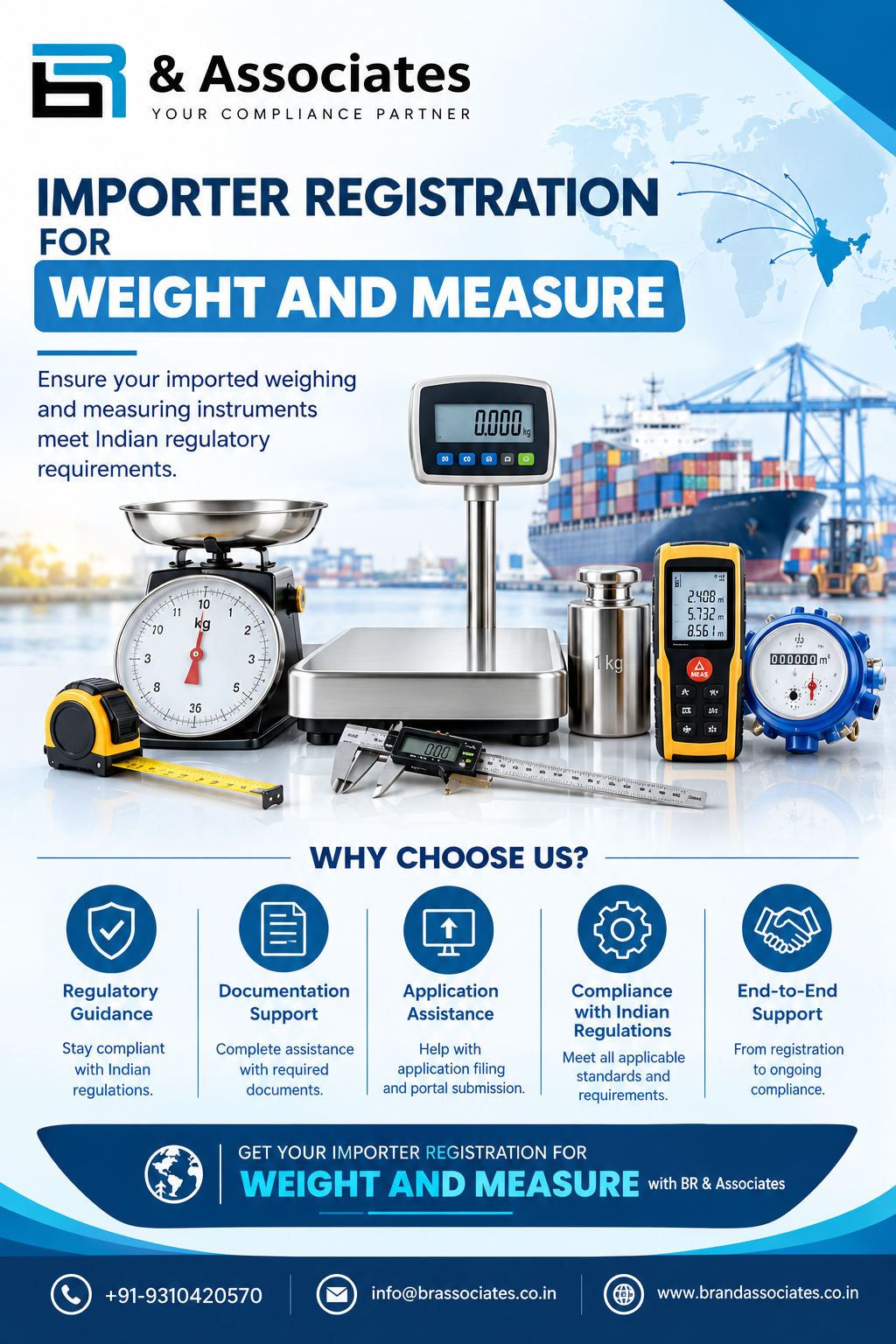
India imports a wide range of weighing and measuring instruments, including digital weighing scales, industrial measuring equipment, water meters, measuring devices and other precision instruments. Businesses importing these products must understand the applicable Indian regulatory requirements before bringing them into the market.
Importer Registration for Weight and Measure is an important compliance requirement under India's Legal Metrology framework for businesses importing regulated weights and measures. The applicable requirements may include importer registration, model approval, verification, stamping and other product-specific obligations.
The primary legislation is the Legal Metrology Act, 2009, together with the rules made under it. Depending on the product and business activity, different provisions may apply.
BR & Associates assists businesses in understanding regulatory requirements, preparing documentation and navigating the applicable registration process.
What Is Importer Registration for Weight and Measure?
Importer registration is a regulatory process associated with importing weights and measures covered by India's Legal Metrology framework.
Section 19 of the Legal Metrology Act, 2009 addresses the registration of persons intending to import weights or measures. Rule 15 of the Legal Metrology (General) Rules, 2011 sets out the importer registration procedure.
The purpose of this framework is to support the accuracy, reliability and legal conformity of weights and measures used in trade and commerce.
Depending on the product, businesses may need to determine whether they require:
-
Importer registration for weights and measures.
-
Approval of the instrument's model.
-
Verification and stamping before use or sale, where applicable.
-
Registration as an importer of pre-packaged commodities.
-
Additional licences or approvals under other applicable laws.
These requirements are not interchangeable. The correct compliance pathway depends on the nature of the product, how it will be marketed and the activities performed by the importer.
Which Businesses May Need Importer Registration?
Importer registration requirements may be relevant to businesses importing regulated weights and measures for commercial purposes.
Examples include:
-
Importers of digital weighing scales.
-
Suppliers of industrial weighing machines.
-
Businesses importing measuring instruments.
-
Dealers and distributors of regulated measurement equipment.
-
Companies importing water meters and other measuring devices.
-
Businesses importing precision instruments used in trade or commerce.
Whether a particular product requires registration or other approval must be assessed against the applicable law and current regulatory notifications.
Importers should not assume that every electronic instrument is covered in the same way. The product's intended use, technical characteristics and applicable exemptions should be checked before an application is filed.
Key Legal Metrology Requirements for Importers
1. Importer Registration
Section 19 of the Legal Metrology Act, 2009 and Rule 15 of the Legal Metrology (General) Rules, 2011 form the core framework for importer registration for covered weights and measures.
Under Rule 15, the prescribed application is submitted through the Controller of Legal Metrology of the state where the applicant carries on business, for onward processing by the Director as provided in the rule.
Applicants should consult the current official application procedure to confirm the submission route, applicable fee and supporting documents.
2. Model Approval
Importer registration and model approval are separate regulatory matters.
Section 22 of the Legal Metrology Act, 2009 addresses approval of models of weights and measures. Depending on the product and applicable rules, an instrument's model may need approval before it can be manufactured, imported or marketed for regulated use.
Importers should check whether their exact model is covered by an existing approval and whether any recognition or endorsement procedure applies. The Department of Consumer Affairs publishes guidance and procedures relating to model approval.
3. Verification and Stamping
Certain weights and measures must undergo verification and stamping by the competent authority or an authorised facility, as applicable, before being used or sold for regulated purposes.
The requirement depends on the instrument, its intended use and the applicable provisions. Importers should establish the verification requirements for their products rather than assuming that importer registration alone completes every compliance obligation.
4. Pre-Packaged Commodity Registration
If a business imports pre-packaged commodities for sale, it may also need to assess the separate registration and declaration requirements under the Legal Metrology (Packaged Commodities) Rules, 2011.
This is different from importer registration for weights and measures. The applicable requirements depend on the type of packaged product, the business's role and any relevant exemptions.
Documents Required for Importer Registration
The documents required can vary according to the application route, applicant type, product and current official checklist.
Applicants may need to prepare the following categories of information:
Business and Applicant Documents
-
Business constitution and registration details.
-
Applicant's identity and address details, as applicable.
-
Registered or business address proof.
-
Details of the applicant's authorised representative.
-
Relevant declarations and undertakings.
Product and Technical Documents
-
Description of the weights or measures to be imported.
-
Product catalogue, technical specifications or brochures.
-
Manufacturer details and country of origin.
-
Model numbers and product variants.
-
Existing model approval documents, where applicable.
-
Additional technical information requested by the competent authority.
Supporting Documents
-
Prescribed application form and fee payment proof.
-
Authorisation documents, where required.
-
Any additional documents specified in the applicable rules or official checklist.
Important: This is a general preparation list, not a definitive statutory checklist. Confirm the latest requirements with the relevant Legal Metrology authority before filing. Missing or inconsistent information may lead to queries or delays.
Step-by-Step Process for Importer Registration
Step 1: Identify the Product Category
Determine whether the product qualifies as a weight or measure under the applicable Legal Metrology framework. Review its intended use, specifications and relevant product category.
Step 2: Confirm the Applicable Approvals
Check whether the product requires importer registration, model approval, verification, stamping or any additional regulatory permission.
For instruments with existing approvals, verify that the approved model and product specifications correspond to the proposed imports.
Step 3: Prepare the Application Documents
Gather the business details, product information, technical documents and declarations required for the specific application.
Ensure that the product name, manufacturer details, model number and specifications are consistent across all documents.
Step 4: Submit the Application
Follow the current official application process and submission route. Rule 15 provides for an application through the Controller of the state in which the applicant carries on business, for forwarding to the Director.
Confirm whether the applicable authority requires online filing, physical documents or both.
Step 5: Respond to Queries
The authority may seek additional information or clarification. Respond with accurate, complete documents within the prescribed timeframe.
Step 6: Complete Applicable Compliance Requirements
After registration, confirm whether model approval, verification, stamping, labelling or any other requirement must be completed before the product can be marketed or used.
Keep copies of the registration, approvals and supporting records for future reference.
How Long Does Importer Registration Take?
Processing time can depend on the application type, completeness of documents, technical assessment and the authority's review process.
Rule 15 of the Legal Metrology (General) Rules, 2011 states that an importer registration application should be submitted at least one month before the proposed import date. This is an application-planning requirement, not a guarantee that every application will be approved within one month.
Businesses should allow sufficient time for document preparation, model approval where applicable and any other required regulatory steps.
Common Mistakes to Avoid
Applying Without Checking Model Approval
Importer registration does not automatically mean that every instrument model is approved. Check the applicable model approval requirements separately.
Submitting Incomplete Documents
Missing business information, technical specifications or supporting declarations can result in application queries.
Confusing Different Types of Registration
Importer registration for weights and measures is distinct from registration of an importer of pre-packaged commodities under the Packaged Commodities Rules.
Ignoring Verification Requirements
Some instruments may require verification and stamping. Determine the applicable requirements before distribution or use.
Planning Imports Too Late
Begin the regulatory assessment well before the expected shipment date, taking account of the prescribed application process and any additional approvals.
Benefits of Professional Regulatory Assistance
Legal Metrology requirements can be challenging for businesses importing unfamiliar products or entering the Indian market for the first time.
Professional assistance can help businesses:
-
Identify the applicable registration pathway.
-
Understand the distinction between importer registration and model approval.
-
Organise business and technical documentation.
-
Prepare applications for submission.
-
Address regulatory queries.
-
Plan for relevant post-registration compliance obligations.
The actual requirements and outcome depend on the product, applicable law and the competent authority's assessment.
Why Choose BR & Associates?
BR &Associates provides regulatory compliance assistance to businesses seeking guidance on importer registration for weights and measures in India.
Our support may include:
Regulatory Guidance: Help understanding applicable Legal Metrology requirements.
Documentation Support: Assistance in preparing and organising relevant documents.
Application Assistance: Guidance through the applicable application and submission process.
Compliance Guidance: Help identifying model approval, verification and other potential obligations.
End-to-End Support: Assistance with regulatory process coordination based on your product and business requirements.
Our objective is to help businesses approach the registration process in an organised and informed manner.
Conclusion
Importer registration for weights and measures is an important part of regulatory planning for businesses importing covered instruments into India. Understanding the Legal Metrology Act, 2009, the General Rules, model approval requirements and any applicable verification obligations can help importers prepare more effectively.
Before placing an import order, identify the applicable requirements for your specific product and confirm the current application process with the relevant authority.
Need assistance with Importer Registration for Weight and Measure in India? Contact BR & Associates for professional regulatory compliance guidance.
Contact Details
Phone: +91-9310420570
Email: info@brassociates.co.in
Website: www.brandassociates.co.in

 English
 Arabic
 French
 Spanish
 Portuguese
 Deutsch
 Turkish
 Dutch
Dutch
 Italiano
 Russian
 Romaian
 Portuguese (Brazil)
