

Exploring Robotic Applications in Modern Manufacturing and Industrial Operations
Introduction
Technology is transforming the way businesses manufacture products, manage operations, and maintain quality. Industries are increasingly adopting automated equipment to improve accuracy, reduce repetitive manual tasks, and meet growing production demands. Robotics has become an important part of this transformation by helping businesses perform tasks that require speed, consistency, and precision.
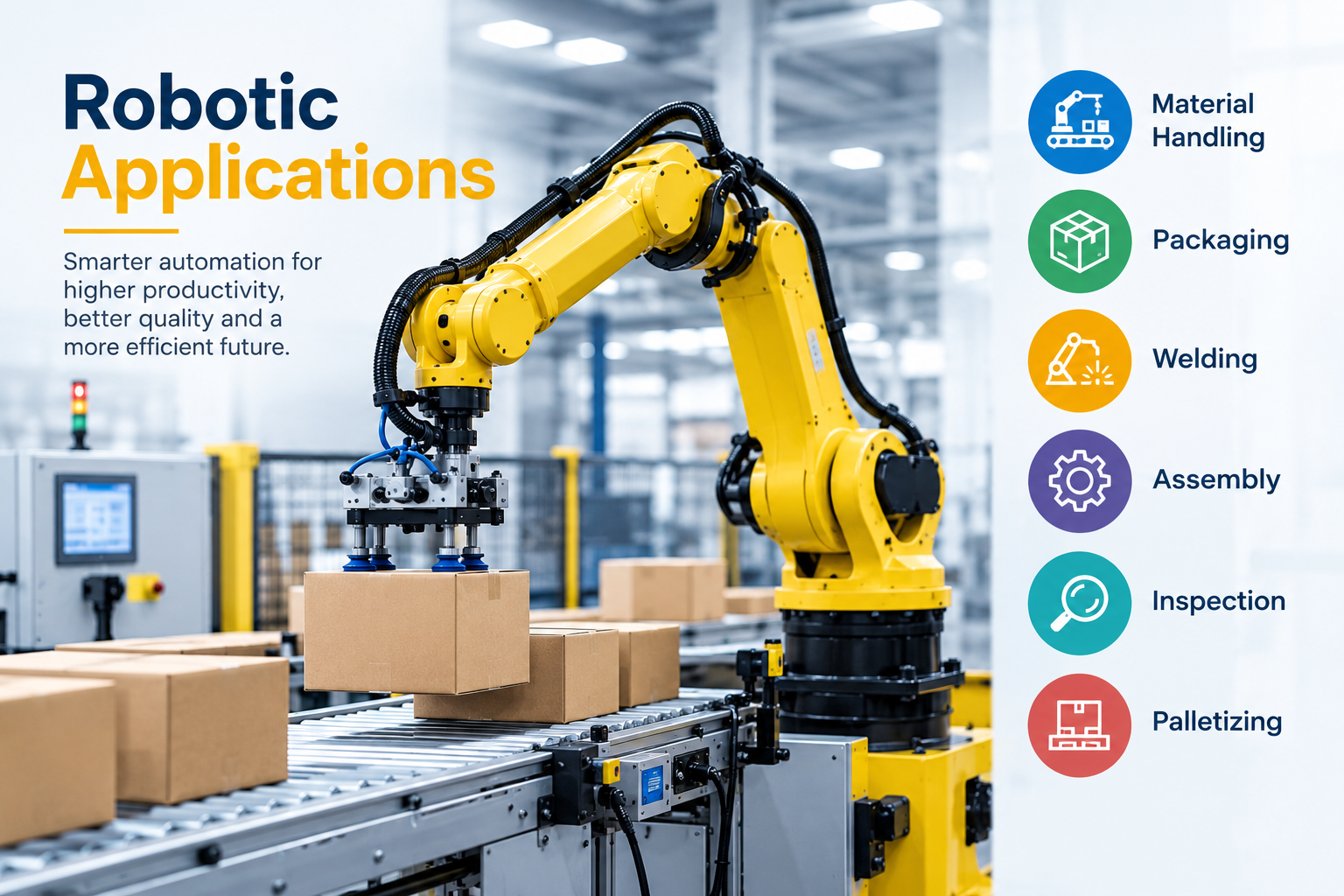
Robotic Applications are expanding across manufacturing, automotive production, warehousing, healthcare, and other industries. From handling materials to performing complex assembly tasks, robots help organizations improve operational efficiency and address demanding technical requirements.
Understanding how robotic technology works and where it can be applied helps businesses identify opportunities to improve their processes.
What Are Robotic Applications?
Robotic applications involve using programmable robotic systems to perform specific tasks in industrial, commercial, or specialized environments.
These systems may include robotic arms, mobile robots, sensors, cameras, controllers, and specialized gripping equipment. Each component contributes to the robot's ability to interact with its surroundings and perform its assigned function.
For example, a manufacturing facility may use a robotic arm to assemble components, apply adhesive, or inspect products. A warehouse may use mobile robots to transport materials between designated locations.
The appropriate robotic system depends on the task, working environment, product characteristics, and required level of precision.
Key Benefits of Robotic Technology
1. Improved Productivity
Robots can perform repetitive tasks consistently and, when designed for continuous operation, work across extended production schedules.
Automating suitable activities helps businesses manage high workloads and improve production flow. Employees can then focus on supervision, quality checks, maintenance, and other tasks that require human judgment.
2. Greater Precision and Consistency
Some industrial operations require highly repeatable movements and accurate positioning. Properly configured robotic systems can perform these tasks consistently within their specified operating limits.
This can be particularly useful for component assembly, product handling, dispensing, and other operations where variation may affect product quality.
3. Improved Workplace Safety
Certain industrial activities involve heavy materials, high temperatures, hazardous substances, or repetitive movements.
Robots can perform suitable tasks in these environments, helping reduce workers' direct exposure to specific hazards. However, effective risk assessments, guarding, emergency stops, and appropriate safety systems remain essential.
4. Reduced Repetitive Work
Employees may spend considerable time completing repetitive or physically demanding tasks. Automating suitable activities can reduce physical strain and allow workers to focus on more complex responsibilities.
Successful implementation requires appropriate task allocation, training, and coordination between people and robotic equipment.
5. Greater Operational Flexibility
Programmable robots can often be reconfigured for different tasks, depending on their design and capabilities.
This flexibility can help businesses adapt to changes in product specifications, production volumes, and manufacturing requirements without completely redesigning their operations.
Common Robotic Applications Across Industries
Robotic technology supports a wide range of industrial and commercial activities.
- Automotive Manufacturing: Robots perform welding, painting, component assembly, and material handling.
- Electronics Production: Robotic systems support component placement, assembly, and precision handling.
- Warehousing: Mobile robots transport materials and assist with internal logistics.
- Healthcare: Specialized robots support selected surgical procedures, rehabilitation activities, and laboratory operations.
- Food Processing: Robots handle suitable products during packaging, sorting, and processing.
- Agriculture: Robotic equipment supports tasks such as crop monitoring, targeted spraying, and selected harvesting operations.
Each application requires equipment suited to its working conditions, safety requirements, and performance objectives.
Important Factors When Implementing Robotic Systems
Adopting robotics requires careful planning to ensure that the selected equipment meets actual business needs.
Task Assessment: Identify repetitive, hazardous, or precision-sensitive activities that may benefit from automation.
Equipment Selection: Evaluate the robot's payload, reach, speed, accuracy, and suitability for the intended task.
Workspace Design: Ensure that the equipment has sufficient space and can operate safely alongside other machinery and personnel.
System Integration: Determine how the robot will communicate with existing equipment, sensors, and control systems.
Employee Training: Provide training for operators and maintenance personnel to support safe and effective operation.
Maintenance Planning: Establish inspection schedules and maintenance procedures to help maintain performance and reduce unexpected downtime.
Considering these factors helps businesses make informed decisions and avoid investing in equipment that does not match their operational requirements.
Future Developments in Robotics
Robotics continues to evolve as advances in artificial intelligence, machine vision, sensors, and computing improve system capabilities.
Machine vision can help robots identify objects and respond to changes in their surroundings. Collaborative robots are designed for applications where people and robots may share a workspace under appropriate safety conditions.
Artificial intelligence can also support selected tasks involving recognition, inspection, and decision-making. Meanwhile, improvements in sensing and navigation are expanding the potential uses of autonomous mobile robots.
These developments are creating new opportunities for businesses to improve production processes and explore more flexible ways of working.
Conclusion
Robotic Applications are helping industries improve productivity, maintain consistent quality, and manage repetitive or physically demanding tasks. Their uses range from manufacturing and electronics production to warehousing, healthcare, and agriculture.
Successful adoption depends on selecting suitable equipment, evaluating safety requirements, integrating systems effectively, and training employees. By identifying the right opportunities for automation, businesses can develop more efficient operations and respond to changing industry demands.

 English
 Arabic
 French
 Spanish
 Portuguese
 Turkish
 Dutch
 Italiano
 Russian
 Romaian
 Portuguese (Brazil)
 Greek
