

Can a Corporate Plant Supplier Help Turn Scattered Office Greenery Into a Cohesive Space?
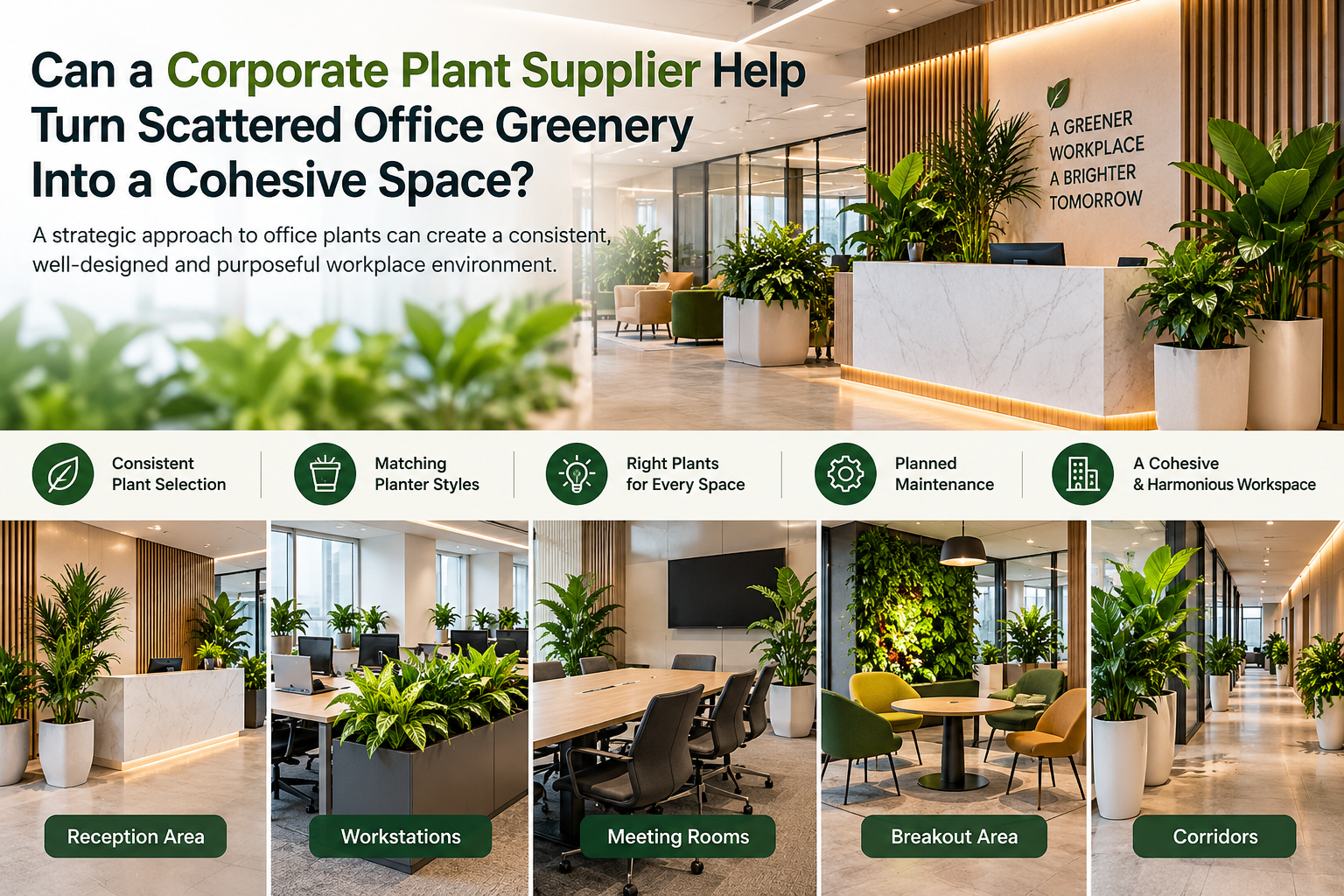
Many offices gradually collect plants without ever having a clear planting strategy. A few plants may sit near reception, another group may appear beside workstations, while an empty corner may have a completely different type of planter. A Corporate Plant Supplier can help bring these scattered choices together by considering the workplace as one connected environment rather than treating every plant as a separate purchase.
The goal is not simply to add more greenery. It is to create a consistent approach to plant selection, placement, containers, maintenance, and overall visual balance. When these elements work together, office greenery can feel intentional rather than randomly distributed.
Why Can Scattered Office Plants Make a Workplace Feel Disconnected?
Plants are often purchased at different times for different reasons.
One department may choose plants for its reception area. Another may add greenery to improve an empty corner. A meeting room may receive a few decorative planters, while a cafeteria gets a completely different collection.
Individually, these choices may work well. Together, however, they may lack consistency.
Common signs of scattered office greenery include:
-
Different planter styles throughout the same floor
-
Plants with very different care requirements
-
Uneven distribution of greenery
-
Oversized plants in small spaces
-
Empty areas next to heavily planted zones
-
Plants placed without considering natural light
-
No consistent maintenance routine
The problem is not necessarily the number of plants. It is the absence of an overall approach.
Can a Corporate Plant Supplier Create a More Consistent Planting Strategy?
A suitable supplier can do more than provide individual plants.
The supplier can first understand the workplace environment, identify different types of spaces, and then recommend greenery according to those conditions.
For example, a corporate office may contain:
-
Reception areas
-
Open-plan workstations
-
Private cabins
-
Meeting rooms
-
Corridors
-
Cafeterias
-
Waiting areas
-
Breakout zones
-
Terraces or outdoor areas
Each space can have different lighting, traffic, temperature, and maintenance requirements.
Instead of selecting the same plant for every location, a coordinated strategy can use different plants while maintaining an overall visual connection.
How Can Different Plants Still Look Cohesive?
Cohesion does not mean every office plant needs to be identical.
In fact, using exactly the same plant throughout a large workplace can sometimes make the environment feel repetitive.
A more balanced approach is to create consistency through selected design elements.
For example:
Consistent Planter Styles
Different plants can appear more connected when their containers share a similar material, shape, colour, or design language.
Repeated Plant Forms
A particular plant type can be repeated in several locations to create visual continuity.
Similar Green Tones
Using plants with complementary foliage can help different areas feel connected.
Strategic Grouping
Instead of placing single plants randomly, groups can be arranged according to the size and purpose of each space.
Consistent Spacing
The distance between plants and their relationship to furniture can also influence how organised the workplace appears.
This allows variety without visual confusion.
What Should Be Considered Before Selecting Office Plants?
Plant selection should begin with the workplace environment rather than personal preference.
A plant may look attractive but still be unsuitable for a particular location.
Important considerations include:
-
Natural light levels
-
Artificial lighting
-
Indoor temperature
-
Available floor space
-
Air movement
-
Plant growth habits
-
Watering requirements
-
Maintenance frequency
-
Workplace traffic
-
Safety and accessibility
For example, a plant that performs well beside a bright window may not be suitable for a darker interior corner.
Similarly, a large floor plant may look impressive in a reception area but create an obstruction in a narrow corridor.
Matching plants to their environment can help create a healthier and more practical office planting system.
Can a Plant Supplier Help Businesses Use Space More Effectively?
Yes. One of the biggest advantages of planned office greenery is that plants can be selected according to the scale and function of a space.
A large lobby may support tall statement plants.
A small workstation may need a compact tabletop plant.
A long corridor may benefit from occasional vertical greenery rather than continuous planters.
A breakout area may work well with a combination of medium-sized plants and smaller decorative greenery.
This means the objective is not simply:
“Where can we put another plant?”
Instead, the better question is:
“What type of greenery makes sense for this particular space?”
That shift can prevent unnecessary clutter while making better use of existing areas.
How Does Plant Maintenance Affect Workplace Consistency?
Even a well-designed plant collection can become inconsistent if maintenance is irregular.
Plants grow at different rates. Leaves may become damaged. Some plants may need pruning, while others may require replacement.
Without a planned maintenance routine, an office can gradually develop a different problem: healthy-looking plants in one area and neglected greenery in another.
Regular plant care may include:
-
Watering
-
Pruning
-
Leaf cleaning
-
Plant health monitoring
-
Replacement of declining plants
-
Pest observation
-
Planter and surrounding-area cleaning
-
Adjustment of plant placement where necessary
For larger offices, having a structured plant maintenance plan can make it easier to keep different areas looking connected.
Why Is Plant Maintenance Often Overlooked?
When businesses purchase plants, attention naturally goes toward the initial appearance.
The plants arrive looking fresh, the planters are positioned, and the space immediately feels different.
But office greenery is a living system.
Plants change over time, and their care requirements can vary depending on their location.
A plant positioned near an air-conditioning outlet may experience different conditions from one near a window. A plant in a high-traffic area may require more frequent attention than one in a quiet meeting room.
A professional approach considers what happens after installation, not just on the day plants are delivered.
Can a Corporate Plant Supplier Help With Workplace Branding?
Office greenery does not have to compete with corporate branding.
Instead, it can complement the company's visual environment.
For example, businesses may use:
-
Planters that complement interior colours
-
Greenery around reception branding
-
Consistent containers across departments
-
Statement plants in important visitor areas
-
Vertical greenery in selected feature zones
The result can feel more intentional without turning the workplace into an overly decorated space.
This is particularly useful when a company wants its office to feel consistent across multiple floors or departments.
What Happens When an Office Has Multiple Floors?
Multi-floor offices can make plant consistency more challenging.
Different teams may occupy different areas, and plants may be purchased independently.
A coordinated planting plan can help establish common principles across the building.
For example, the business could define:
Reception areas: statement greenery
Workstations: compact indoor plants
Meeting rooms: medium plants
Corridors: selected vertical or floor greenery
Break areas: relaxed plant groupings
This does not mean every floor must look identical. Instead, each area can have its own character while still following a common visual language.
How Can Businesses Avoid Over-Planting?
More greenery does not automatically mean a better workplace.
Too many plants can make an office difficult to navigate, harder to maintain, and visually crowded.
A cohesive planting strategy should consider balance.
Businesses can ask:
-
Is this area already visually busy?
-
Does the plant interrupt movement?
-
Is there enough light?
-
Can the plant be maintained easily?
-
Does this location actually need greenery?
-
Does the plant improve the space or simply fill it?
Sometimes removing an unsuitable plant can improve the overall design more than adding another one.
Can Professional Plant Planning Reduce Random Purchases?
It can help businesses move away from reactive plant buying.
Instead of purchasing plants whenever an empty space appears, companies can maintain a broader understanding of their workplace greenery.
This can make it easier to identify:
-
Which plant types are already being used
-
Which locations need greenery
-
Which plants require replacement
-
Which planters should be standardised
-
Which areas need more frequent maintenance
-
Which plants are unsuitable for specific locations
This type of planning can be particularly useful for larger commercial offices where greenery is spread across multiple spaces.
What Should Businesses Look for in a Corporate Plant Supplier?
The right supplier should understand that corporate greenery is not simply a product purchase.
Businesses can consider whether the supplier offers support with:
-
Plant selection
-
Workplace assessment
-
Planter recommendations
-
Installation
-
Plant replacement
-
Regular maintenance
-
Indoor landscaping
-
Long-term greenery planning
A supplier who understands the environment in which plants will live can offer more practical recommendations than one focused only on delivering individual plants.
The best approach will vary according to the office, budget, available space, and maintenance expectations.
How Can an Office Create a Cohesive Greenery Plan?
A simple process can help businesses organise their existing plants before adding more.
Step 1: Audit the Existing Plants
List the plants currently placed throughout the workplace.
Step 2: Map the Spaces
Identify reception areas, workstations, corridors, meeting rooms, lounges, and unused corners.
Step 3: Review Plant Conditions
Check whether each plant is receiving appropriate light and care.
Step 4: Identify Inconsistencies
Look for mismatched planters, unsuitable plant sizes, neglected areas, or unnecessary clutter.
Step 5: Create Planting Zones
Group spaces according to their function and environmental conditions.
Step 6: Establish a Maintenance Routine
Create a consistent approach to watering, pruning, cleaning, and replacement.
Step 7: Add New Greenery Strategically
Only add plants where they support the overall plan.
This process can turn an assortment of individual plants into a more connected workplace landscape.
Frequently Asked Questions
1. What does a Corporate Plant Supplier provide?
A Corporate Plant Supplier may provide indoor plants, planters, installation, plant maintenance, replacement services, and workplace greenery solutions depending on the supplier and project requirements.
2. How can businesses make different office plants look cohesive?
Consistency can be created through planter styles, repeated plant varieties, similar foliage tones, strategic grouping, and a planned approach to placement.
3. Should every office area have the same plants?
Not necessarily. Different areas may have different lighting, space, and usage requirements. Using suitable plants for each area while maintaining a consistent design approach can produce better results.
4. How often should corporate office plants be maintained?
The frequency depends on plant type, environmental conditions, season, and workplace conditions. A maintenance schedule should be created around the actual needs of the plants.
5. Can a plant supplier help choose the right plants for low-light offices?
Yes. A knowledgeable supplier can recommend plant varieties based on the available light and other conditions. However, plant suitability should always be assessed for the specific location.
6. Is it better to have many plants or fewer well-placed plants?
There is no universal number. Strategic placement is generally more important than simply increasing the quantity of plants. The goal should be visual balance, practical use of space, and manageable maintenance.
7. Can office greenery be planned across multiple floors?
Yes. A workplace can use consistent design principles across different floors while adapting plant choices and arrangements to each area's specific conditions.
Final Thoughts
Office greenery often develops gradually. A plant is added here, another planter appears there, and eventually the workplace may contain plenty of greenery without a clear visual connection between the different areas.
A thoughtful Corporate Plant Supplier can help businesses look at the bigger picture.
The goal is not to make every corner identical or fill the office with plants. It is to understand how each space works, choose greenery that suits its conditions, create visual consistency, and maintain the plants over time.
When plant selection, planters, placement, maintenance, and workplace design are considered together, scattered greenery can become a cohesive part of the office environment.
The result is not simply a workplace with more plants. It is a workplace where the greenery feels like it belongs.

 Arabic
 French
 Spanish
 Portuguese
 Deutsch
 Turkish
 Dutch
 Italiano
 Russian
 Romaian
 Portuguese (Brazil)
 Greek
