

How to Verify Company Registration Details Through MCA Master Data
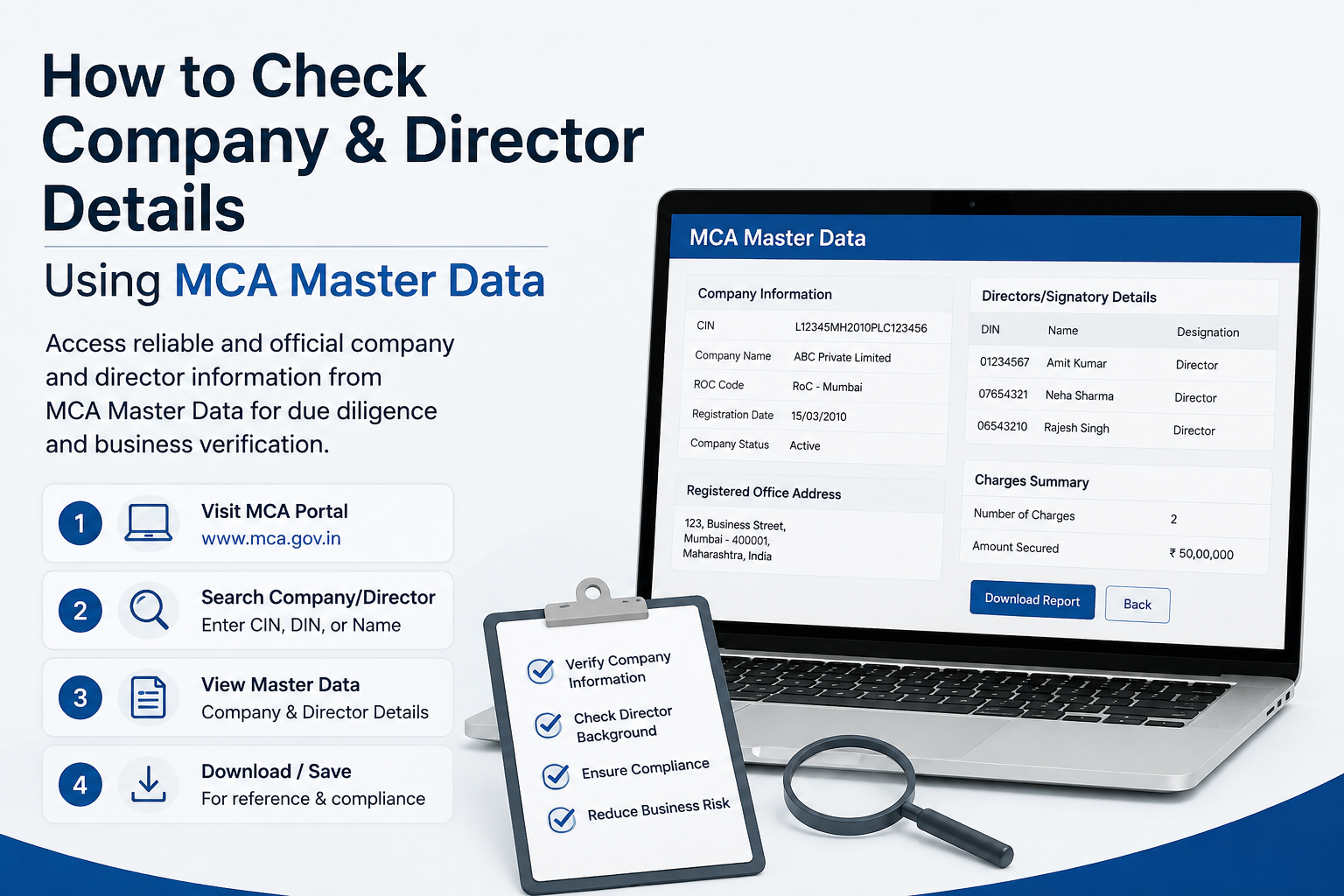
Before signing a contract, approving a supplier, or offering business credit, it is important to confirm that the company you are dealing with matches its official registration records. A business name on an invoice, website, or proposal does not provide sufficient evidence of its legal identity. Checking government-maintained corporate information helps establish a more reliable starting point for verification.
In India, the Ministry of Corporate Affairs (MCA) provides access to company registration information through its Master Data services. These records help individuals, financial institutions, procurement teams, and businesses examine key details associated with registered companies and Limited Liability Partnerships (LLPs).
This article explains how to verify company registration details through MCA Master Data, which records to examine, how to identify discrepancies, and why registration verification matters for business due diligence.
What Is MCA Master Data?
MCA Master Data is a collection of corporate information maintained through the Ministry of Corporate Affairs' electronic systems. The information is based on records and filings submitted by companies and other relevant sources within the MCA framework.
Users can consult these records to identify a registered entity and review selected information about its legal structure, incorporation, registered office, and recorded status. Depending on the entity and the information available, the master data view may also display capital details and other corporate particulars.
The official portal provides separate master data facilities for companies and LLPs. You can access the MCA Corporate Data Management portal or visit the official MCA website to locate the relevant services.
It is important to understand that master data is a starting point for verification, not a guarantee that a company is financially sound or that every detail supplied by a business partner is genuine.
Why Is Company Registration Verification Important?
Corporate registration checks help businesses establish whether the legal entity they intend to engage with corresponds to an official record. This is particularly relevant when a transaction involves advance payments, credit facilities, recurring supplies, or substantial contractual commitments.
Here are some important reasons to verify company registration details.
Confirm the Legal Identity of a Business
Companies with similar names can operate in different industries or locations. Checking the Corporate Identity Number (CIN) alongside the legal name helps distinguish the intended entity from other businesses.
Reduce Supplier and Customer Onboarding Risks
Procurement and credit teams can compare registration information with onboarding documents before approving a new customer, vendor, or distributor. Any unexplained difference can be referred for additional checks.
Support Commercial Credit Decisions
A company's registration information provides context for further credit assessment. However, the decision to extend credit should also consider payment history, financial performance, existing liabilities, and the proposed transaction.
Identify Information That Needs Further Investigation
A difference between a company's claimed registration details and the official record may indicate outdated paperwork, a clerical error, or a more significant concern. Verification helps identify these issues before they affect a business relationship.
How to Verify Company Registration Details Through MCA Master Data
Follow these steps to check a company's registration information through the official MCA services.
Step 1: Open the Official MCA Website
Visit www.mca.gov.in or access the MCA Corporate Data Management portal.
Use the official government website to avoid relying exclusively on information reproduced by third-party company directories.
Step 2: Find the Company Master Data Service
Navigate to the relevant company master data facility. The portal's layout and service names may change, so use the current navigation available on the website.
If you are checking a Limited Liability Partnership, select the LLP Master Data facility instead of the company search option.
Step 3: Search Using the Company Name or CIN
Enter the company's registered name or Corporate Identity Number, depending on the search facility available.
The CIN is generally the more precise identifier because it distinguishes a particular company from other entities with similar names. If you do not know the CIN, search by name and carefully identify the correct legal entity from the results.
For an LLP, use the applicable LLP identification details, such as its LLPIN.
Step 4: Review the Registration Record
Once the relevant entity is identified, examine the information displayed in its master data record.
Check the legal name, CIN, date of incorporation, company classification, registered state, and recorded status. Review the registered office address and capital details where available.
Do not stop after confirming that the company name exists. The objective is to determine whether the official record corresponds to the business you intend to verify.
Step 5: Compare the Record With Business Documents
Compare the MCA information against the company's invoice, purchase order, contract, onboarding form, or other documents.
For example, if a supplier provides a CIN that belongs to a differently named company, ask for clarification and supporting documentation before proceeding. A name change, restructuring, or outdated document may explain a discrepancy, but it should be verified.
Step 6: Examine Additional Corporate Records When Necessary
Master data may not answer every question about a company's financial position or legal obligations. Depending on the risk involved, review the relevant annual filings, financial statements, director or signatory details, and registered charge information through the appropriate official services.
For a significant credit decision, use multiple reliable sources rather than treating one master data screen as a complete due diligence report.
Key Details to Check in MCA Master Data
The following information can help you organise a company registration verification exercise.
| Detail to check | What it helps establish |
|---|---|
| Legal company name | Whether the name matches the entity in the business documents. |
| Corporate Identity Number | Whether the registration identifier corresponds to the intended company. |
| Date of incorporation | When the company was registered. |
| Company status | The status recorded in the MCA database at the time of checking. |
| Company category and type | The entity's recorded corporate classification. |
| Registered office address | Whether the address aligns with the available business records. |
| Authorised and paid-up capital | Relevant information about the company's registered capital. |
| Director or signatory information | Details that can support checks on corporate representation, where available. |
| Filing and charge information | Additional records that may require separate searches or document access. |
The availability and presentation of individual fields can vary. Always check the relevant official record instead of assuming that every company will display the same information.
How to Identify Potential Red Flags During Verification
A registration check becomes more useful when the findings are evaluated in context. The following situations warrant further investigation.
1. CIN and company name do not match: Confirm that the identifier has been entered correctly and belongs to the intended legal entity.
2. The recorded company status raises concerns: Review the current record and investigate the implications before entering into a transaction. Do not rely on an old downloaded report for a current status check.
3. Registered address details differ: Ask the business to explain the discrepancy and provide supporting records where appropriate. An address difference alone does not prove misconduct.
4. The person representing the company cannot demonstrate authority: Check the relevant director or authorised signatory records, then request appropriate authorisation documents. A director's name appearing in a database does not automatically establish that the individual can approve every transaction.
5. Important documents contain inconsistent information: Compare the legal name, CIN, addresses, and other identifiers across invoices, contracts, and onboarding records. Resolve material differences before approval.
6. Registration information is being used as proof of financial strength: An existing corporate registration does not establish repayment capacity, financial stability, or a reliable payment history. These factors need separate assessment.
MCA Master Data vs. a Comprehensive Business Information Report
MCA Master Data and a comprehensive business information report serve different purposes.
MCA Master Data helps users examine basic corporate registration information and identify the relevant legal entity. A business information report may provide a broader assessment by combining corporate records with other relevant information, depending on the scope and sources used.
| Area of assessment | MCA Master Data | Comprehensive business information report |
|---|---|---|
| Corporate identity | Provides key registration details | Can cross-check identity against additional sources |
| Registration status | Shows the status recorded in the database | May incorporate the finding into a broader assessment |
| Financial assessment | Does not independently establish creditworthiness | May include financial analysis where data is available |
| Payment behaviour | Does not establish actual payment performance | May include relevant payment or credit indicators where available |
| Litigation and risk checks | May require separate searches | May incorporate relevant legal and risk information, subject to coverage |
| Business decision support | Useful for initial verification | Can support more detailed due diligence |
The exact scope of a business report depends on the information available and the services included. Neither registration data nor a business report should be treated as a guarantee against fraud or financial loss.
How Businesses Can Use MCA Verification in Their Due Diligence Process
Businesses can make registration verification more consistent by introducing it into their standard onboarding and review procedures.
-
At customer onboarding: Confirm the legal entity before establishing credit terms.
-
During supplier selection: Check registration details before finalising a significant procurement arrangement.
-
Before extending credit: Combine corporate verification with financial analysis and payment-risk assessment.
-
During periodic reviews: Recheck relevant information when a contract is renewed or the business relationship changes.
-
When discrepancies appear: Document the issue, obtain supporting evidence, and escalate unresolved concerns to the appropriate team.
For businesses managing many customers and suppliers, a documented verification process can help reduce avoidable errors and improve the quality of commercial decisions.
Conclusion
Verifying company registration details through MCA Master Data is a practical step toward establishing the identity of a business before entering into a commercial relationship. Checking the legal name, CIN, incorporation details, recorded status, and other available information helps businesses identify inconsistencies and decide when further investigation is necessary.
However, corporate registration is only one part of due diligence. Businesses that extend credit or manage substantial receivables should also evaluate financial information, payment behaviour, and other relevant risk indicators.
MNS Credit Management Group provides business information and credit assessment services to support organisations in evaluating counterparties and making better-informed commercial decisions. Combining official corporate records with appropriate due diligence can help businesses establish a more reliable basis for managing credit and commercial risk.
Frequently Asked Questions (FAQs)
1. How can I verify whether a company is registered with MCA?
Visit the official MCA website, locate the company master data service, and search using the company's name or CIN. Review the resulting record and confirm that its details match the entity you intend to verify.
2. Can I check company registration details online for free?
Basic company master data is generally available through official MCA services without a fee. Certain documents, filings, or additional services may have separate access requirements or charges.
3. What is the difference between CIN and company registration number?
CIN is the Corporate Identity Number assigned to a company registered in India. A registration number may refer to a component of the company's registration particulars, so the terms should not automatically be treated as interchangeable.
4. Does MCA Master Data confirm that a company is genuine?
It helps verify whether a corresponding corporate registration record exists and provides details recorded in the database. It does not independently establish that the person contacting you represents the company or that the business transaction is legitimate.
5. Can MCA Master Data show whether a company is financially stable?
No. Registration details alone do not establish financial stability or creditworthiness. Financial statements, liabilities, payment history, and other relevant indicators may be needed for a more complete assessment.
6. How often should company registration details be checked?
Check them before establishing a significant business relationship and repeat the verification when circumstances warrant it, such as during periodic credit reviews, contract renewals, or when material discrepancies arise. Higher-risk relationships may require more frequent checks.
7. What should I do if the MCA record differs from the company's documents?
First, check for typing errors and confirm that the correct entity has been selected. Then request supporting documentation and investigate the discrepancy. Avoid making a final decision based on an unexplained mismatch alone.

 Arabic
 French
 Spanish
 Portuguese
 Deutsch
 Turkish
 Dutch
 Italiano
 Russian
 Romaian
 Portuguese (Brazil)
 Greek
