

How Business Information Reports Support Smarter Lending Decisions
Lending decisions involve more than reviewing a loan application and checking a company's financial statements. Before extending credit, lenders need to understand the business behind the application, its financial position, ownership structure, regulatory compliance, and potential risk exposure. Missing important details during this process can lead to unsuitable lending decisions, delayed approvals, or unexpected repayment difficulties.
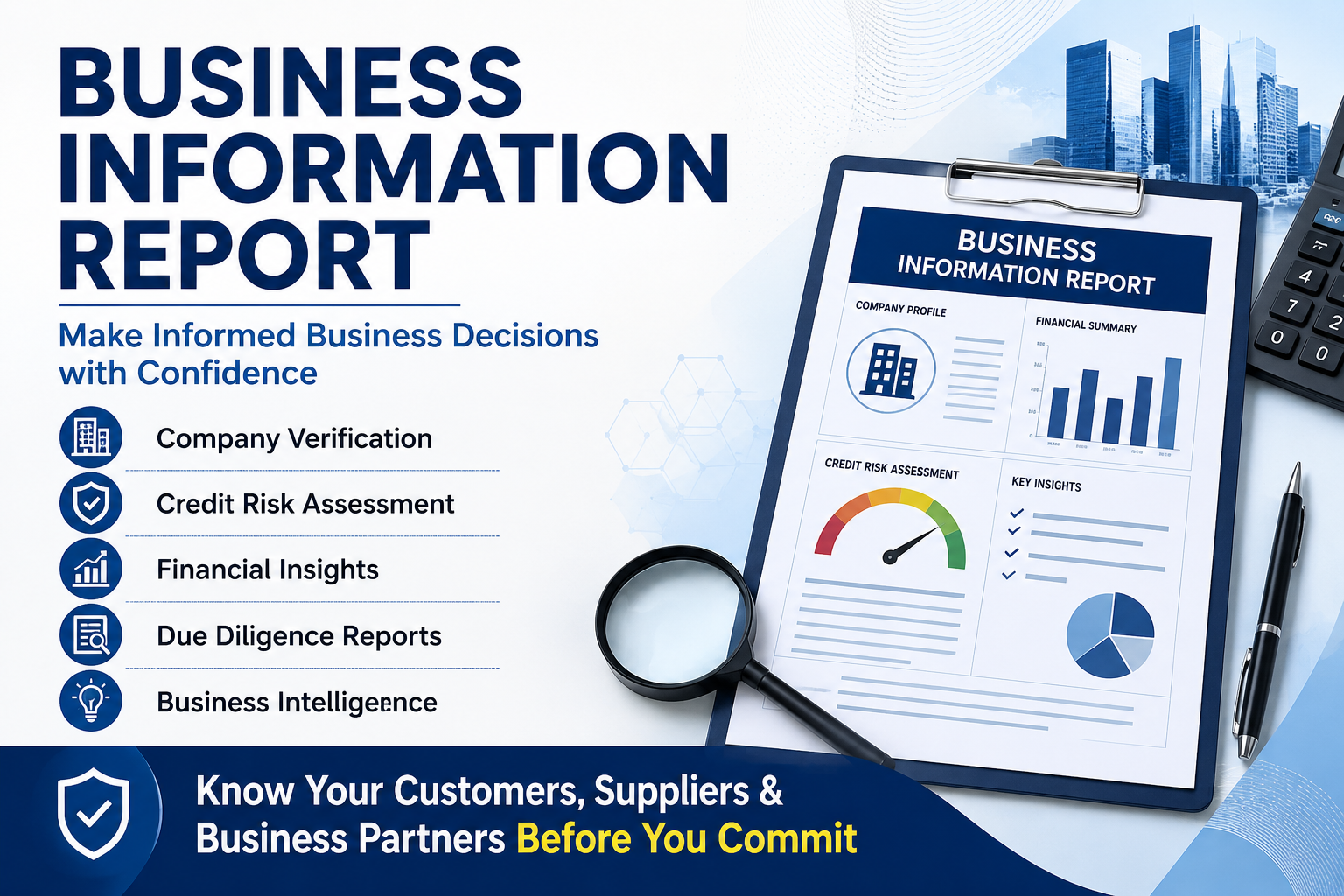
A Business Information Report (BIR) helps address these challenges by bringing together relevant information about a company in a structured format. It enables banks, Non-Banking Financial Companies (NBFCs), fintech firms, and other lenders to examine business credentials and identify factors that may influence creditworthiness.
As lending operations become increasingly data-driven, Business Information Reports can support faster research, more consistent borrower assessments, and stronger credit risk management. However, their value depends on the quality of the underlying information and how effectively lenders interpret it alongside financial statements, repayment history, and other credit assessment inputs.
What Is a Business Information Report?
A Business Information Report is a structured document that presents relevant information about a business to help users evaluate its background, credibility, financial position, and potential risks.
Depending on the provider, report coverage, and availability of records, a BIR may include:
-
Company registration details and legal status
-
Directors, promoters, and ownership-related information
-
Financial statements and performance indicators
-
Registered charges and borrowing-related disclosures
-
Litigation records and legal proceedings
-
Statutory filings and compliance information
-
Business associations and related-entity linkages
-
Other available corporate disclosures and risk indicators
Lenders use these details to develop a more complete picture of a borrower before approving credit, renewing an existing facility, or reviewing an ongoing business relationship.
A Business Information Report is not necessarily the same as a credit bureau report or a credit rating. It primarily provides business intelligence that helps lenders conduct due diligence and assess company-level risks. It should be interpreted alongside other relevant evidence rather than used as the sole basis for a lending decision.
1. Strengthening Borrower Verification Before Loan Approval
One of the first steps in lending is confirming that the applicant is a genuine business entity and that the information submitted during the application process is consistent with available records.
A Business Information Report can help lenders verify essential details, including the company's registered name, incorporation information, business status, and director details. Where relevant records are available, these checks can also help identify discrepancies between application documents and public corporate information.
For example, a company may submit a loan application using an address or director detail that differs from its latest available corporate filing. This discrepancy does not automatically indicate fraud, but it creates a reason for the lender to investigate further.
By identifying such inconsistencies early, credit teams can request clarification before progressing with underwriting. This reduces the likelihood of relying on incomplete or outdated information during the initial assessment.
Practical benefit: Better borrower verification creates a stronger foundation for credit appraisal and helps lenders direct their attention toward applications requiring additional checks.
2. Understanding Financial Strength Beyond Revenue
Revenue alone does not determine whether a business can repay its borrowing. A company may generate substantial sales but still face cash-flow pressure, rising liabilities, or declining profitability.
Business Information Reports that include financial information can help lenders examine a company's performance across multiple dimensions.
Important indicators may include:
-
Revenue trends: Whether business income is increasing, stable, or declining.
-
Profitability: Whether the company generates sufficient earnings relative to its operating costs.
-
Debt obligations: Whether existing borrowing may place pressure on repayment capacity.
-
Liquidity: Whether available short-term resources appear adequate to meet near-term obligations.
-
Net worth and capital structure: How the business is financed and whether its financial position has changed over time.
Consider a hypothetical borrower whose revenue has increased over two financial years. At first glance, the company may appear to be expanding successfully. However, further analysis might reveal that its debt has grown faster than its earnings or that its working capital position has weakened.
These findings would not automatically justify rejecting the application. Instead, they would help the lender ask more relevant questions about cash-flow management, repayment sources, and the proposed loan amount.
Financial information should always be assessed in context, considering the company's industry, business model, reporting period, and the availability of current records.
3. Identifying Existing Borrowing and Financial Exposure
Before extending additional credit, lenders need to understand the borrower's existing financial commitments.
Available corporate charge records and other borrowing-related disclosures can provide useful context about secured financing arrangements. In India, registered charges with the Ministry of Corporate Affairs (MCA) may help lenders identify certain security interests created over a company's assets.
This information can support questions such as:
-
Does the company have existing secured borrowing?
-
Are assets already subject to registered charges?
-
Have borrowing-related disclosures changed since the previous assessment?
-
Does the lender need to investigate the company's existing obligations further?
For example, a business seeking a new working capital facility may already have created security interests over important assets. The lending team may need to examine the relevant charge records, existing lender arrangements, and available facility documentation before determining whether additional financing is appropriate.
It is important to distinguish registered charges from total outstanding debt. A charge record does not necessarily establish the current amount owed, the remaining repayment balance, or the complete picture of a company's liabilities. Lenders should reconcile available disclosures with financial statements, lender confirmations, and other relevant documents.
This approach helps credit teams evaluate potential financial exposure without treating a single record as conclusive evidence.
4. Evaluating Directors, Promoters, and Business Relationships
A company's risk profile can be influenced by its ownership structure, management, and relationships with other businesses.
Business Information Reports may provide information about directors, promoters, and corporate linkages that helps lenders understand who manages the company and whether relevant connections warrant additional investigation.
For example, a director may be associated with several companies operating in related sectors. This information could help a lender understand the broader business network and investigate whether any shared ownership, financial dependence, or other relationship is relevant to the proposed lending arrangement.
Corporate linkages are particularly useful when the borrower operates through multiple entities or when the lender needs to understand the relationship between a holding company, subsidiaries, and associated businesses.
However, a shared director or business connection should not automatically be interpreted as evidence of financial distress or misconduct. Lenders should establish whether the relationship has a material impact on the borrower's financial position, repayment ability, or risk exposure.
When used appropriately, business linkage information adds context that may not be apparent from an individual company's financial statements alone.
5. Using Litigation and Compliance Information to Assess Risk
Legal disputes and compliance-related developments can affect business operations, financial commitments, and the reliability of information available to lenders.
A Business Information Report may help identify available litigation records, statutory filing information, and other relevant corporate disclosures that deserve closer examination.
For lending teams, these details can help identify questions such as:
-
Is the company involved in a legal dispute that could materially affect its operations?
-
Are there relevant corporate filing gaps that require clarification?
-
Has the business experienced changes in its legal or compliance position?
-
Could a disclosed matter create a financial obligation or operational disruption?
Imagine a supplier applying for a loan to expand its operations while being involved in a significant commercial dispute. The existence of a dispute does not necessarily mean that the company is a poor credit risk. Its relevance depends on the nature of the case, the amount involved, the stage of proceedings, and the possible effect on cash flow or business continuity.
Similarly, a missing or delayed filing should be investigated in context rather than treated as definitive proof of non-compliance across all applicable requirements.
Lenders should verify material findings against authoritative records and obtain professional advice where necessary. This makes legal and compliance information a useful input into credit assessment rather than a standalone approval or rejection criterion.
6. Supporting More Consistent Credit Assessment
Credit assessment can become inconsistent when different analysts rely on different documents, research methods, and evaluation criteria.
A structured Business Information Report can help standardise the initial research process by presenting relevant company details in a common format. This makes it easier for credit teams to follow a defined set of checks and document their findings.
A lender might establish a review process covering:
-
Business identity and registration verification.
-
Financial performance and available debt disclosures.
-
Director, promoter, and ownership information.
-
Litigation and compliance checks.
-
Identification of discrepancies and additional verification requirements.
-
Integration of findings into the wider credit appraisal.
This structure can reduce repetitive manual research and improve the traceability of information used during underwriting.
It does not eliminate the need for analyst judgement. Instead, it gives credit professionals a more organised starting point for evaluating applications and identifying issues that require deeper investigation.
For institutions handling large application volumes, a consistent assessment framework can also help improve coordination between relationship managers, credit analysts, risk teams, and compliance professionals.
7. Improving Lending Decisions Through Early Risk Identification
Credit risk is not limited to the time when a loan is approved. A borrower's business conditions may change during the loan tenure because of financial pressure, management changes, legal disputes, or other developments.
Business Information Reports can support periodic reviews when updated information is available. Comparing current records with earlier assessments may help lenders identify changes that warrant further investigation.
Examples include:
-
A deterioration in reported financial performance.
-
Newly disclosed borrowing-related arrangements.
-
Changes in directors or ownership.
-
New litigation information relevant to the company's operations.
-
Changes in corporate status or filing patterns.
Suppose a lender reviews an existing borrower and finds that the company's reported profitability has declined while its borrowing-related disclosures have changed. The combination of these developments may justify an updated financial review or a request for additional documentation.
Neither development should automatically be treated as evidence of impending default. The purpose is to identify changes early enough for the lender to investigate their significance and respond according to its risk policies.
For institutions that require ongoing oversight, a Business Information Report can form part of a wider portfolio monitoring process. Where continuous alerts are required, lenders may need a dedicated monitoring solution in addition to periodic reports.
8. Business Information Reports and the Lending Workflow
The usefulness of a Business Information Report increases when its findings are integrated into the lender's existing workflow rather than treated as a separate document.
A practical approach is to use the report at several stages of the lending lifecycle.
During initial screening: Verify the business identity and identify obvious information gaps.
During underwriting: Examine relevant financial, legal, ownership, and borrowing-related information alongside the application documents.
Before approval: Resolve material discrepancies and document the reasoning behind the credit decision.
During renewals: Compare available updated information with the previous assessment and investigate meaningful changes.
After disbursement: Use relevant new information as an input into periodic reviews and broader portfolio risk management.
The exact checks should vary according to the loan type, borrower profile, exposure amount, industry, and the lender's internal policies. A small working capital facility may require a different level of investigation from a large secured loan or complex corporate credit arrangement.
The objective is not to collect the maximum amount of information for every application. It is to identify the information most relevant to the credit decision.
9. How to Choose the Right Business Information Report Provider
Not all Business Information Reports offer the same level of detail, freshness, or usability. Lenders should evaluate providers according to the requirements of their credit assessment process.
Coverage of relevant business information
Check whether the provider covers the types of entities and records relevant to your portfolio, including companies, LLPs, and other business categories where supported.
Source transparency
Understand where the information originates, how it is collected, and whether important findings can be traced to underlying records.
Data freshness
Confirm the date of the information and how frequently different data categories are updated. Some corporate disclosures may be historical, even when presented in a recently generated report.
Depth of analysis
Assess whether the report simply presents company details or also helps users interpret financial indicators, corporate relationships, and potential risk factors.
Ease of use
A clear structure, searchable information, and accessible reporting formats can make it easier for credit analysts to find relevant details without unnecessary manual effort.
Integration with existing processes
Consider whether the provider's reporting capabilities fit the institution's underwriting, due diligence, renewal, and monitoring workflows.
Data governance
Review the provider's data handling practices, access controls, applicable licensing conditions, and suitability for the intended business use.
The right provider should help credit teams conduct meaningful due diligence while making it easier to verify findings and document decisions.
10. How Credhive Supports Business Information Research
Credhive helps financial institutions access business intelligence that can support company evaluation and credit risk assessment. Its Business Information Reports bring together relevant corporate information to help users investigate business credentials and understand factors that may influence a lending decision.
Depending on available records and report coverage, this information may include MCA filings, financial indicators, registered charges, director relationships, litigation details, and compliance-related disclosures.
For banks, NBFCs, fintech companies, and other credit professionals, these insights can support borrower verification, business due diligence, underwriting research, and periodic company reviews.
Credhive's broader Credit Decision Engine capabilities also align business intelligence with the practical needs of credit evaluation and risk management. By helping teams access relevant company-level information in a structured manner, the platform can support a more organised approach to lending research.
The final credit decision remains with the lender and should incorporate verified financial information, repayment capacity, applicable policies, and the complete circumstances of the borrower.
Conclusion
Business Information Reports can make lending decisions more informed by helping credit teams understand a borrower's corporate background, financial position, ownership structure, borrowing-related disclosures, and relevant legal or compliance matters.
Their greatest value lies in connecting these different areas of business information to the questions that matter during credit appraisal. Rather than relying on isolated documents, lenders can use a structured report to identify inconsistencies, investigate potential risks, and strengthen the evidence supporting their decisions.
When combined with financial analysis, repayment assessment, appropriate verification, and ongoing risk reviews, Business Information Reports become a valuable part of a disciplined lending process.
For institutions seeking to improve the quality of business research, solutions such as Credhive can help make company information more accessible and useful throughout the credit assessment lifecycle.
Frequently Asked Questions
1. What is the purpose of a Business Information Report in lending?
A Business Information Report helps lenders examine a company's background, financial information, ownership, legal disclosures, and compliance-related details. It supports borrower verification, due diligence, and credit risk assessment before a lending decision is made.
2. How does a Business Information Report help banks and NBFCs?
It helps banks and NBFCs organise company-level information, identify discrepancies, investigate potential risks, and improve the consistency of credit research. The report complements financial statements, repayment analysis, and other underwriting checks.
3. Is a Business Information Report the same as a credit report?
No. A Business Information Report generally provides broader information about a company's background and business profile, while a credit report typically focuses on credit history and repayment-related information available from the relevant reporting source. The scope of each document depends on its provider.
4. Can a Business Information Report predict loan default?
A Business Information Report may reveal indicators that deserve further investigation, but it cannot guarantee whether a borrower will repay or default. Lenders should combine its findings with financial analysis, repayment capacity assessment, and other relevant risk indicators.
5. When should lenders obtain a Business Information Report?
Lenders may use a Business Information Report during initial borrower screening, underwriting, credit renewals, corporate due diligence, and periodic borrower reviews. The timing and depth of assessment should reflect the institution's credit policies and the level of risk involved.

 English
 Arabic
 French
 Spanish
 Portuguese
 Deutsch
 Turkish
 Dutch
 Italiano
 Romaian
 Portuguese (Brazil)
 Greek
