

How Android App Development Companies in UAE Are Using Generative AI in 2027?
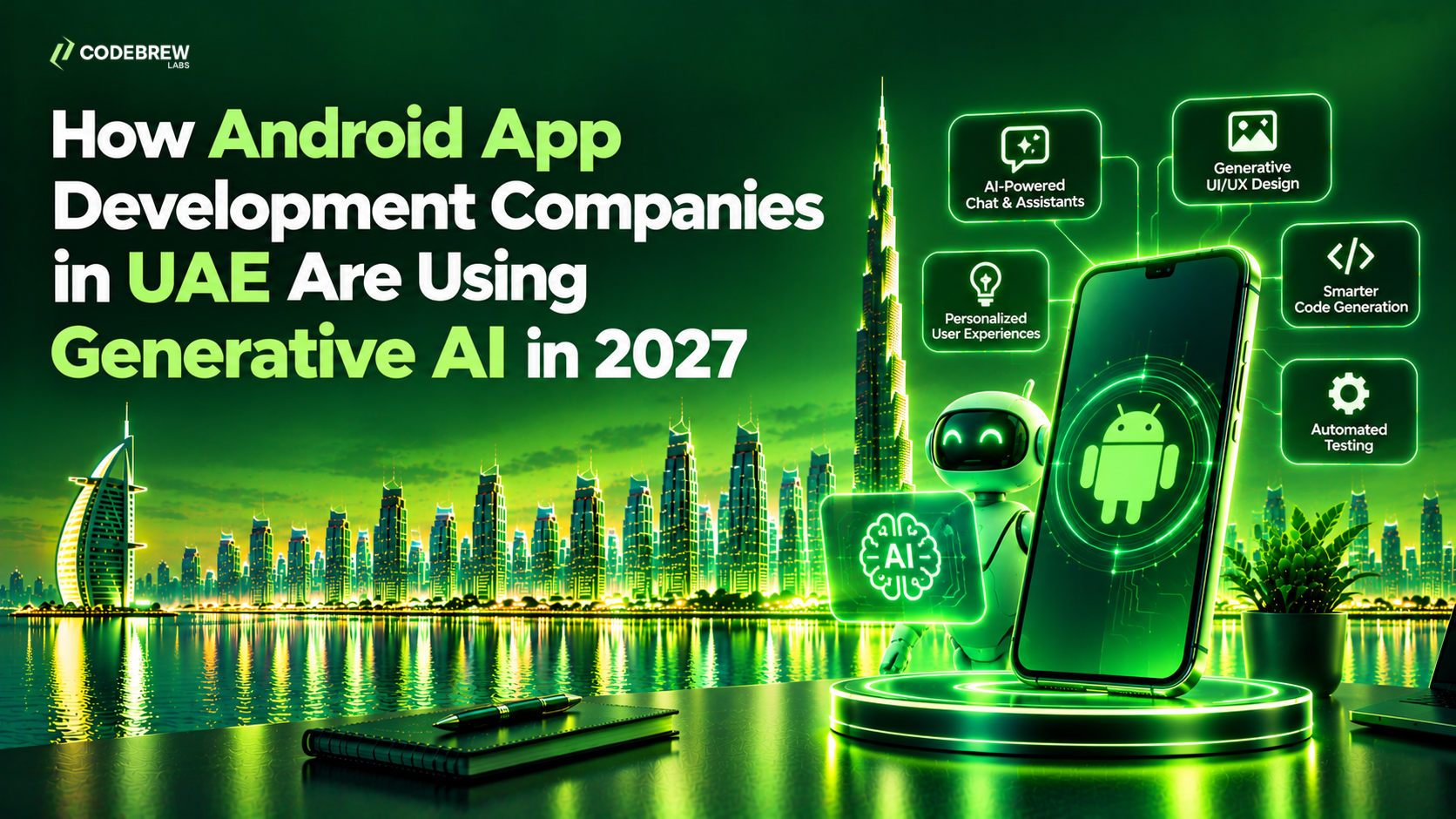
Businesses across the UAE are looking for new ways to improve mobile services, simplify daily operations, and deliver more personalized customer interactions. As digital adoption continues across industries, generative AI is becoming an important consideration for companies planning their next Android application.
Unlike traditional automation, generative AI can create text, summarize information, respond to natural-language questions, and assist users with tasks based on their needs. When integrated thoughtfully, these capabilities can make mobile applications more useful for customers and employees.
In 2027, Android app development companies in UAE are exploring ways to incorporate AI assistants, intelligent search, content generation, personalized recommendations, and automated workflows into mobile products. Android's growing support for on-device AI and AI-agent integrations is also opening new possibilities for application developers.
For businesses, the goal is not simply to add an AI feature. It is to identify where intelligent functionality can solve a real problem, improve usability, and create measurable business value.
What Is Generative AI in Android App Development?
Generative AI refers to artificial intelligence that can produce new content, including text, summaries, images, and other outputs, in response to user instructions or contextual information.
Within an Android application, this technology can support features such as conversational assistants, product descriptions, automated report summaries, intelligent search, and personalized content suggestions.
For example, an eCommerce application could help shoppers find products using natural-language questions. A logistics application could summarize delivery updates for managers, while a business productivity app could turn lengthy notes into concise action items.
Development teams can integrate cloud-based models, use compatible on-device AI capabilities, or combine both approaches.
The most suitable approach depends on the application's requirements, privacy needs, device compatibility, response speed, and operating costs.
7 Ways Android App Development Companies in UAE Are Using Generative AI in 2027
1. Building AI-Powered Chatbots and Virtual Assistants
Customer support is one of the clearest applications of generative AI in mobile development. Instead of relying entirely on fixed responses and traditional chatbot menus, businesses can introduce assistants that understand natural-language questions and generate relevant answers.
An Android application for a retail business, for instance, could help users understand return policies, find order information, or discover products. A service platform could guide customers through booking steps or explain how to access particular services.
Development teams can connect AI models to approved company information so responses reflect the business's products, policies, and services. They can also provide escalation options when a question requires human assistance.
For UAE businesses serving customers in different languages, multilingual support may be particularly useful. However, language quality should be tested carefully, especially when responses involve local terminology or business-specific information.
The objective is to make support easier to access without removing the option to speak with a person when needed.
2. Personalizing Mobile App Content
Customers have diverse needs and purchasing habits. Generative AI can help applications customize content to match user preferences and context.
For example, a shopping app can generate product summaries based on what a customer wants, while a travel platform can suggest itineraries based on individual interests and available time.
Android app development teams can utilize generative AI with recommendation systems and user preferences to enhance personalization.
It's important for businesses to ensure that personalization is transparent. Users should have control over their information, and recommendations shouldn't rely on sensitive data without proper justification.
When done correctly, personalization can simplify the search for relevant information and improve user navigation in applications.
3. Introducing Intelligent Search and Product Discovery
Traditional search often depends on exact keywords. Generative AI can help users describe what they need in everyday language, making discovery more flexible.
Consider an eCommerce customer searching for "comfortable office shoes for long working hours." An AI-enabled search experience could interpret the request and identify products that match relevant attributes, provided the product catalogue contains reliable information.
The same principle can apply to property listings, travel services, educational resources, and business software.
Development companies can combine language models with structured databases and retrieval systems to generate answers grounded in available information. This approach can also help users explore large collections of documents or products.
However, the application should distinguish between verified information and generated explanations. Search results, prices, availability, and other changing details should be checked against authoritative data sources rather than invented by the model.
4. Automating Repetitive Business Tasks
Generative AI can help reduce the time employees spend on routine activities. Android applications can provide access to these capabilities while employees are away from their desks or working across different locations.
A logistics team, for example, might use an application to summarize delivery reports. Sales representatives could generate draft follow-up messages, while field service employees could turn voice notes into structured job summaries.
The AI model generates or organizes information, while the application connects that output to the relevant business workflow.
More advanced Android integrations are also being developed to make app functions available to AI agents. Google's AppFunctions initiative is designed to let compatible assistants discover and invoke defined application capabilities, although availability and integration requirements depend on the platform and release status.
For businesses, these capabilities may reduce manual work and improve consistency. Important actions, such as approving payments, changing customer records, or confirming orders, should still follow suitable permissions and verification procedures.
5. Using On-Device AI for Faster Responses
Not every AI task needs to send information to a cloud service. On-device AI can process supported tasks directly on compatible hardware, potentially reducing network dependence and response delays.
Android applications could use compatible local models for tasks such as summarizing text, generating writing suggestions, or processing supported content when connectivity is limited.
This approach may also help reduce the amount of information transmitted to external services. However, on-device processing does not automatically guarantee privacy, and developers still need to handle stored data and permissions responsibly.
There are practical limitations, too. Model availability, memory requirements, device performance, battery consumption, and supported functionality vary. Development teams should test across the devices their intended users are likely to own.
For UAE businesses serving a broad customer base, a hybrid approach may be more appropriate: use on-device AI for supported lightweight tasks and cloud models for requests that require greater capability.
6. Improving App Development, Testing, and Maintenance
Generative AI is also changing how development teams build and maintain Android applications. Rather than serving only as a feature inside the finished product, AI can assist developers throughout the software development process.
AI coding assistants can help generate code suggestions, explain unfamiliar code, identify potential errors, and support repetitive development tasks.
For example, a development team working on a business application may use AI assistance to draft initial interface components, prepare test cases, or investigate an error reported during testing.
These tools can help teams move through certain tasks more efficiently, but generated code still requires review. Developers must check functionality, security, compatibility, and maintainability before releasing changes.
Testing should also cover different Android versions, screen sizes, device capabilities, and network conditions. Human review remains important when applications handle payments, personal information, or business-critical operations.
Creating Smarter Industry-Specific Applications
Generative AI can be more useful when its capabilities are designed around a particular industry's needs rather than added as a general-purpose chatbot.
Android app development companies can help businesses identify practical use cases across sectors such as:
- Healthcare: Summarizing approved medical information, helping patients navigate administrative services, and drafting non-diagnostic communications.
- Real estate: Generating property descriptions from verified listing details and helping users search for properties based on their preferences.
- Fintech: Explaining financial product information, summarizing transactions, and supporting customer service, subject to appropriate security and compliance controls.
- Logistics: Summarizing delivery updates, organizing field reports, and helping operations teams retrieve shipment information.
- eCommerce: Creating product descriptions, assisting with product discovery, and responding to common customer questions.
- Education: Generating practice questions, explaining learning material, and adapting educational content to different learning needs.
Each industry has its own requirements for data quality, security, accuracy, and oversight. Businesses should therefore prioritize use cases that address clear operational challenges and establish appropriate safeguards before deploying AI features.
Key Benefits of Generative AI for UAE Businesses
Integrating generative AI into an Android application can offer several potential business benefits when the technology is selected and implemented appropriately.
Better customer support: AI assistants can handle suitable routine questions and help customers find information without navigating multiple screens.
More efficient operations: Summarization, drafting, and information retrieval can reduce time spent on repetitive tasks.
Improved product discovery: Natural-language search can help customers describe their needs more clearly and find relevant information.
Flexible digital services: AI features can support new ways for customers and employees to interact with existing business systems.
Faster development workflows: AI-assisted coding and testing can support development teams, although actual time savings depend on the project and the level of human review required.
New product opportunities: Businesses can explore AI-enabled services, from personalized learning tools to intelligent business assistants, that may differentiate their applications.
These benefits are not automatic. Companies should measure outcomes using relevant indicators, such as task completion rates, customer satisfaction, support resolution time, model accuracy, and the cost of serving each request.
Challenges to Consider Before Integrating Generative AI
Although generative AI creates new opportunities, businesses need to understand its limitations before committing to an implementation.
Data privacy and security
AI applications may process customer messages, business documents, or other confidential information. Development teams should define what data can be collected, where it is processed, how long it is retained, and which services can access it.
Accuracy and reliability
Generative models can produce incorrect or misleading information. Applications should ground answers in reliable sources, apply validation where appropriate, and offer escalation to human support for sensitive questions.
Integration with existing systems
An AI feature may need access to product catalogues, customer records, payment services, or internal databases. Secure APIs, access controls, and clearly defined permissions are essential for these connections.
Performance and operating costs
Cloud-based models may introduce usage charges, network delays, and service dependencies. On-device models have their own hardware and compatibility limitations. Teams should evaluate these trade-offs during prototyping.
Regulatory requirements
Businesses operating in the UAE should assess applicable privacy, cybersecurity, sector-specific, and other legal obligations. Requirements can differ depending on the industry, data involved, and location of processing.
Addressing these concerns early helps companies avoid unnecessary costs and build AI features that are easier to maintain.
How to Choose an Android App Development Company in UAE for Generative AI
Selecting a suitable development partner is an important step for businesses planning an AI-enabled mobile application. Alongside conventional Android development skills, decision-makers should assess the team's ability to design, integrate, test, and maintain AI features.
Consider the following factors before making a decision:
- Android development expertise: Look for relevant experience with Kotlin, Android SDK, Jetpack Compose, application architecture, and device compatibility.
- AI integration capabilities: Ask how the team selects models, connects APIs, grounds responses in business data, and evaluates output quality.
- Security practices: Discuss authentication, access controls, data handling, API protection, and testing procedures.
- Relevant project experience: Request examples of similar applications or prototypes and clarify the team's specific contribution.
- Scalability and maintenance: Understand how the solution will handle growing usage, model changes, application updates, and ongoing support.
- Transparent budgeting: Ask for separate estimates covering development, AI usage, infrastructure, testing, and maintenance where applicable.
- Defined success measures: Agree on measurable outcomes so the business can assess whether the AI feature is delivering value.
A suitable partner should also be able to explain when generative AI is unnecessary. In some cases, a conventional search function, fixed workflow, or rules-based automation may provide a more reliable and cost-effective solution.
The Future of Generative AI in Android App Development in UAE
Generative AI is moving beyond standalone chat interfaces toward applications that can understand context, retrieve relevant information, and help users complete multi-step tasks.
Android's evolving AI capabilities, including on-device models and integrations designed for AI agents, point toward new ways for applications to make their functions accessible through natural-language interactions.
For UAE businesses, the next phase will likely involve identifying where these developments can solve specific customer or operational problems. Companies may explore more responsive service applications, AI-assisted business workflows, intelligent search, and tools that help employees access information faster.
Success will depend on more than the underlying model. Clear product planning, reliable data, thoughtful user interface design, appropriate security controls, and ongoing evaluation will remain essential.
Conclusion
Generative AI is creating new possibilities for Android applications, from customer support and personalized content to workflow automation and industry-specific digital services. For businesses in the UAE, these capabilities offer opportunities to improve mobile services while exploring more efficient ways to serve customers and employees.
Choosing the right development partner starts with a clear understanding of the business problem, followed by careful evaluation of technical capabilities, privacy requirements, implementation costs, and long-term support. Code Brew Labs helps businesses explore digital product development opportunities, including mobile applications and AI-powered solutions tailored to their operational needs.
In 2027, the most useful AI-enabled applications will not necessarily be those with the largest number of AI features. They will be the ones that use the technology thoughtfully, deliver dependable results, and make important tasks easier for the people who use them.

 English
 Arabic
 Spanish
 Portuguese
 Deutsch
 Turkish
 Dutch
 Italiano
 Russian
 Romaian
 Portuguese (Brazil)
 Greek
