

How Digital PR and GEO Work Together in AI Search
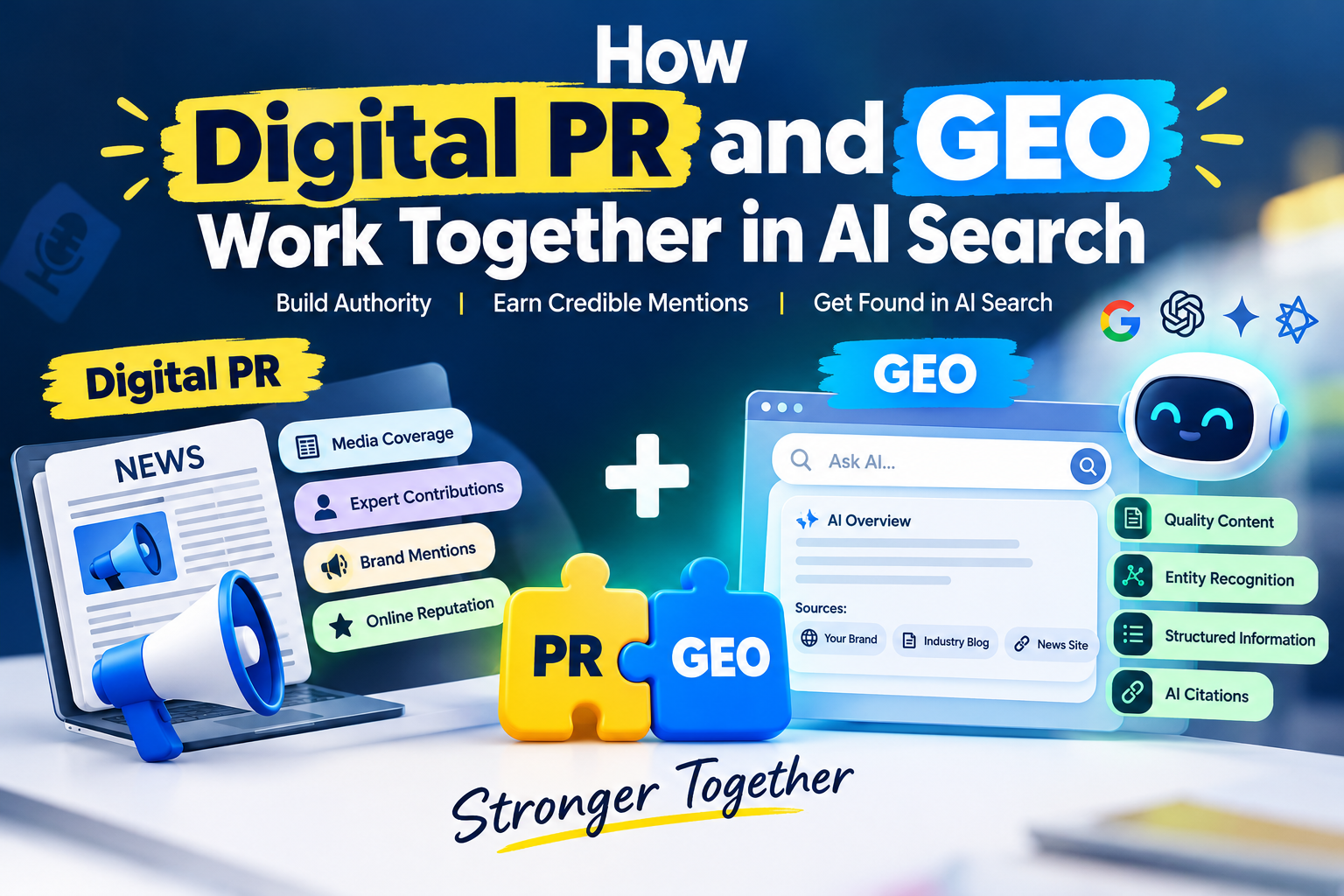
Digital PR and Generative Engine Optimization (GEO) are becoming important parts of modern digital marketing because people are increasingly using AI-powered search tools to find information, compare businesses, and make decisions. Traditional SEO focuses on improving website rankings in search engine results, while GEO focuses on helping a brand become a reliable source of information in AI-generated answers. Digital PR supports both strategies by building brand awareness, earning media coverage, gaining relevant mentions, and strengthening online credibility. When Digital PR and GEO work together, businesses can improve their chances of appearing in traditional search results and being referenced by AI platforms such as Google AI Overviews, ChatGPT, Gemini, and Perplexity.
What Is Digital PR in Modern SEO?
Digital PR is a marketing strategy that helps businesses build their online reputation through media coverage, expert contributions, industry publications, interviews, research-based content, and relevant brand mentions. Unlike traditional public relations, which often focuses on newspapers, television, and offline communication, Digital PR primarily uses online platforms to increase visibility and establish credibility.
For example, a digital marketing institute can publish original research about career opportunities, contribute expert opinions to industry websites, or share insights about changing SEO practices. When relevant websites and publications reference that information, the brand can reach new audiences and build stronger associations with its area of expertise.
Digital PR can also support SEO through editorial backlinks, referral traffic, and brand recognition. However, its value is not limited to links. Consistent and credible mentions across relevant sources can help people understand what a business does, which subjects it specialises in, and why its information may be worth considering.
What Is Generative Engine Optimization (GEO)?
Generative Engine Optimization, commonly known as GEO, is the practice of improving digital content and brand information so that AI-powered search experiences can understand, evaluate, and potentially reference it in generated responses.
Traditional search engines typically present a list of pages that users can visit. AI search experiences may instead combine information from multiple sources to provide a direct answer. Depending on the platform and query, these answers can include citations, links, brand names, or recommendations.
GEO focuses on making content clear, useful, factually supported, and easy to interpret. A website should answer relevant questions directly, demonstrate subject knowledge, maintain consistent brand information, and support important claims with credible evidence.
GEO does not guarantee that an AI platform will mention a particular business. AI systems use different retrieval methods, ranking signals, and source-selection processes. Nevertheless, publishing trustworthy content and developing a credible online presence can improve a brand's overall discoverability.
Why Digital PR and GEO Are Connected
Digital PR and GEO share a common goal: helping people and digital platforms recognise a brand as a relevant and trustworthy source.
Digital PR builds a brand's reputation beyond its own website. GEO helps make the brand's information understandable and useful in AI-driven search environments. These strategies complement each other because AI systems may retrieve information from websites, publications, reference pages, and other publicly available sources when generating answers.
Consider a company that publishes an original report about digital marketing trends. If relevant industry publications discuss the report, quote its findings, and identify the company as the source, the brand gains exposure and supporting evidence of its expertise. If the company also publishes a detailed, well-structured explanation of the research on its own website, users and search systems have a clearer resource to consult.
The two strategies therefore work best as part of one coordinated approach. Digital PR creates opportunities for credible third-party recognition, while GEO strengthens the quality, clarity, and accessibility of the information associated with the brand.
How Digital PR Supports GEO in AI Search
1. Building Brand Authority Through Credible Mentions
AI search visibility is not just about publishing more content. A brand also needs a clear identity and a credible reputation in its subject area. Relevant mentions in respected publications can help establish that identity.
For example, if a company regularly contributes useful insights to digital marketing publications, its name may become associated with SEO, content strategy, or online advertising. These references can reinforce the brand's topical relevance and help audiences recognise its expertise.
Not every mention has the same value. A relevant editorial reference from a respected industry publication is generally more useful for reputation-building than a large number of unrelated or low-quality mentions. Digital PR campaigns should therefore prioritise relevance, editorial quality, and genuine audience value rather than chasing mention counts alone.
2. Creating Opportunities for AI Citations
AI-powered search tools may provide citations or links to sources that support their answers. Digital PR can help businesses create useful information that other websites may reference, increasing the number of credible sources discussing their work.
Original surveys, industry statistics, expert commentary, case studies, and practical research are particularly useful because they offer information that other publishers may want to cite. When a brand becomes the original source of a valuable insight, it creates a stronger reason for other websites to mention it.
However, a backlink or media mention does not automatically lead to an AI citation. Different platforms retrieve and select information differently. The goal is to build a strong collection of useful, accessible, and credible resources that can be found when relevant questions arise.
3. Strengthening Brand Entity Recognition
A brand entity is a distinct business or organisation that can be identified through its name, activities, website, location, and relationships with other entities. Consistency in these details helps people and automated systems understand which organisation a piece of information refers to.
Digital PR can reinforce these connections by ensuring that credible publications identify the brand correctly and describe its area of expertise accurately. Consistent business information, a clear About page, expert biographies, and relevant coverage can all contribute to a more understandable online identity.
For businesses operating in specific locations, accurate location information is also important. If a company serves customers in Noida, Delhi, or Ghaziabad, its website and legitimate business profiles should communicate those service areas clearly without making unsupported claims.
4. Earning Trust Through Expert-Led Content
AI search users often ask questions that require explanations, comparisons, and practical recommendations. Brands that publish well-supported expert content can offer useful answers to these questions.
Digital PR gives businesses opportunities to share their expertise through interviews, expert quotes, guest contributions, and research commentary. GEO helps ensure that the same expertise is presented clearly on the brand's own website.
For example, an SEO specialist could explain how technical SEO differs from GEO, provide practical examples, and support the explanation with reliable sources. When this information is also discussed in relevant industry publications, the brand has more opportunities to demonstrate its knowledge to potential customers.
How to Build a Digital PR and GEO Strategy Together
Step 1: Identify Relevant Topics and Search Intent
Begin by understanding what your target audience wants to know. Research the questions people ask about your industry, the problems they need to solve, and the comparisons they make before choosing a product or service.
For a digital marketing business, relevant topics might include AI search visibility, technical SEO, content marketing, paid advertising, and digital marketing career opportunities. Choose topics that match your actual expertise and business goals.
Step 2: Publish Original and Helpful Resources
Create content that offers something valuable beyond general information. Original research, detailed case studies, expert explanations, and practical guides can give journalists and industry publishers a reason to reference your website.
Keep the writing straightforward. Use descriptive headings, explain technical terms, support factual claims, and answer the main question early in the article. Include the author's relevant expertise where appropriate and update information when it becomes outdated.
Step 3: Build Relationships With Relevant Publications
Identify journalists, editors, industry blogs, and professional publications that cover subjects related to your business. Offer meaningful insights, credible data, and useful commentary rather than sending generic promotional pitches.
A successful Digital PR campaign should provide value to the publication's audience. When your contribution is genuinely useful, it has a better chance of earning relevant coverage and building a lasting relationship.
Step 4: Improve Website Structure and Technical Accessibility
Your website should make important information easy to locate and understand. Use descriptive page titles, logical heading structures, internal links, accessible page content, and clear author or business information.
Maintain a technically sound website with crawlable pages and appropriate indexing settings. Structured data can help search engines interpret supported information, but it does not guarantee enhanced visibility or inclusion in AI answers.
Step 5: Measure Visibility Beyond Rankings
Traditional keyword rankings remain useful, but they do not tell the whole story. Monitor referral traffic, quality backlinks, relevant brand mentions, branded searches, conversions, and the performance of pages that support your Digital PR campaigns.
You can also periodically test relevant questions on AI search platforms to see whether your brand appears and which sources are cited. Treat these checks as directional indicators rather than definitive measurements because AI answers can vary by platform, query, and time.
Common Mistakes to Avoid in Digital PR and GEO
One common mistake is treating Digital PR as a link-building shortcut. Buying links, publishing irrelevant guest posts, or pursuing low-quality mentions can undermine a campaign's credibility. Focus on genuine editorial value and relevant relationships instead.
Another mistake is producing content primarily for AI systems rather than people. Repeating keywords, adding unnecessary paragraphs, or publishing large volumes of similar articles can reduce usefulness. Clear, original, audience-focused content is a better foundation.
Businesses should also avoid assuming that every media mention will produce an AI citation. Third-party recognition can support brand awareness and credibility, but AI visibility depends on several factors outside a business's direct control.
Finally, do not neglect your own website. Even a successful PR campaign may send visitors to a page that fails to explain the business, answer questions, or provide a clear next step. Make sure important landing pages are accurate, informative, and easy to navigate.
How Digital Marketing Skills Help Businesses Adapt to AI Search
The relationship between Digital PR, SEO, and GEO shows why modern marketers need a broader understanding of digital channels. They must be able to research audiences, create useful content, analyse performance, manage online reputation, and understand how search technology is evolving.
For professionals who want to build these capabilities, structured training can provide a foundation in search optimisation, content strategy, analytics, and AI-assisted marketing workflows. Practical projects are particularly valuable because they help connect theory with real business requirements.
SEO Course Online
Understanding SEO is a useful starting point for learning how search engines discover, crawl, and rank web pages. An SEO Course Online can help aspiring marketers develop knowledge of keyword research, on-page optimisation, technical SEO, and content planning that supports a broader digital visibility strategy.
AI Digital Marketing Course Online
AI tools are increasingly used for research, content planning, audience analysis, and marketing workflows. An AI Digital Marketing Course Online can help learners understand how AI fits into digital marketing while recognising the importance of human judgement, fact-checking, and responsible implementation.
AI Digital Marketing Course in Noida
Local businesses need digital marketing strategies that reflect their audiences, competition, and service areas. Learners looking for practical AI-focused marketing training can consider an AI Digital Marketing Course in Noida to build relevant skills for today's changing digital landscape.
AI Digital Marketing Course in Delhi
Delhi has a diverse business environment in which digital marketing skills can support different industries and customer segments. An AI Digital Marketing Course in Delhi is a relevant option for learners who want to understand AI-supported marketing strategies and their practical applications.
AI Digital Marketing Course in Ghaziabad
Businesses in Ghaziabad can benefit from digital campaigns that combine local audience research, useful content, and measurable marketing activities. An AI Digital Marketing Course in Ghaziabad may suit learners who want to develop their understanding of AI-driven marketing techniques.
AI Digital Marketing Course in Greater Noida
As businesses compete for attention across search engines, social platforms, and AI-powered tools, marketers need adaptable skills. An AI Digital Marketing Course in Greater Noida provides a relevant training pathway for people interested in the evolving digital marketing field.
Content Creation Course Online
Digital PR and GEO both depend on clear, informative content that answers genuine audience questions. A content creation course online can help learners develop skills in content planning, writing, storytelling, and creating material that communicates ideas effectively across digital platforms.
Performance Marketing Course Online
Digital PR can help increase awareness, while performance marketing focuses on measurable outcomes such as leads, sales, and conversions. A performance marketing course online can help learners understand campaign planning, paid advertising, audience targeting, and performance measurement.
Full Stack Development Course Online
Website performance and technical accessibility are important foundations of digital visibility. A full stack development course online can help learners understand how websites and web applications are developed, including the front-end and back-end concepts involved in building digital experiences.
Cybersecurity Course Online
Trust is important to any online business. Website security, data protection, and responsible handling of customer information help protect both users and organisations. A cybersecurity course online can introduce learners to security concepts that are relevant to modern digital environments.
Top 10 Digital Marketing Courses in Gurgaon
Choosing the right training programme involves comparing course content, practical learning opportunities, mentorship, and career support. This guide to the top 10 digital marketing courses in Gurgaon can help prospective learners research available options and make a more informed decision.
Digital Marketing Course Fees in Noida
Course fees are another important consideration when selecting a digital marketing programme. Factors such as course duration, curriculum, practical projects, mentorship, and included services can influence the overall value. Read about digital marketing course fees in Noida to understand the factors worth comparing before enrolling.
Digital Marketing Opportunities in Indirapuram
Local market knowledge can help aspiring marketers understand how businesses reach customers in particular areas. This resource about Indirapuram provides a location-focused starting point for people researching digital marketing education in and around the area.
SEO Course in Greater Noida
SEO knowledge can help marketers understand organic search visibility, website optimisation, and the role of content in attracting relevant visitors. Learners interested in developing these skills can review the SEO Course in Greater Noida for information about SEO training.
Top Digital Marketing Institute in Haldwani
When comparing digital marketing institutes, prospective learners should consider practical assignments, course relevance, trainer experience, and opportunities to apply what they learn. This guide to the Top Digital Marketing Institute in Haldwani offers a location-specific resource for people researching training options.
Digital Marketing Course in Laxmi Nagar
Location can be an important factor when choosing in-person training, especially for learners who prefer classroom interaction and practical guidance. Those researching nearby options can visit the page for a Digital Marketing Course in Laxmi Nagar to review the available course information.
The Future of Digital PR and GEO
Digital PR and GEO are likely to remain closely connected as search experiences continue to evolve. Users increasingly expect direct answers, trustworthy recommendations, and information that helps them make decisions without unnecessary effort.
For businesses, this means moving beyond a narrow focus on keyword rankings. A strong digital presence requires helpful website content, credible third-party recognition, consistent brand information, and a clear understanding of audience needs.
Companies should also recognise that AI search is not replacing every traditional search behaviour. People continue to use search engines, social platforms, online communities, and specialist websites in different ways. A balanced strategy should therefore support organic search, brand reputation, referral traffic, and AI visibility rather than depending entirely on one channel.
Businesses that invest in useful information and genuine relationships with relevant publishers can build a more resilient online presence. Although no strategy can guarantee inclusion in AI-generated answers, combining Digital PR with sound SEO and GEO practices creates a stronger foundation for long-term discoverability.
Conclusion
Digital PR and GEO work together by connecting a brand's reputation with the quality and accessibility of its online information. Digital PR helps businesses earn relevant media coverage, expert recognition, and credible brand mentions, while GEO focuses on making their content useful and understandable in AI-powered search experiences.
The most effective approach combines original research, expert-led content, relevant publisher relationships, technically accessible web pages, and consistent brand information. Businesses should measure results across multiple channels and avoid treating backlinks or AI citations as guaranteed outcomes.
As AI search develops, brands that prioritise genuine expertise, trustworthy information, and audience value will be better positioned to build lasting digital visibility. Digital PR and GEO are not separate shortcuts; they are complementary parts of a broader strategy for helping the right people find, understand, and trust a business online.
Frequently Asked Questions (FAQs)
1. What is the difference between Digital PR and GEO?
Digital PR focuses on building brand awareness and credibility through online media coverage, expert contributions, and relevant third-party mentions. GEO focuses on making a brand's information easier for AI-powered search systems to understand and potentially reference. Both can support a stronger digital presence.
2. How does Digital PR help GEO?
Digital PR can help GEO by increasing credible references to a brand, creating opportunities for original research to be cited, and strengthening associations between a business and its area of expertise. These activities can support discoverability, although they do not guarantee AI citations.
3. Can Digital PR improve AI search visibility?
Digital PR may contribute to AI search visibility when it helps establish credible information about a brand across relevant sources. However, AI platforms use different systems to retrieve and select information, so media coverage alone cannot guarantee that a brand will appear in generated answers.
4. Are backlinks still important for GEO?
Backlinks remain useful for traditional SEO when they are relevant and earned naturally. For GEO, the wider context of a brand's credibility, content quality, and online presence also matters. There is no universal backlink requirement that guarantees inclusion in AI-generated responses.
5. What type of content works best for Digital PR and GEO?
Original research, expert commentary, detailed case studies, practical guides, reliable statistics, and clear answers to common questions can work well. The best content provides genuine value, supports important claims, and gives other publishers a meaningful reason to reference it.
6. How can a business measure the success of a Digital PR and GEO strategy?
Businesses can track relevant media mentions, quality backlinks, referral traffic, branded search activity, organic performance, leads, and conversions. They can also periodically monitor brand appearances and citations in AI search tools, while recognising that these results may vary between queries and platforms.
7. Is GEO replacing traditional SEO?
No. GEO complements traditional SEO rather than making it unnecessary. Technical accessibility, useful content, search intent, and website quality remain important. Businesses should develop a combined strategy that supports conventional search results and emerging AI-powered search experiences.

 English
 Arabic
 French
 Spanish
 Deutsch
 Turkish
 Dutch
 Italiano
 Russian
 Romaian
 Portuguese (Brazil)
 Greek
